

What Is the MOTS-C Peptide?
The MOTS-C peptide is a mitochondrial-derived peptide that has become an important subject of research into mitochondrial signaling, cellular stress responses, metabolism, exercise biology, and aging-related processes. Scientific literature describes MOTS-c as a 16-amino-acid peptide encoded from a short open reading frame associated with the mitochondrial 12S rRNA region.
Its commonly reported sequence is:
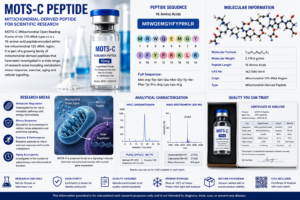
MRWQEMGYIFYPRKLR
Expanded, the sequence is:
Met-Arg-Trp-Gln-Glu-Met-Gly-Tyr-Ile-Phe-Tyr-Pro-Arg-Lys-Leu-Arg
PubChem lists MOTS-c with the molecular formula C₁₀₁H₁₅₂N₂₈O₂₂S₂ and a molecular weight of approximately 2,174.6 g/mol.
This page focuses on scientific identity, published research, analytical documentation, and laboratory considerations. It does not provide dosing, administration, or treatment instructions.
Research-use notice: MOTS-C peptide information is presented for scientific and laboratory research purposes. Experimental findings should not be interpreted as proof of clinical safety, therapeutic effectiveness, or regulatory approval.
What Does MOTS-C Mean?
MOTS-c is commonly expanded as Mitochondrial Open Reading Frame of the 12S rRNA type-c. It belongs to a broader group of molecules known as mitochondrial-derived peptides, or MDPs.
Research into mitochondrial-derived peptides has expanded understanding of the mitochondrial genome beyond its traditionally recognized protein-coding genes. Scientific reviews describe MOTS-c alongside other mitochondrial-derived peptides, including Humanin and the small Humanin-like peptides.
The mitochondrial origin of MOTS-c is one reason it has attracted attention in studies involving communication between mitochondria and other cellular systems.
MOTS-C as a Mitochondrial-Derived Peptide
Mitochondria are widely recognized for their role in cellular energy production. However, they also participate in signaling and communication processes.
MOTS-c has been studied as part of this broader signaling environment. Reviews describe experimental observations in which MOTS-c responds to metabolic or cellular stress and is associated with changes in nuclear gene regulation.
This research has led to interest in several areas, including:
- Cellular stress responses
- Energy metabolism
- Mitochondrial signaling
- Exercise-related molecular responses
- Muscle biology
- Aging research
- Metabolic homeostasis
These remain areas of scientific investigation. Research findings should be distinguished from established clinical outcomes.
MOTS-C Peptide Sequence
The commonly reported MOTS-C peptide sequence is:
MRWQEMGYIFYPRKLR
The sequence contains 16 amino-acid residues.
| Position | Code | Amino Acid |
|---|---|---|
| 1 | M | Methionine |
| 2 | R | Arginine |
| 3 | W | Tryptophan |
| 4 | Q | Glutamine |
| 5 | E | Glutamic acid |
| 6 | M | Methionine |
| 7 | G | Glycine |
| 8 | Y | Tyrosine |
| 9 | I | Isoleucine |
| 10 | F | Phenylalanine |
| 11 | Y | Tyrosine |
| 12 | P | Proline |
| 13 | R | Arginine |
| 14 | K | Lysine |
| 15 | L | Leucine |
| 16 | R | Arginine |
PubChem records the condensed peptide form and the sequence MRWQEMGYIFYPRKLR.
Sequence identity is important because the precise order of amino acids defines the primary structure of the peptide. A change in composition or sequence order represents a different molecular structure.
MOTS-C Molecular Formula and Molecular Weight
For the commonly referenced MOTS-c peptide form, PubChem lists:
Molecular Formula:
C₁₀₁H₁₅₂N₂₈O₂₂S₂
Molecular Weight:
Approximately 2,174.6 g/mol
Researchers should also distinguish between the peptide itself and specific salt or counterion forms. PubChem, for example, separately lists a MOTS-c trifluoroacetate salt with a different overall formula and molecular weight while retaining the same peptide sequence.
This distinction matters when reviewing:
- Analytical reports
- Molecular-weight data
- Product specifications
- Certificates of Analysis
- Sample documentation
The sequence may remain the same while the documented chemical form differs.
Why Is MOTS-C Studied?
comes primarily from its proposed role as a mitochondrial-derived signaling molecule.
Early and subsequent research has explored its relationship with metabolic regulation and skeletal-muscle biology. Reviews have discussed MOTS-c in connection with glucose metabolism, lipid metabolism, stress adaptation, exercise, and aging research.
However, it is important to use precise language.
Scientific investigation into a biological pathway does not automatically establish that a compound or peptide:
- Treats a disease
- Prevents a medical condition
- Improves athletic performance
- Reverses aging
- Is clinically safe
- Is approved for therapeutic use
For a scientifically responsible MOTS-C peptide page, these topics should be described as areas of ongoing or published research rather than guaranteed outcomes.
MOTS-C and Metabolic Research
Metabolic research is one of the major scientific areas associated with MOTS-c.
Published studies and reviews have explored the relationship between MOTS-c and cellular energy regulation, glucose metabolism, and metabolic stress. Reviews describe proposed involvement in pathways related to energy homeostasis and stress adaptation.
This research contributes to broader questions such as:
- How mitochondrial signals influence cellular metabolism
- How cells respond to metabolic stress
- How mitochondrial and nuclear signaling interact
- Whether mitochondrial-derived peptides participate in systemic metabolic communication
These questions remain active subjects of research.
For SEO content, appropriate phrasing includes:
“MOTS-C has been investigated in experimental research involving metabolic regulation.”
Avoid phrasing such as:
“MOTS-C cures metabolic disease.”
The first describes the evidence; the second makes an unsupported therapeutic claim.
MOTS-C and Cellular Stress Research
MOTS-c has also been studied in connection with cellular responses to stress.
Scientific reviews report experimental observations involving MOTS-c nuclear translocation and regulation of genes associated with stress adaptation under certain conditions.
This has generated research interest in:
- Stress-response signaling
- Nuclear gene regulation
- Mitochondrial-to-nuclear communication
- Cellular adaptation
The exact biological mechanisms and their relevance across different experimental systems continue to be investigated.
MOTS-C and Exercise Research
Exercise represents another area of interest in the scientific literature.
Reviews have discussed MOTS-c expression and signaling in relation to exercise and metabolic stress.
For a research-focused page, this topic can be presented as:
Published research has explored relationships between MOTS-c, exercise-related signaling, and metabolic adaptation.
This language accurately reflects scientific interest without implying that a MOTS-C product produces a specific exercise or performance result.
MOTS-C and Aging Research
Aging-related biology is another major area discussed in reviews of MOTS-c and other mitochondrial-derived peptides.
Researchers have investigated how mitochondrial signaling changes with age and how mitochondrial-derived peptides may participate in metabolic and cellular adaptation.
These findings have helped generate hypotheses regarding:
- Mitochondrial communication
- Cellular resilience
- Metabolic homeostasis
- Age-associated biological changes
However, aging research should not be presented as proof that MOTS-C reverses or stops aging.
Understanding MOTS-C Peptide Quality
For laboratories and research users, scientific identity and quality documentation are important considerations.
A research material should ideally be evaluated using more than a single claim or measurement.
Useful categories include:
Peptide Identity
Does the analytical evidence support the expected material?
For MOTS-C, the expected sequence is:
MRWQEMGYIFYPRKLR
Purity
Purity generally describes the composition of a tested sample according to a defined analytical method.
Molecular Characterization
Mass-based or other analytical techniques may be used to compare a sample with expected molecular characteristics.
Lot Traceability
Documentation should, where possible, connect the tested material to a specific production or sample lot.
MOTS-C Purity and Identity Are Not the Same
A common mistake is treating purity as proof of complete identity.
These are separate analytical questions.
Identity asks:
Is the expected peptide present?
Purity asks:
What does the analytical method indicate about the relative composition of the tested sample?
For this reason, a quality-focused research framework may consider:
Sequence information
+
Mass characterization
+
Chromatographic analysis
+
Lot-specific documentation
A single percentage alone does not provide the complete scientific picture.
HPLC Analysis and MOTS-C Peptide Research
High-performance liquid chromatography, or HPLC, can be used to separate components in a peptide sample.
Depending on the analytical method, HPLC documentation may provide information about:
- Chromatographic profiles
- Peak separation
- Relative peak areas
- Reported purity
However, HPLC results should be interpreted in the context of the specific analytical method.
A useful analytical record may identify:
- Sample name
- Lot number
- Method used
- Test date
- Chromatographic conditions
- Reported result
A generic chromatogram that cannot be linked to the material being evaluated provides less useful traceability.
Mass Spectrometry and Molecular Identity
Mass spectrometry can provide information relevant to molecular mass and peptide characterization.
For MOTS-c, reference information can be compared against expected molecular characteristics. PubChem lists a molecular weight of approximately 2,174.6 g/mol for the referenced peptide form.
Different forms, salts, or associated counterions may produce different documented molecular weights.
Therefore, analytical interpretation should consider:
- Expected peptide sequence
- Expected molecular form
- Analytical method
- Sample preparation
- Product-specific specifications
MOTS-C COA and Lot Traceability
A Certificate of Analysis (COA) can provide documentation for a specific tested material.
Depending on the testing performed, a COA may include:
- Product identification
- Lot or batch number
- Test date
- Analytical method
- Purity result
- Identity information
- Molecular characterization
The strongest documentation connects the COA directly to the relevant lot.
For example:
MOTS-C Research Material
↓
Lot Number
↓
Analytical Test Record
↓
Certificate of Analysis
This structure can support research recordkeeping and reproducibility.
Research Documentation and Reproducibility
Scientific reproducibility depends on many variables.
For peptide research, researchers may document:
- Peptide name
- Sequence
- Supplier or source
- Lot number
- Analytical documentation
- Experimental conditions
- Storage history
- Date of testing or use
This creates a clearer research record.
If experimental results vary, researchers can review whether differences may be associated with:
- Different material lots
- Different analytical characteristics
- Different experimental conditions
- Changes in sample handling
Documentation alone does not guarantee reproducibility, but it supports systematic research practices.
Storage and Handling Considerations
Storage and handling requirements should follow the specific product label, manufacturer documentation, and laboratory procedures.
General research documentation may include:
- Receipt date
- Storage conditions
- Lot number
- Container identification
- Handling history
A product page should avoid inventing universal storage specifications when they have not been established for the specific material.
Instead, use wording such as:
Follow the storage and handling conditions supplied with the specific research material and maintain appropriate laboratory documentation.
Research and Regulatory Considerations
Scientific research, chemical identity, and regulatory approval are different concepts.
The existence of published studies, database records, or experimental findings does not itself establish that a material is approved for clinical use.
MOTS-c reviews discuss substantial scientific interest and potential future applications, while also describing the continuing need for additional research and clinical translation.
For responsible content, clearly separate:
Chemical identity
from
Experimental findings
from
Clinical evidence
from
Regulatory status
This improves scientific accuracy and helps prevent misleading claims.