

Introduction: What Is a Biochemistry Grade Peptide?
Biochemistry grade peptides are peptide materials prepared and characterized for use in laboratory and biochemical research. Researchers may work with peptides to investigate molecular interactions, protein-related processes, analytical methods, structure-function relationships, and other experimental questions.
When selecting a peptide for laboratory work, the name or advertised purity percentage is only one part of the evaluation process. Researchers should also consider identity, purity profile, analytical characterization, batch documentation, formulation, storage conditions, and supplier quality controls.
A reliable research peptide should be accompanied by documentation that allows researchers to understand what material they are receiving and how the reported specifications were established.
For this reason, the term
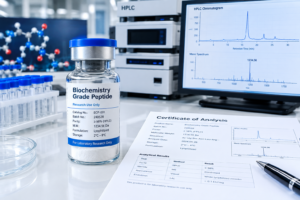
is often associated with laboratory-oriented quality requirements rather than consumer or therapeutic applications.
This guide explains the important factors to evaluate when researching or purchasing biochemistry grade peptides online, including analytical testing, Certificates of Analysis (COAs), purity, molecular characterization, storage considerations, and supplier documentation.
Research-use notice: Products described on this page are intended for laboratory research and analytical applications only. They are not presented as medicines, dietary supplements, or products for diagnosis, treatment, prevention, or use in humans or animals.
What Does “Biochemistry Grade” Mean?
The phrase biochemistry grade generally communicates that a material is intended for biochemical or laboratory applications and that quality characteristics are important to the intended research.
However, “biochemistry grade” is not necessarily a universal regulatory classification with one standardized specification across every supplier or peptide. Researchers should therefore examine the actual specifications and analytical documentation associated with an individual product.
Important characteristics can include:
- Peptide identity
- Reported purity
- Molecular weight
- Amino-acid sequence
- Analytical method
- Batch or lot number
- HPLC or UPLC results
- Mass spectrometry results
- Appearance and formulation
- Storage recommendations
- Manufacturing or quality-control information
A high-quality research listing should make it possible to distinguish between a general marketing statement and verifiable batch-specific information.
Why Peptide Quality Matters in Biochemical Research
Peptide quality can influence how researchers interpret experimental observations.
For example, an analytical sample may contain the target peptide together with related impurities, degradation products, residual synthesis-related materials, or other components. Depending on the experiment, these additional components may complicate analytical interpretation.
Researchers therefore commonly evaluate several dimensions of quality rather than relying on a single specification.
Identity
Identity testing helps establish that the material corresponds to the intended peptide.
Mass spectrometry is commonly used as an analytical technique for determining molecular mass and supporting peptide identification.
Purity
Purity describes the proportion of the analyzed material associated with the desired peptide under the specified analytical method.
HPLC or UPLC chromatograms can provide useful information about the observed analytical profile.
Molecular Characterization
Molecular weight and sequence information help researchers compare the expected molecular characteristics with analytical results.
Batch Documentation
A batch-specific COA can connect analytical results to a particular production lot.
This is particularly useful when researchers need traceability for laboratory records.
Biochemistry Grade Peptide Purity
One of the most important considerations when selecting a research peptide is the reported purity.
Peptide purity is frequently expressed as a percentage, but the number should not be interpreted in isolation.
For example, a product described as having a particular purity percentage should ideally have supporting analytical information explaining:
- Which analytical method was used?
- Was the analysis performed on the specific batch?
- What does the chromatogram show?
- Is the molecular identity supported independently?
- Does the COA contain a batch or lot number?
A reported purity figure without supporting documentation provides less information than a documented analytical result associated with a specific production lot.
Why HPLC Is Important
High-performance liquid chromatography (HPLC) is widely used in peptide analysis.
In a typical analytical workflow, compounds are separated based on their interactions with the chromatographic system. The resulting chromatogram can help researchers assess the presence of the principal peptide peak and additional detectable components.
HPLC results are therefore useful for evaluating the analytical profile of a research peptide.
Why Mass Spectrometry Is Important
Mass spectrometry can provide molecular-mass information that supports peptide identity.
Using both chromatographic and mass-spectrometric information can provide a more informative characterization than relying on a single measurement.
Certificate of Analysis for Biochemistry Grade Peptides
A Certificate of Analysis, commonly called a COA, is an important quality document for laboratory research materials.
A useful COA may include information such as:
- Product name
- Peptide sequence
- Molecular weight
- Batch or lot number
- Test date
- Purity result
- Analytical method
- Identity or mass confirmation
- Appearance
- Storage information
- Quality-control information
The exact information varies by supplier and product.
What Researchers Should Look For in a COA
Before purchasing a biochemistry grade peptide, researchers should check whether the COA corresponds to the exact product and batch being offered.
A strong documentation process should allow the researcher to connect:
Product → Batch/Lot → Analytical Test → Reported Result
This provides better traceability than a generic document that does not identify the production lot.
Peptide Sequence and Molecular Weight
Peptide sequence is another important piece of product information.
A peptide is composed of amino acids arranged in a defined sequence. Even relatively small sequence differences can result in different molecular characteristics.
For research documentation, it can therefore be useful to verify:
- Full peptide name
- Amino-acid sequence
- Molecular formula where applicable
- Molecular weight
- Modifications, if applicable
- Terminal modifications
- Salt or counter-ion information
- Product formulation
Researchers should ensure that the material described in product documentation corresponds to the compound required by their experimental design.
Biochemistry Grade Peptide vs. Research Grade Peptide
The terms biochemistry grade peptide and research grade peptide can overlap considerably.
Both may describe peptide materials intended for laboratory applications. However, the terminology alone does not establish a universal quality level.
Instead of selecting a product solely because it uses the phrase “research grade” or “biochemistry grade,” researchers should compare the underlying documentation.
Important Comparison Criteria
| Quality Factor | What to Examine |
|---|---|
| Identity | Is peptide identity documented? |
| Purity | Is analytical purity reported? |
| HPLC/UPLC | Is chromatographic testing available? |
| Mass spectrometry | Is molecular mass supported? |
| COA | Is batch-specific documentation available? |
| Sequence | Is the peptide sequence clearly stated? |
| Storage | Are storage requirements provided? |
| Traceability | Can the product be connected to a specific lot? |
The documentation behind the label is often more useful than the label itself.
Choosing a Biochemistry Grade Peptide Supplier
When purchasing peptides online for laboratory research, supplier evaluation should extend beyond product price.
A supplier’s documentation and quality-control practices can be important considerations.
1. Review the Product Documentation
Look for clear information about peptide identity, purity, molecular weight, sequence, formulation, and analytical testing.
2. Check for Batch-Specific COAs
A COA associated with the specific lot provides stronger traceability than a generic certificate.
3. Examine Analytical Methods
Determine whether the supplier provides HPLC, UPLC, mass spectrometry, or other relevant analytical information.
4. Check Product Labeling
Research-use products should be clearly represented as laboratory materials rather than being marketed as approved medical treatments.
5. Review Storage Information
Peptides can be sensitive to environmental conditions. Product documentation should provide appropriate storage information for the specific formulation.
6. Consider Packaging and Traceability
Proper labeling and batch identification can make it easier to maintain accurate laboratory records.
Biochemistry Grade Peptide Storage
Storage requirements depend on the specific peptide, formulation, container, and experimental requirements.
Researchers should always follow the supplier’s product-specific storage instructions.
Factors that may be relevant include:
- Temperature
- Moisture exposure
- Light exposure
- Container integrity
- Repeated handling
- Formulation
- Dissolution status
- Long-term versus short-term storage
Lyophilized materials and prepared solutions can have different storage considerations.
For research documentation, it is useful to record the product’s lot number, date received, storage conditions, and relevant handling information.
Lyophilized Peptides for Biochemical Research
Many research peptides are supplied in a lyophilized, or freeze-dried, form.
Lyophilization can provide a practical format for storage and shipment because the peptide is supplied as a dry material rather than as a prepared solution.
The product documentation should identify the supplied form and provide appropriate storage and handling information.
Researchers should avoid assuming that all peptides have identical stability characteristics. Different sequences and formulations can behave differently under laboratory conditions.
Peptide Analytical Testing
Analytical testing is central to evaluating research peptide quality.
Depending on the product and intended research application, relevant analytical approaches may include:
HPLC or UPLC
Used to evaluate chromatographic purity and identify the principal analytical peak.
Mass Spectrometry
Used to assess molecular mass and support peptide identity.
Additional Quality Tests
Depending on the research material, other testing may be relevant, including tests related to residual materials, water content, counter-ions, or other product-specific characteristics.
The appropriate testing panel depends on the peptide and its intended laboratory application.
How to Compare Biochemistry Grade Peptides Online
Online peptide catalogs can contain many similar-looking products. A structured comparison process can make evaluation easier.
Step 1: Confirm the Exact Peptide
Check the product name, sequence, molecular weight, and modifications.
Step 2: Review Purity
Look for a clearly reported analytical purity specification.
Step 3: Examine the COA
Confirm that the COA corresponds to the relevant batch.
Step 4: Check Analytical Evidence
Look for HPLC/UPLC and mass-spectrometry documentation where appropriate.
Step 5: Review Storage Information
Verify that storage recommendations are clearly provided.
Step 6: Evaluate Supplier Transparency
Consider whether product specifications and quality documentation are easy to access and understand.
Common Mistakes When Buying Research Peptides Online
Choosing Only by Price
The least expensive product is not necessarily the best choice for laboratory work.
Quality documentation, analytical characterization, and traceability may be more important than the headline price.
Assuming “High Purity” Means Everything
A purity percentage does not independently establish identity, sequence accuracy, or every aspect of product quality.
Accepting a Generic COA
A generic certificate may provide less traceability than a document tied to the actual batch.
Ignoring Molecular Information
Sequence and molecular-weight information can help prevent confusion between related peptide products.
Treating Research Products as Medicines
Research-use materials should not automatically be considered approved pharmaceutical products.
Biochemistry Grade Peptide Applications in Research
Biochemistry grade peptides can be used as laboratory materials in areas such as:
- Peptide chemistry
- Biochemical assays
- Analytical method development
- Molecular interaction studies
- Protein and peptide characterization
- Structure-function research
- Laboratory assay development
- Chromatographic research
- Mass-spectrometry research
- Academic and industrial biochemical studies
The suitability of a particular peptide depends on the experimental requirements and the documented characteristics of the material.
Research-Use Wording
For a commercial research website, clear research-use language helps distinguish laboratory products from approved pharmaceutical products.
Recommended wording
Research Use Only: This peptide is supplied for laboratory research and analytical applications. It is not intended for human or veterinary use, diagnosis, treatment, prevention, or mitigation of disease. Researchers are responsible for determining whether the material is appropriate for their specific experimental requirements and for following applicable institutional, laboratory, and regulatory requirements.
This wording should be adapted to the applicable laws, regulations, and product-specific requirements of the markets in which the product is offered.
Why Documentation Matters for Laboratory Buyers
Good documentation supports reproducibility and traceability.
When a researcher records the peptide identity, lot number, analytical results, storage conditions, and experimental information, it becomes easier to understand which material was used in a particular experiment.
This can be particularly valuable when comparing results across experiments or repeating a study at a later date.
A well-documented research material therefore contributes not only to purchasing decisions but also to broader laboratory quality practices.