

What Is PNC-27 Peptide?
PNC-27 is a 32-amino-acid synthetic chimeric peptide that has been investigated in laboratory research involving the p53 signaling pathway, HDM-2/MDM-2 biology, peptide structure, and membrane-associated interactions.
The peptide was designed by combining a segment corresponding to residues 12–26 of human p53 with a membrane-penetrating or membrane-residency sequence. Published research describes investigations into how this molecular design interacts with HDM-2 and cellular membranes in experimental models.
For researchers, PNC-27 is particularly relevant because its structure provides an example of how a biologically derived peptide sequence can be combined with a membrane-active domain to investigate protein interactions and cellular membrane behavior.
PNC-27 should be described as an
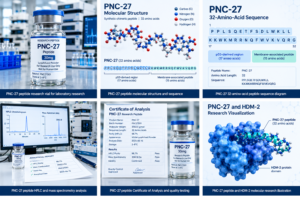
, not as an approved medicine or established human treatment. Published findings have primarily involved laboratory and preclinical models.
PNC-27 Peptide at a Glance
| Property | PNC-27 |
|---|---|
| Peptide type | Synthetic chimeric peptide |
| Length | 32 amino acids |
| Primary sequence | PPLSQETFSDLWKLLKKWKMRRNQFWVKVQRG |
| Molecular weight | Approximately 4,032 g/mol |
| Molecular formula | C188H293N53O44S |
| CAS number | 1159861-00-3 |
| Common format | Lyophilized research material |
| Research areas | p53, HDM-2/MDM-2, peptide structure, membrane research |
| Intended context | Laboratory and analytical research |
The reported molecular identity is consistent across multiple current reference sources, while the peer-reviewed literature establishes the 32-residue sequence and its experimental design.
PNC-27 Peptide Sequence
The published PNC-27 peptide sequence is:
PPLSQETFSDLWKLLKKWKMRRNQFWVKVQRG
Written as a complete peptide:
H-Pro-Pro-Leu-Ser-Gln-Glu-Thr-Phe-Ser-Asp-Leu-Trp-Lys-Leu-Leu-Lys-Lys-Trp-Lys-Met-Arg-Arg-Asn-Gln-Phe-Trp-Val-Lys-Val-Gln-Arg-Gly-OH
The sequence contains two principal regions.
The first 15 residues correspond to the p53-derived portion associated with HDM-2 binding. The remaining sequence is the membrane-residency or membrane-penetrating portion described in the literature.
This two-part architecture is important when studying PNC-27 because the molecule is not simply a short fragment of p53. It is a covalently linked chimeric peptide with distinct structural components.
Why the PNC-27 sequence matters
Sequence information can help researchers:
- Confirm peptide identity
- Compare research materials
- Evaluate analytical results
- Interpret mass-spectrometry data
- Distinguish PNC-27 from related peptide constructs
- Investigate structure-function relationships
- Develop appropriate analytical workflows
For SEO purposes, searches such as “PNC-27 peptide sequence,” “PNC-27 sequence,” and “PNC-27 p53 peptide” are closely related and can be incorporated naturally throughout a supporting content cluster.
PNC-27 and p53 Research
One of the defining characteristics of PNC-27 is its connection to the p53 protein.
The peptide incorporates residues 12–26 of human p53, a region associated with interaction with HDM-2. Researchers subsequently combined this region with a membrane-associated peptide sequence to create the PNC-27 construct.
This design makes PNC-27 useful as a research tool for investigating questions surrounding:
- Protein-peptide recognition
- p53-derived sequences
- HDM-2 binding
- Peptide conformation
- Membrane-associated protein interactions
- Synthetic peptide design
It is important to distinguish studying a p53-derived peptide from claiming that the peptide reproduces all biological functions of the full-length p53 protein.
PNC-27 is a defined synthetic construct with its own molecular characteristics.
PNC-27 and HDM-2 Research
HDM-2, also known as MDM-2, is a protein extensively studied in connection with p53 regulation.
Research on PNC-27 has focused in part on the interaction between the peptide’s p53-derived domain and HDM-2.
A peer-reviewed structural study reported that the p53-derived region of PNC-27 adopts a conformation compatible with the HDM-2 binding site. The authors investigated this relationship using structural and biochemical approaches.
A later study published in Biomedicines examined PNC-27 as a 32-residue peptide containing an HDM-2 binding domain and a cell-penetrating leader sequence. The study investigated peptide-HDM-2 interactions and membrane-pore formation in experimental cellular models.
These studies provide useful background for researchers investigating peptide-protein interactions, but experimental findings should not be interpreted as evidence of clinical effectiveness.
PNC-27 Peptide and Membrane Research
Another important area of PNC-27 research concerns cellular membrane interactions.
The peptide’s membrane-associated region was incorporated into the construct to facilitate interaction with cellular membranes and support investigation of membrane-associated mechanisms.
Experimental publications have described membrane-pore formation following exposure of certain cancer-cell models to PNC-27. Researchers have used techniques including microscopy and structural analysis to investigate these observations.
A separate research program investigated membrane-associated HDM-2 and PNC-27 in experimental leukemia models. These findings remain part of the preclinical research literature and should not be presented as proof of safety or efficacy in humans.
For an SEO product page, appropriate wording includes:
- “studied in experimental models”
- “investigated in preclinical research”
- “research involving HDM-2”
- “used as a research compound”
- “investigated for membrane-associated activity”
Avoid unsupported wording such as “cures cancer,” “treats cancer,” or “clinically proven.”
PNC-27 Molecular Weight
The commonly reported molecular weight of PNC-27 is approximately:
4,032 g/mol
Current chemical-reference and research-product sources report values around 4,031.72–4,032 g/mol.
Small differences between displayed molecular-weight values can occur because of rounding conventions and the way molecular mass is reported.
For an SEO page, the recommended wording is:
PNC-27 molecular weight: approximately 4,032 g/mol.
Researchers should use the molecular identity and analytical documentation associated with the specific research material being evaluated when performing exact analytical work.
PNC-27 Molecular Formula
The commonly reported molecular formula for PNC-27 is:
C188H293N53O44S
This formula represents the elemental composition associated with the complete peptide construct. Current reference sources list the same formula alongside CAS number 1159861-00-3.
The molecular formula is useful when evaluating:
- Chemical identity
- Mass calculations
- Analytical expectations
- Database records
- Research documentation
- Mass-spectrometry results
For researchers building an analytical reference library, molecular formula and molecular weight should be considered together with the peptide sequence and appropriate analytical data.
PNC-27 CAS Number
The commonly listed CAS Registry Number for PNC-27 is:
1159861-00-3
The CAS number provides an additional chemical-identity reference and can be useful when searching scientific databases, supplier catalogs, and research documentation.
Researchers should still verify that a supplier’s documentation, sequence, molecular formula, and analytical information correspond to the intended compound rather than relying solely on a CAS number.
PNC-27 Research Peptide and Laboratory Applications
PNC-27 has been investigated in several areas of laboratory research.
1. Peptide-protein interaction research
The p53-derived portion of PNC-27 provides a model for studying peptide recognition of HDM-2.
2. Structural biology
PNC-27 has been examined using structural approaches, including NMR-based investigations and molecular modeling related to its interaction with HDM-2.
3. Membrane research
The membrane-associated region makes PNC-27 relevant to studies investigating peptide-membrane interactions and membrane-active peptide behavior.
4. Cancer-cell model research
Published research has examined PNC-27 in experimental cancer-cell systems. These studies are useful for understanding biological mechanisms but should not be converted into clinical claims.
5. Analytical peptide research
Because PNC-27 is a defined synthetic peptide, researchers can evaluate its identity and quality using established peptide-analysis techniques.
PNC-27 COA and Analytical Testing
A Certificate of Analysis (COA) is an important document when evaluating a research peptide.
For PNC-27, researchers may want to review documentation covering:
- Product identity
- Batch or lot number
- HPLC purity
- Mass spectrometry
- Molecular-mass confirmation
- Quantity
- Testing date
- Analytical laboratory
- Specification and observed result
The original scientific literature reports that PNC-27 used in specific experiments was characterized at greater than 95% purity by HPLC and mass spectrometric analysis.
That result applies to the research material described in those studies. It should not be interpreted as a universal purity specification for every PNC-27 product.
For commercial research material, batch-specific COA documentation is therefore preferable to generic claims such as “high purity.”
PNC-27 Lyophilized Peptide
PNC-27 research material is commonly offered in lyophilized or freeze-dried form. Current research-product references list lyophilized powder as the physical form.
Lyophilization is widely used for synthetic peptide research materials because it provides a dry format suitable for laboratory storage and analytical handling under the manufacturer’s specified conditions.
A product page should avoid presenting generalized storage or reconstitution instructions as universal. Handling requirements can vary according to the specific material, formulation, packaging, and supplier documentation.
Researchers should follow the product-specific documentation and institutional laboratory procedures applicable to their work.
PNC-27 30mg Research Format
PNC-27 30mg refers to a product quantity, not a recommended biological dose.
Research suppliers may package PNC-27 in different quantities, including 30mg formats. A current commercial reference lists PNC-27 in a 30mg research format alongside analytical information.
When writing SEO content, it is useful to distinguish between:
PNC-27 30mg
The quantity of research material supplied.
PNC-27 molecular weight
The molecular mass of the peptide.
PNC-27 purity
An analytical characteristic that should be tied to a specific batch or COA.
These terms represent different product attributes and should not be used interchangeably.
How to Evaluate a PNC-27 Research Supplier
Researchers comparing PNC-27 peptide suppliers can evaluate several documentation and quality factors.
Sequence transparency
The supplier should clearly identify the peptide sequence or provide sufficient information to verify molecular identity.
Analytical documentation
Look for accessible batch-specific documentation rather than unsupported general purity statements.
HPLC information
HPLC data can provide information about chromatographic purity.
Mass spectrometry
Mass-spectrometry data can support molecular identity by comparing measured mass with the expected molecular mass.
Lot traceability
A clear lot or batch number allows analytical documentation to be connected to the actual material.
Research-use labeling
PNC-27 should be clearly represented as research material rather than marketed as a drug or dietary supplement.
PNC-27 Peptide: Research Limitations
PNC-27 is an experimental research compound. The published literature contains laboratory and preclinical findings, but these should be interpreted within the limitations of those experimental systems.
Laboratory results do not automatically establish:
- Human safety
- Human efficacy
- Appropriate clinical use
- Therapeutic dosage
- Long-term safety
- Regulatory approval