

Introduction
DES(1-3)IGF-1 is a truncated variant of insulin-like growth factor-I (IGF-I) that has been studied extensively in peptide and growth-factor research.
The name refers to the absence of the first three amino acids of mature IGF-I. Specifically, the N-terminal Gly-Pro-Glu sequence is absent in des(1-3)IGF-I. Scientific literature describes it as a distinct IGF-I analogue rather than simply another presentation of full-length IGF-I.
This distinction is important when evaluating research materials because DES(1-3)IGF-1, full-length IGF-1, IGF-1 LR3 and other IGF-related analogues have different molecular structures and should not automatically be treated as interchangeable.
For laboratory research, the most useful evaluation points include:
- Molecular identity
- Peptide sequence
- Structural characteristics
- Molecular mass
- HPLC purity
- Mass-spectrometry confirmation
- COA documentation
- Batch traceability
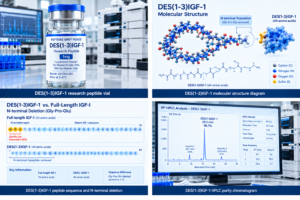
DES(1-3)IGF-1 - Related substances
- Research-use positioning
This guide provides a research-focused overview of DES(1-3)IGF-1, with particular attention to molecular characterization and analytical quality.
What Is DES(1-3)IGF-1?
DES(1-3)IGF-1, also written as des(1-3)IGF-I, is a truncated form of human IGF-I.
The “1-3” designation indicates that residues 1 through 3 of mature IGF-I are absent. Those three residues are:
Gly-Pro-Glu
The scientific literature identifies des(1-3)IGF-I as a truncated IGF-I variant and has described its occurrence in biological material as well as its production through recombinant methods.
The compound may appear under several names in scientific and commercial contexts:
- DES(1-3)IGF-1
- DES(1-3)IGF-I
- des(1-3)IGF-I
- IGF-DES
- IGF-1 DES
- DES IGF-1
- Des(1-3) insulin-like growth factor-I
For SEO purposes, these related terms are valuable because users may search for the same research compound using different naming conventions.
Understanding the DES(1-3)IGF-1 Name
The nomenclature itself provides useful structural information.
DES indicates deletion or absence of a portion of the original sequence.
(1-3) indicates the first three residues.
IGF-1 / IGF-I identifies the insulin-like growth factor-I framework.
Therefore:
DES(1-3)IGF-1 = IGF-I lacking its N-terminal residues 1–3.
The literature specifically identifies the missing N-terminal tripeptide as Gly-Pro-Glu.
This makes DES(1-3)IGF-1 structurally different from full-length IGF-I.
DES(1-3)IGF-1 vs. Full-Length IGF-1
One of the most important distinctions for researchers is the difference between full-length IGF-I and DES(1-3)IGF-I.
| Characteristic | Full-Length IGF-I | DES(1-3)IGF-I |
|---|---|---|
| General identity | IGF-I | Truncated IGF-I variant |
| N-terminal residues | Present | First three residues absent |
| Missing sequence | None | Gly-Pro-Glu |
| Structural classification | Mature IGF-I | Des(1-3) analogue |
| Research designation | IGF-I | DES(1-3)IGF-I / IGF-DES |
| Analytical identity | Distinct | Distinct |
| Interchangeability | — | Should not be assumed |
Research has shown that removing the N-terminal tripeptide changes interactions with IGF-binding proteins, making the analogue analytically and biologically distinguishable from full-length IGF-I.
For product documentation, therefore, the exact name and sequence should be verified rather than inferred from the general term “IGF-1.”
DES(1-3)IGF-1 Peptide Sequence
The DES(1-3)IGF-1 peptide sequence is one of the most important pieces of molecular information when evaluating research material.
Full-length mature human IGF-I begins with the N-terminal sequence:
Gly-Pro-Glu…
DES(1-3)IGF-I lacks this initial tripeptide.
Consequently, the analogue begins at the corresponding fourth residue of mature IGF-I.
This apparently small sequence difference is analytically important because it changes the molecular identity of the peptide.
Scientific research has used N-terminal sequence analysis together with HPLC to characterize recombinant des(1-3)IGF-I.
Why sequence verification matters
A product label alone does not provide complete molecular confirmation.
Researchers evaluating a peptide should consider whether documentation supports:
- Expected sequence
- Expected molecular mass
- Chromatographic profile
- Mass-spectrometric identity
- Batch-specific testing
Together, these provide a stronger basis for molecular characterization.
DES(1-3)IGF-1 Molecular Structure
DES(1-3)IGF-1 retains the broader structural framework of IGF-I while lacking the first three amino acids of the mature sequence.
Structural research on human IGF-I has identified multiple helical regions and disulfide-linked structural elements within the molecule.
When discussing DES(1-3)IGF-1, it is therefore useful to distinguish:
Primary structure
The amino-acid sequence.
Secondary structure
Local structural elements such as helices and turns.
Tertiary structure
The overall three-dimensional arrangement.
Analytical structure confirmation
Evidence obtained through methods such as mass spectrometry, chromatography and sequence analysis.
The deletion of three N-terminal residues makes the analogue chemically distinct even though much of its structural framework remains related to IGF-I.
DES(1-3)IGF-1 Molecular Weight
The DES(1-3)IGF-1 molecular weight should be verified against the exact molecular form and sequence being supplied.
This is especially important because IGF-related research materials can include:
- Full-length IGF-I
- DES(1-3)IGF-I
- IGF-I fragments
- IGF-1 LR3
- Other modified analogues
These compounds should not share a molecular-weight value simply because they belong to the same IGF family.
For a commercial research page, the most defensible approach is to publish the molecular mass supported by the product’s exact analytical documentation.
Recommended SEO wording
“The molecular weight of DES(1-3)IGF-1 should be verified against the exact sequence, molecular form and batch-specific analytical documentation.”
This avoids copying a molecular-weight value from an unrelated IGF analogue.
DES(1-3)IGF-1 Purity
DES(1-3)IGF-1 purity is typically discussed in connection with chromatographic analysis.
Reverse-phase HPLC can separate the target material from related chromatographic components. The resulting chromatogram may provide a reported area percentage for the principal peak.
However:
HPLC area purity is not automatically equivalent to total peptide content.
A research-quality evaluation should distinguish among:
- HPLC purity
- Molecular identity
- Total peptide content
- Water content
- Residual solvents
- Related substances
- Degradation products
The scientific literature has used HPLC as part of the purification and characterization of recombinant des(1-3)IGF-I.
DES(1-3)IGF-1 HPLC Analysis
RP-HPLC is a valuable analytical technique for peptide characterization.
A typical chromatographic report can provide:
- Main peak
- Retention time
- Peak area
- Related peaks
- Total chromatographic area
- Method conditions
A useful COA should identify the analytical method sufficiently to place the result in context.
For example, researchers may want to know:
- Was reverse-phase HPLC used?
- What was the reported purity?
- Was the result calculated by area percentage?
- Was the test performed on the actual batch?
- Were related peaks reported?
Historical research on recombinant des(1-3)IGF-I specifically reported purification to homogeneity as assessed by HPLC and N-terminal sequence analysis.
DES(1-3)IGF-1 Mass Spectrometry
Mass spectrometry provides complementary information to chromatographic analysis.
While HPLC can demonstrate how components separate, MS can provide information about molecular mass that helps support molecular identity.
Modern analytical studies have successfully detected Des(1-3)-IGF-I using liquid chromatography coupled with high-resolution mass spectrometry.
This makes LC-MS/MS and high-resolution MS valuable tools for research involving:
- Molecular identification
- Peptide characterization
- Analogue differentiation
- Metabolite studies
- Related-species investigation
A combination of HPLC and MS can therefore provide a more complete analytical picture than either method considered independently.
DES(1-3)IGF-1 COA
A Certificate of Analysis (COA) provides batch-level documentation that can help researchers evaluate a research material.
A useful DES(1-3)IGF-1 COA may include:
- Product name
- Batch number
- Lot number
- Test date
- HPLC purity
- Analytical method
- Mass spectrometry result
- Molecular mass
- Appearance
- Storage information
- Related substances
- Specification
- Actual result
- Testing laboratory
Why batch number matters
A generic certificate is less informative than documentation directly connected to the lot being evaluated.
The ideal chain is:
Product → Batch → Test → Result → COA
This approach makes analytical information easier to trace.
DES(1-3)IGF-1 Analytical Testing
A comprehensive research-quality assessment can combine several analytical techniques.
RP-HPLC
Useful for chromatographic purity and separation of related components.
Mass Spectrometry
Useful for molecular-mass and identity information.
N-Terminal Sequence Analysis
Historically used to characterize recombinant des(1-3)IGF-I.
Peptide Mapping
Can provide additional structural or sequence-related information when appropriate.
Additional Quality Tests
Depending on the material and manufacturing process, testing may also address:
- Water content
- Residual solvents
- Related substances
- Aggregation
- Oxidation
- Other process-related impurities
The appropriate analytical package depends on the research material and laboratory requirements.
DES(1-3)IGF-1 and Oxidized Forms
Research involving IGF-I analogues has demonstrated why researchers may need to distinguish the expected molecular form from modified forms.
A high-resolution mass-spectrometry study examining IGF-I analogues reported the presence of lower-quality oxidized peptide forms in certain products and emphasized monitoring both native and mono-oxidized forms.
This is relevant to analytical quality because a simple purity percentage may not communicate the complete impurity profile.
For research documentation, the following can therefore be useful:
HPLC → chromatographic profile
MS → molecular mass and identity
Additional analysis → modification/impurity characterization
DES(1-3)IGF-1 Research Applications
DES(1-3)IGF-1 has appeared in scientific research involving the biology and analytical characterization of IGF-I analogues.
Potential research areas include:
IGF-I Molecular Biology
Researchers can investigate how sequence changes affect the molecular characteristics of IGF-I-related compounds.
Protein and Peptide Chemistry
DES(1-3)IGF-1 provides a model for studying the effect of N-terminal sequence modification.
IGF-Binding Protein Research
Research has investigated the relationship between the truncated analogue and IGF-binding proteins.
Analytical Chemistry
DES(1-3)IGF-I has been investigated using HPLC, LC-MS and high-resolution MS methods.
Peptide Characterization
The compound can be used as an analytical reference or research material where the experimental design specifically calls for this IGF-I analogue.
DES(1-3)IGF-1 vs. IGF-1 LR3
DES(1-3)IGF-1 and IGF-1 LR3 are different modified IGF-I analogues.
They should not be treated as interchangeable simply because both are derived from IGF-I.
Analytical research has specifically examined Des(1-3)-IGF-I alongside R3-IGF-I and LongR3-IGF-I, demonstrating that these are distinguishable molecular targets.
For SEO and product categorization, separate pages should therefore be created for:
- DES(1-3)IGF-1
- IGF-1
- IGF-1 LR3
- IGF-DES research peptide
- IGF-DES purity
- IGF-DES molecular weight
- IGF-DES COA
This creates a clearer topical structure and prevents keyword cannibalization between different molecular entities.
How to Evaluate DES(1-3)IGF-1 Research Material
When evaluating DES(1-3)IGF-1 research material, consider five major areas.
1. Identity
Does the documentation clearly identify DES(1-3)IGF-I?
2. Sequence
Is the expected N-terminal truncation documented?
3. Purity
Is an HPLC result available?
4. Molecular Confirmation
Is mass-spectrometric evidence available?
5. Batch Documentation
Does the COA correspond to the material being evaluated?
A research-material page that provides these details is more useful than a page that only lists a product name and quantity.
Quantity vs. Purity
A common SEO and purchasing misconception is that the quantity listed on a product automatically indicates purity.
It does not.
For example:
2 mg describes the stated quantity.
98% HPLC describes a reported chromatographic purity result.
They represent different pieces of information.
A product page should therefore keep these fields separate:
- Product quantity
- Purity specification
- Actual analytical result
- Molecular identity
- Batch number
- COA
This distinction improves both scientific clarity and product-page transparency.
Research-Use Positioning
DES(1-3)IGF-1 should be presented on a research-oriented website according to its intended laboratory context.
Product descriptions should emphasize:
- Molecular identity
- Sequence
- Structure
- Analytical characterization
- HPLC
- Mass spectrometry
- Purity
- COA
- Research applications
Avoid presenting the material as:
- a treatment,
- a medicine,
- a dietary supplement,
- a bodybuilding product,
- a performance-enhancement product,
- or a product intended for human administration.
Scientific literature can describe biological effects of IGF-I analogues, but those findings should not be converted into consumer treatment claims.
FAQ: DES(1-3)IGF-1
What is DES(1-3)IGF-1?
DES(1-3)IGF-1 is a truncated IGF-I variant lacking the N-terminal Gly-Pro-Glu tripeptide of mature IGF-I.
Is DES(1-3)IGF-1 the same as IGF-1?
No. DES(1-3)IGF-1 is a truncated analogue of IGF-I and has a different primary structure.
What does “1-3” mean in DES(1-3)IGF-1?
It indicates that residues 1 through 3 of mature IGF-I are absent. The missing N-terminal tripeptide is Gly-Pro-Glu.
What is IGF-DES?
IGF-DES is a commonly used abbreviated name for des(1-3)IGF-I.
How is DES(1-3)IGF-1 analyzed?
Research methods can include RP-HPLC, mass spectrometry and sequence-based characterization. High-resolution LC-MS methods have been developed specifically for detecting Des(1-3)-IGF-I.
What is DES(1-3)IGF-1 purity?
Purity generally refers to the proportion of the target material detected under a specified analytical method, commonly HPLC. Actual purity should be verified using batch-specific documentation.
Why is HPLC useful for DES(1-3)IGF-1?
HPLC can separate the target peptide from related chromatographic components and provide a reported chromatographic purity measurement.
Why is mass spectrometry useful?
Mass spectrometry can provide molecular-mass information that complements chromatographic purity and supports molecular identity.
Is DES(1-3)IGF-1 the same as IGF-1 LR3?
No. DES(1-3)IGF-1 and IGF-1 LR3 are distinct IGF-I analogues with different molecular modifications.
What should an DES(1-3)IGF-1 COA include?
A useful COA should ideally identify the product and batch and provide analytical specifications and actual results, such as HPLC purity and identity testing.
Is DES(1-3)IGF-1 intended for human use?
Research material should be clearly labeled and represented for laboratory research only. It should not be marketed on the basis of unapproved human therapeutic or performance claims.