

PEG-MGF HPLC: An Analytical Research Guide
PEG-MGF HPLC is a key analytical topic for laboratories evaluating PEGylated mechano growth factor-related research materials.
High-performance liquid chromatography, commonly abbreviated HPLC, can provide information about the chromatographic composition of a peptide sample. For PEG-MGF, however, interpretation requires additional care because PEGylated materials can have analytical characteristics that differ from conventional unmodified peptides.
A useful HPLC evaluation should therefore look beyond a single percentage.
Researchers should consider the:
- HPLC method
- Column
- Mobile phase
- Gradient
- Detection wavelength
- Retention time
- Main chromatographic peak
- Related peaks
- Integration method
- Batch number
- Certificate of Analysis
- Other identity-testing methods
Current 2026 analytical records demonstrate why this matters. One published PEG-MGF COA reports 99.27% RP-HPLC area purity for a specific batch, while other independently reported batches show different results. These are batch- and method-specific measurements rather than a universal PEG-MGF purity value.
What Is PEG-MGF HPLC?
PEG-MGF HPLC refers to the use of high-performance liquid chromatography to analyze a PEG-MGF research material.
HPLC separates components within a sample according to their interactions with the chromatographic system. The resulting chromatogram can contain a principal peak along with smaller peaks representing other chromatographically distinguishable components.
For research materials, this can help laboratories evaluate:
- Chromatographic purity
- Related substances
- Retention behavior
- Batch consistency
- Degradation-related components
- Unmodified or differently modified material
The exact interpretation depends on the analytical method.
A reported value such as 99.27% HPLC purity means something specific about the chromatographic measurement performed under the stated conditions. It should not automatically be interpreted as 99.27% total chemical content, 99.27% active material by mass, or confirmation of every aspect of molecular identity. Current analytical reports explicitly distinguish chromatographic purity from other measurements such as active content or peptide content.
Why HPLC Matters for PEG-MGF Research
HPLC is valuable because a product label alone cannot establish chromatographic composition.
A laboratory may use HPLC to investigate whether the sample produces the expected dominant chromatographic profile and whether additional detectable components are present.
For PEG-MGF, this is particularly relevant because the material contains a PEG component that can complicate conventional peptide analysis.
The analytical record should therefore be reviewed as a complete package rather than reduced to one number.
Important questions include:
- What HPLC method was used?
- Which column was used?
- What wavelength was used for detection?
- What was the gradient?
- What was the main peak retention time?
- Which secondary peaks were detected?
- How were peaks integrated?
- What sample and batch were tested?
- Does the COA correspond to the physical product?
- Was identity independently confirmed?
These questions help establish what an HPLC result actually demonstrates.
PEG-MGF HPLC Purity
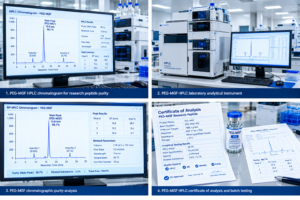
generally refers to the percentage of chromatographic detector area attributed to the specified principal component under the stated analytical conditions.
For example, a current 2026 PEG-MGF COA reports a main chromatographic peak at 11.40 minutes with an area of 99.27% for its tested batch. The certificate identifies the column, mobile phases, gradient and detection conditions used for that result.
That result should be described as:
99.27% RP-HPLC area purity for the specified batch under the reported method.
That wording is more scientifically precise than simply saying:
“PEG-MGF is 99.27% pure.”
The first statement identifies the analytical basis and batch. The second can imply a broader conclusion than the test actually establishes.
HPLC Area Purity vs. Peptide Content
One of the most important concepts for a PEG-MGF HPLC page is the distinction between chromatographic area purity and material content.
These measurements answer different questions.
HPLC area purity
This generally describes the relative detector response assigned to chromatographic peaks under a defined method.
Peptide content
This can describe how much peptide material is present on a specified mass basis.
Label-claim assay
This evaluates the measured quantity against the stated amount.
These values should not automatically be substituted for one another.
A current CertiPeptide PEG-MGF certificate, for example, reports 99.5% HPLC purity while separately reporting 90.9% peptide content, illustrating why the two measurements should not be treated as identical.
This distinction is particularly valuable for researchers comparing COAs from different laboratories.
PEG-MGF HPLC Method Parameters
A scientifically useful HPLC report should provide enough information to understand how the chromatographic result was produced.
Commonly documented parameters include:
Column
The stationary phase and dimensions should be identified.
For peptide analysis, reversed-phase columns are commonly used, with C18 and other phases selected according to the material and analytical objective.
Mobile Phase
The report should identify the solvents and additives.
Gradient
The percentage of organic solvent can be changed over time to separate components according to their chromatographic behavior.
Flow Rate
Flow rate influences retention time and chromatographic resolution.
Detection Wavelength
Peptide HPLC methods often use UV detection at wavelengths suitable for peptide detection.
Injection Volume
The quantity of sample introduced into the chromatographic system should be documented.
Column Temperature
Temperature can influence retention and separation.
Run Time
The complete chromatographic run should be long enough to evaluate relevant components.
Documenting these parameters makes the result more interpretable and potentially more reproducible.
Example of a PEG-MGF HPLC Method
A currently published PEG-MGF COA provides an example of a detailed method.
The reported method uses reversed-phase HPLC with a C4 column, water/acetonitrile mobile phases containing 0.1% TFA, a 20–70% B gradient over 40 minutes, a 1.0 mL/min flow rate and UV detection. The report identifies a principal peak at approximately 11.4 minutes and provides system-suitability measurements.
This should be understood as one published batch-specific analytical method, not a mandatory universal method for all PEG-MGF testing.
Different laboratories may use different columns and chromatographic conditions.
Understanding a PEG-MGF Chromatogram
A chromatogram is the graphical output of an HPLC analysis.
The horizontal axis generally represents retention time, while the vertical axis represents detector response.
A simplified chromatogram might contain:
Small early peak → Main PEG-MGF peak → Small later peaks
Each peak can represent a chromatographically distinguishable component.
The principal peak is normally the largest signal associated with the target material, but the identity of every peak should not be inferred solely from its position.
For example:
- An early peak may represent a different component.
- A nearby peak may represent a related peptide species.
- A later peak may represent another chromatographically retained component.
- Very small peaks may fall below the reporting threshold.
Peak assignment requires appropriate analytical evidence.
PEG-MGF Retention Time
Retention time is the time between sample injection and detection of a chromatographic component.
For example, a published 2026 PEG-MGF COA reports a principal peak at approximately 11.40 minutes under its specified method.
However, researchers should not expect every PEG-MGF HPLC chromatogram to show the same retention time.
Retention time can change because of:
- Column chemistry
- Column dimensions
- Mobile phase
- Gradient
- Flow rate
- Temperature
- Instrument configuration
- Sample preparation
Therefore, retention time should be interpreted within the context of the method used.
A 10-minute peak from one method cannot automatically be compared directly with an 11-minute peak from another method.
PEG-MGF Related Peaks and Impurities
One purpose of HPLC analysis is to identify chromatographically distinguishable components other than the principal peak.
Depending on the material and method, these may include:
- Related peptide species
- Deletion sequences
- Degradation products
- Unmodified material
- Differently modified material
- Process-related components
A current PEG-MGF COA provides an example in which smaller peaks were separately reported around the main peak and assigned to deletion sequences.
However, peak assignment should be supported by the analytical method and available reference data.
A chromatogram alone does not necessarily establish the molecular identity of every peak.
PEG-MGF HPLC and Batch Testing
Batch-specific analysis is especially important for research materials.
A product page may describe a general specification, but the HPLC chromatogram and numerical result apply to the specific sample that was tested.
For example, a current analytical report identifies a particular PEG-MGF source batch, certificate number, analysis date and HPLC result.
Independent analytical records also demonstrate variation between tested samples. One current database lists PEG-MGF HPLC results ranging from approximately 98% to 100% across its published records. Because the database represents submitted/publicly available tests rather than every production batch, its results should not be interpreted as a universal population estimate.
This illustrates an important SEO and scientific point:
HPLC purity should always be associated with the tested batch and analytical method.
How to Read a PEG-MGF HPLC COA
When reviewing a PEG-MGF COA, look for the following information.
1. Product identity
Confirm that the document identifies the same material being evaluated.
2. Batch number
The lot number should match the physical product.
3. Analysis date
Check when the sample was tested.
4. HPLC method
Look for the column, mobile phases, gradient and detection conditions.
5. Chromatogram
Where available, review the actual chromatographic trace.
6. Main peak
Identify the reported principal peak and its area percentage.
7. Related peaks
Review reported impurities or secondary chromatographic components.
8. Acceptance specification
Determine what specification the laboratory used.
9. Identity testing
Look for additional methods supporting the material identity.
10. Other measurements
Check whether peptide content, water, endotoxin or other measurements are separately reported.
This approach prevents a single HPLC percentage from being interpreted outside its intended context.
PEG-MGF HPLC and Mass Spectrometry
HPLC and mass spectrometry are complementary analytical approaches.
HPLC primarily provides chromatographic separation and composition information under a specified method.
Mass spectrometry can provide molecular-mass information and, depending on the workflow, additional identity information.
For PEGylated materials, mass-spectrometric interpretation can be more complicated because PEG may produce a distribution of related molecular species.
A strong analytical package therefore may combine chromatographic analysis with an orthogonal identity method.
One current PEG-MGF COA reports HPLC together with peptide mapping by LC-MS/MS, providing sequence-coverage information as an additional identity measurement.
The combination is more informative than treating HPLC purity alone as complete molecular characterization.
Why PEG-MGF HPLC Results Can Differ
Researchers may encounter different HPLC percentages for apparently similar PEG-MGF materials.
Possible reasons include:
- Different manufacturing batches
- Different PEG specifications
- Different conjugation profiles
- Different chromatographic columns
- Different gradients
- Different detectors
- Different integration thresholds
- Different reference standards
- Different sample preparation
- Different definitions of purity
For example, one 2026 analytical record reports 97.66% RP-HPLC area purity for a declared 2mg PEG-MGF lot, while another published batch report gives 99.27%. These numbers should not be treated as contradictory simply because they differ; the relevant methods, batches and specifications must be examined.
PEG-MGF HPLC: What a Strong Analytical Report Contains
For research documentation, an ideal PEG-MGF HPLC report can contain:
| Parameter | Why It Matters |
|---|---|
| Product name | Identifies the tested material |
| Batch number | Establishes traceability |
| Column | Defines chromatographic separation |
| Mobile phase | Defines solvent system |
| Gradient | Defines separation conditions |
| Flow rate | Influences retention |
| Temperature | Can affect chromatographic behavior |
| Detection wavelength | Defines detector response |
| Retention time | Identifies chromatographic position |
| Main peak area | Supports area-based purity reporting |
| Related peaks | Shows additional chromatographic components |
| Chromatogram | Provides visual analytical evidence |
| System suitability | Supports method performance |
| Identity testing | Provides complementary evidence |
This information transforms a basic “99% purity” claim into a much more useful analytical record.
PEG-MGF HPLC Quality Checklist
Before relying on a PEG-MGF HPLC result, researchers can ask:
Method
- Is the HPLC method identified?
- Is the column specified?
- Is the mobile phase disclosed?
- Is the gradient disclosed?
- Is the detection wavelength provided?
Results
- Is the chromatogram available?
- Is the principal peak identified?
- Are secondary peaks reported?
- Is the purity calculation explained?
Traceability
- Is the batch number listed?
- Does it match the physical product?
- Is the testing date provided?
Identity
- Is there an orthogonal identity test?
- Is mass spectrometry or peptide mapping available where appropriate?
Interpretation
- Is HPLC area purity distinguished from peptide content?
- Are results being compared only where methods are sufficiently comparable?
PEG-MGF HPLC for Research Use
HPLC can support several types of laboratory research involving PEG-MGF, including:
- Analytical characterization
- Peptide quality-control studies
- Chromatographic method development
- Batch comparison
- Stability-oriented analytical work
- Related-substance profiling
- Research-material verification
- Method validation studies
The purpose of HPLC in these contexts is to characterize the research material analytically.
HPLC results should not be used as a substitute for biological evidence, clinical evidence or a complete assessment of molecular identity.
Research-Use-Only Statement
PEG-MGF HPLC information on this page is provided for laboratory research and analytical-education purposes only. PEG-MGF research materials are not presented as medicines, dietary supplements, or products intended to diagnose, treat, cure, mitigate or prevent disease.
No human-use, dosing or self-administration instructions are provided.
Researchers should follow applicable laboratory procedures, institutional requirements, safety protocols and relevant laws.
FAQ: PEG-MGF HPLC
What is PEG-MGF HPLC?
PEG-MGF HPLC is high-performance liquid chromatography used to analyze the chromatographic composition of PEG-MGF research material.
What does PEG-MGF HPLC purity mean?
It generally refers to the percentage of chromatographic detector area assigned to the principal component under a specified analytical method. It should not automatically be interpreted as total mass purity or complete molecular identity.
What HPLC column is used for PEG-MGF?
The column depends on the analytical method. A current published PEG-MGF COA uses a C4 reversed-phase column, while other laboratories may use different chromatographic systems.
What is PEG-MGF retention time?
Retention time depends on the HPLC method. A published 2026 batch report lists a principal PEG-MGF peak at approximately 11.4 minutes under its stated conditions.
Can HPLC confirm PEG-MGF identity by itself?
HPLC provides chromatographic information, but identity is stronger when supported by an orthogonal analytical method such as mass spectrometry or peptide mapping.
Is 99% HPLC purity always the same between suppliers?
No. The analytical method, batch, column, integration procedure and definition of purity can differ. Results should be interpreted alongside the complete COA.
Why can PEG-MGF HPLC be complicated?
PEGylated materials can have polymer-related distributions and chromatographic behavior that differs from conventional unmodified peptides.
Should PEG-MGF HPLC results be batch-specific?
Yes. The most useful analytical result is linked to the exact lot or batch being studied.