

Melanotan II 10mg: Research Peptide & Analytical Quality Guide
Melanotan II 10mg for Laboratory Research
Melanotan II 10mg is a peptide research material used in laboratory settings for analytical characterization, molecular research, peptide chemistry studies, and controlled investigation of melanocortin-related pathways. For research organizations evaluating peptide materials, important considerations include identity, purity, molecular characterization, batch traceability, analytical documentation, and appropriate laboratory storage.
Melanotan II is also referred to as MT-II or MT2. The compound belongs to the broader family of melanocortin-related peptides and has been studied in scientific literature for its interaction with melanocortin receptors. Research into melanocortin peptides has contributed to understanding receptor biology, signaling pathways, pigmentation-related processes, and other physiological systems.
A research-grade Melanotan II 10mg product should therefore be evaluated primarily as a laboratory material, rather than by marketing claims about human outcomes.
Research-use notice: Melanotan II is not an FDA-approved drug. This page is intended for scientific and educational purposes and does not provide instructions for human administration, dosing, injection, tanning, or treatment.
What Is Melanotan II?
Melanotan II is a synthetic cyclic peptide related to the melanocortin system. Scientific research has investigated melanocortin peptides because they interact with melanocortin receptors, a group of G-protein-coupled receptors involved in several biological signaling processes.
The FDA’s substance database identifies Melanotan II as an ingredient subst
ance and lists the molecular formula C₅₀H₆₉N₁₅O₉. The database also identifies MT-II and Melanotan II among its synonyms. Importantly, the presence of a substance in an FDA chemical/substance database does not mean that the substance has received FDA approval.
For laboratory researchers, these characteristics make Melanotan II relevant to areas such as:
- Peptide characterization
- Melanocortin receptor research
- Molecular biology
- Peptide chemistry
- Analytical chemistry
- Structure-function studies
- Receptor signaling research
- Comparative peptide analysis
- Chromatographic purity assessment
- Mass-spectrometric characterization
Research publications have described Melanotan II as a melanocortin receptor agonist and have investigated its biological activity in controlled experimental settings.
Melanotan II 10mg: Understanding the Product Format
The term Melanotan II 10mg generally describes a research material supplied with a stated quantity of peptide. The number “10mg” identifies the nominal amount of material represented by the product specification; it should not be interpreted as a recommended amount for human use.
For laboratory procurement, researchers should distinguish between:
- Nominal quantity — the amount stated on the product specification.
- Chemical purity — the proportion of the target compound relative to detected components under a specified analytical method.
- Identity — analytical evidence supporting the molecular identity of the material.
- Peptide content — the actual amount of peptide-related material, which can differ from chromatographic purity.
- Batch traceability — documentation connecting the material to a particular production batch.
- Storage condition — conditions specified by the supplier or validated for the particular material.
These distinctions are particularly important when comparing research materials from different suppliers.
Melanotan II Research Peptide: Why Analytical Documentation Matters
A research peptide should be supported by documentation that allows laboratory personnel to evaluate what was supplied.
A useful documentation package can include:
Certificate of Analysis
A Certificate of Analysis (COA) can provide batch-specific information such as:
- Product name
- Batch or lot number
- Test date
- Analytical methods
- Reported purity
- Identity testing
- Appearance
- Laboratory information
- Specification limits
- Testing results
The COA should correspond to the exact batch being evaluated.
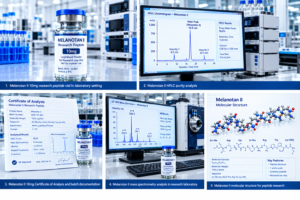
HPLC Analysis
High-performance liquid chromatography (HPLC) is commonly used to assess chromatographic purity in peptide research.
For a Melanotan II 10mg research material, an HPLC report may include:
- Chromatogram
- Retention time
- Main peak
- Additional detected peaks
- Reported chromatographic purity
- Analytical method information
HPLC purity should not automatically be interpreted as proof of molecular identity. A chromatographic result is one component of a broader analytical characterization strategy.
Mass Spectrometry
Mass spectrometry can provide molecular-mass information that helps support compound identity.
For peptide research, LC-MS or related mass-spectrometric methods may be used alongside chromatography to evaluate whether observed molecular-mass characteristics are consistent with the expected compound.
Using multiple analytical methods can provide a more informative characterization profile than relying on a single number.
Melanotan II Molecular Formula and Chemical Identification
The FDA Substance Registration System lists Melanotan II with the molecular formula:
C₅₀H₆₉N₁₅O₉
The FDA record identifies the substance as Melanotan II and provides additional chemical identifiers and synonyms.
For SEO and research documentation, relevant technical search terms include:
- Melanotan II molecular formula
- Melanotan II molecular weight
- Melanotan II chemical structure
- Melanotan II peptide sequence
- Melanotan II CAS number
- Melanotan II analytical characterization
- Melanotan II mass spectrometry
- Melanotan II HPLC
Researchers should verify chemical specifications against a current authoritative database, analytical report, or supplier documentation rather than relying solely on third-party product descriptions.
Melanotan II HPLC Testing
HPLC is particularly useful when evaluating the chromatographic profile of a peptide material.
A typical research workflow may involve comparing an analytical sample against predefined laboratory specifications. Researchers can examine the chromatogram for the principal peak and other detectable components.
Important information to review includes:
1. Analytical method
The report should identify the analytical method or testing procedure where appropriate.
2. Chromatographic purity
The reported percentage should be understood within the context of the method used.
3. Retention time
Retention time can provide useful chromatographic information when interpreted with the relevant method and reference standards.
4. Secondary peaks
Additional peaks may represent impurities, degradation products, synthesis-related components, or other detectable substances.
5. Laboratory documentation
Where available, researchers should review the laboratory identity, test date, batch number, and report reference.
HPLC is therefore most useful when considered as part of a complete analytical documentation package.
Melanotan II Mass Spectrometry
Mass spectrometry is another important analytical technique for peptide research.
While HPLC primarily provides chromatographic separation and purity information, mass spectrometry provides information related to molecular mass. Combining the two approaches can strengthen the analytical characterization of a research sample.
For Melanotan II research, relevant analytical questions can include:
- Does the observed mass correspond with the expected molecular characteristics?
- Is the principal chromatographic peak associated with the expected molecular species?
- Are unexpected mass signals present?
- Does the analytical profile correspond with the supplied documentation?
- Does the batch documentation identify the same material tested?
These questions are more useful for laboratory quality assessment than relying solely on a supplier’s product name.
Melanotan II COA: What Researchers Should Check
A Melanotan II COA should be reviewed carefully before a research material is incorporated into a laboratory workflow.
A practical COA review checklist includes:
Product identity
Does the product name on the COA correspond with the material received?
Batch number
Does the batch number match the vial, container, or supplier documentation?
Test date
Is the testing date clearly identified?
Purity result
Is the reported purity accompanied by a defined analytical method?
Identity testing
Does the documentation identify the analytical method used to support identity?
Testing laboratory
Is the testing laboratory identified where applicable?
Specification
Are acceptance criteria or specifications provided?
Documentation consistency
Do the COA, product label, and purchase documentation refer to the same batch?
This type of documentation review helps establish traceability and reduces ambiguity during laboratory material selection.
Melanotan II 10mg Quality Considerations
Quality assessment of peptide research materials involves more than a stated purity percentage.
Researchers may consider several independent attributes.
Identity
The first question is whether the material corresponds to the compound it is represented to be.
Purity
Purity testing helps identify the relative presence of detectable components under a particular analytical method.
Quantity
The stated quantity should correspond with the product specification and associated documentation.
Physical appearance
Researchers may document the physical appearance of the material as part of laboratory receiving procedures.
Batch consistency
Different batches may exhibit different analytical profiles. Batch-specific documentation is therefore preferable to generic product claims.
Traceability
A traceable material should have sufficient documentation to connect the container, batch, analytical results, and supplier records.
Research Applications of Melanotan II
Scientific literature has examined Melanotan II within the context of melanocortin receptor biology. Melanocortin receptors are a family of receptors involved in diverse physiological signaling processes.
Historical research has examined synthetic melanocortin analogues as tools for investigating receptor activity and related physiological pathways.
Potential laboratory research categories can include:
Melanocortin receptor studies
Researchers may investigate receptor-ligand interactions and signaling mechanisms.
Peptide chemistry
Melanotan II can serve as a research subject for investigating synthetic peptide structure and analytical properties.
Analytical chemistry
Researchers can study chromatographic and mass-spectrometric characteristics.
Structure-function research
Synthetic peptides can be investigated to better understand how structural characteristics influence receptor interactions.
Comparative peptide studies
Researchers may compare related melanocortin peptides and analogues under controlled experimental conditions.
These applications should be conducted within appropriately equipped research environments and under applicable institutional and regulatory requirements.
Melanotan II Research Peptide vs. Clinical Products
One important distinction for SEO content is the difference between a research peptide and an approved pharmaceutical product.
A product labeled “Melanotan II 10mg” as a research material should not be presented as an FDA-approved medicine.
The FDA has historically identified Melanotan II as an unapproved new drug and has taken regulatory action involving products marketed as Melanotan II.
More recently, FDA materials have also identified potential concerns with compounded Melanotan II involving immunogenicity for certain routes and possible aggregation or peptide-related impurities.
Therefore, research-oriented product pages should avoid language suggesting:
- FDA approval
- Medical treatment
- Cosmetic treatment
- Disease prevention
- Human dosing
- Self-administration
- Injectable use
- Guaranteed physiological outcomes
Keeping these distinctions clear improves both scientific accuracy and responsible SEO.
Melanotan II Storage and Handling Considerations
Storage requirements should always follow the supplier’s current documentation and the laboratory’s validated procedures.
Researchers may consider:
- Protection from inappropriate environmental exposure
- Appropriate container closure
- Batch identification
- Documentation of receipt
- Storage-condition monitoring
- Avoidance of unnecessary handling
- Maintaining an inventory record
- Reviewing supplier-specific stability information
Because peptide stability can depend on formulation, container, temperature, moisture, light exposure, and other variables, generic storage statements should not replace product-specific documentation.
For this reason, a professional product page should direct researchers toward the applicable supplier specification rather than making unsupported stability guarantees.
How to Evaluate a Melanotan II 10mg Research Supplier
When comparing research peptide suppliers, researchers can evaluate several objective factors.
Documentation
Look for accessible, batch-specific analytical documentation.
Testing transparency
Determine which analytical methods are reported.
Batch traceability
The product should be identifiable by a batch or lot number.
Product specifications
Review stated quantity, purity specifications, and analytical methods.
Research-use labeling
The intended research status should be clearly communicated.
Packaging
Evaluate whether packaging is appropriate for laboratory material handling.
Technical information
Useful suppliers provide sufficient technical information for laboratory purchasing and documentation.
Consistency
Historical batch records and repeat analytical testing can help researchers evaluate consistency over time.
Melanotan II 10mg and Responsible Research Documentation
Laboratory documentation is an important part of reproducible science.
A research group working with Melanotan II may maintain records covering:
- Supplier
- Product designation
- Batch number
- Date received
- COA
- Analytical reports
- Storage records
- Experimental identifier
- Research protocol
- Laboratory observations
- Disposal documentation where applicable
Good documentation allows researchers to trace experimental materials back to their original source.
This is particularly valuable when analytical results need to be reproduced, compared, or audited.
Why Research-Use-Only Language Matters
Research-use terminology should communicate the intended purpose of a laboratory material without implying that it is suitable for human consumption or medical use.
Appropriate wording includes:
“For laboratory research and analytical purposes only.”
“Not intended for human or veterinary use.”
“Research material supplied for qualified laboratory investigation.”
“Not a pharmaceutical product and not represented as an approved medical treatment.”
This wording should remain consistent throughout product pages, metadata, image captions, product descriptions, and supporting content.
Regulatory authorities have specifically emphasized that simply adding “research use only” language does not determine a product’s regulatory status when other marketing content indicates intended human use.
For that reason, the entire page should maintain a consistent laboratory-research purpose.
Frequently Asked Questions
What is Melanotan II 10mg?
Melanotan II 10mg refers to a research material containing a stated quantity of Melanotan II peptide. It can be investigated in laboratory research involving peptide chemistry, analytical characterization, and melanocortin-related research.
Is Melanotan II FDA approved?
No. FDA materials identify Melanotan II as an unapproved substance/drug and have documented regulatory concerns surrounding products marketed for human use.
What is the molecular formula of Melanotan II?
The FDA Substance Registration System lists the molecular formula as C₅₀H₆₉N₁₅O₉.
What does HPLC tell researchers about Melanotan II?
HPLC can provide chromatographic information and an assessment of purity under a specified analytical method. It should be considered alongside identity testing and other analytical data.
Why is mass spectrometry useful for peptide research?
Mass spectrometry provides molecular-mass information that can help support the identity and characterization of a peptide research material.
What should a Melanotan II COA contain?
A useful COA may include the product name, batch number, testing date, analytical method, purity result, identity testing, specifications, and testing-laboratory information.
Is Melanotan II the same as PT-141?
No. Melanotan II and PT-141 are related melanocortin research compounds, but they are distinct molecules with different structures and research histories. Scientific literature discusses both within the broader melanocortin field.
Is Melanotan II 10mg intended for human use?
A research-grade product should be presented strictly according to its documented intended use. This page does not provide human-use, dosing, injection, tanning, or treatment instructions.
Why is batch-specific documentation important?
Batch-specific documentation connects the analytical results to the exact material supplied, improving traceability and supporting reproducible laboratory research.
What should researchers consider when purchasing Melanotan II?
Researchers can review identity documentation, analytical testing, HPLC results, mass-spectrometry data, COA availability, batch traceability, product specifications, packaging, and supplier documentation.
Research-Use Disclaimer
Melanotan II 10mg described on this page is discussed as a laboratory research material. It is not presented as an FDA-approved drug or medical treatment. This information is intended for qualified research and educational purposes only. It does not provide instructions for human administration, dosing, injection, tanning, diagnosis, treatment, or disease prevention. Researchers are responsible for complying with applicable laws, institutional requirements, laboratory safety procedures, and supplier documentation.