

Introduction
SNAP-8 10mg is a synthetic peptide research material commonly identified as Acetyl Octapeptide-3. It is of interest in peptide chemistry, analytical characterization, cosmetic-science research, and laboratory studies involving short synthetic peptides.
For research organizations and qualified laboratories, evaluating a peptide involves considerably more than the name printed on a vial. Researchers may need to consider chemical identity, molecular characteristics, chromatographic behavior, analytical purity, batch documentation, storage conditions, and traceability.
SNAP-8 is particularly relevant to analytical research because its nomenclature appears across chemical databases and commercial literature with some differences in structural representation. PubChem currently provides records for Acetyl Octapeptide-3 that should be distinguished carefully when documenting a material. One PubChem record identifies a structure with the formula C41H70N16O16S and molecular weight 1,075.2 g/mol, while another record lists C42H72N16O15S and 1,073.2 g/mol.
For this reason, researchers should use the exact batch documentation and analytical data supplied with a material rather than assuming that every SNAP-8 reference represents exactly the same chemical form.
Research-use statement: SNAP-8 10mg is presented for laboratory research, analytical characterization, and scientific investigation only. It is not presented as a medicine, treatment, dietary supplement, or product for human or veterinary use.
What Is SNAP-8?
SNAP-8 is commonly associated with the name Acetyl Octapeptide-3, a synthetic eight-residue peptide. A PubChem record identifies the peptide sequence as EEMQRRAD, with N-terminal acetylation and a C-terminal amide represented in the chemical structure.
The extended chemical representation is:
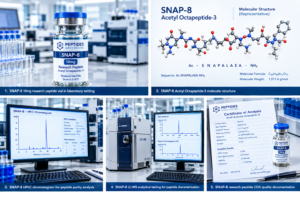
Ac-Glu-Glu-Met-Gln-Arg-Arg-Ala-Asp-NH2
This distinction is important because peptide names can be abbreviated, commercial, or database-dependent. A laboratory record should ideally include several identifiers rather than relying on a trade name alone.
Useful identifiers can include:
- Chemical name
- CAS number where applicable
- Molecular formula
- Molecular weight
- Peptide sequence
- Structural modifications
- Batch or lot number
- Certificate of Analysis
- HPLC or chromatographic data
- Mass-spectrometric data where available
The PubChem record associated with CAS 868844-74-0 identifies Acetyl Octapeptide-3 with a molecular weight of approximately 1,075.2 g/mol.
SNAP-8 10mg Research Material
The 10mg designation describes the nominal quantity of material supplied in the research vial. It should not be interpreted as a concentration, dose, or recommendation for administration.
For laboratory purposes, the quantity can be useful when planning analytical workflows, comparative testing, method-development experiments, or material characterization.
A research product page should clearly distinguish:
Product identity
What chemical material is being supplied?
Quantity
How much material is represented by the 10mg designation?
Purity
What analytical purity is reported for the specific batch?
Identity testing
What evidence supports the chemical identity?
Documentation
Is a batch-specific COA available?
Traceability
Can the vial be connected to a defined batch or lot?
These distinctions make product information more useful to researchers and reduce ambiguity between product marketing terminology and laboratory documentation.
SNAP-8 Molecular Formula and Molecular Weight
Molecular data are useful for analytical planning and database identification.
One PubChem record for Acetyl Octapeptide-3 lists:
| Property | Reported value |
|---|---|
| Chemical name | Acetyl Octapeptide-3 |
| Molecular formula | C41H70N16O16S |
| Molecular weight | 1,075.2 g/mol |
| Exact mass | 1,074.48764138 Da |
| CAS | 868844-74-0 |
| PubChem CID | 76283482 |
These values come from the PubChem record associated with the C41H70N16O16S structure.
However, PubChem also contains another Acetyl Octapeptide-3 record with a different deposited formula and molecular weight.
Why the discrepancy matters
Peptide chemistry can involve differences in:
- terminal modifications
- salt or counterion forms
- amidation
- acetylation
- database structure assignments
- deposited chemical records
Consequently, a high-quality research workflow should compare the product’s stated identity with its COA and analytical results.
For SEO purposes, this also creates an important distinction between the keyword “SNAP-8 molecular weight” and the actual laboratory task of verifying molecular identity.
SNAP-8 Peptide Sequence
The PubChem record associated with CAS 868844-74-0 gives the modified sequence as:
Ac-Glu-Glu-Met-Gln-Arg-Arg-Ala-Asp-NH2
The underlying residue sequence is represented as:
EEMQRRAD
PubChem identifies the sequence and terminal modifications within its chemical structure record.
Sequence information is valuable for:
- Chemical identification
- Peptide synthesis documentation
- Mass calculations
- Analytical method development
- Reference-standard comparison
- Database searching
- LC-MS interpretation
Researchers should distinguish the unmodified residue sequence from the complete chemically modified molecule. Acetylation and C-terminal amidation affect the molecular formula and calculated mass.
SNAP-8 HPLC Analysis
HPLC, or high-performance liquid chromatography, is one of the most useful analytical techniques for characterizing synthetic peptide materials.
For SNAP-8 research, chromatographic analysis can provide information about:
- Retention behavior
- Main-component peak
- Related chromatographic peaks
- Relative chromatographic purity
- Potential degradation products
- Batch-to-batch differences
A chromatogram generally plots detector response against retention time. A prominent principal peak can indicate the major chromatographic component, while additional peaks may indicate other detectable components.
However, an HPLC chromatogram should not automatically be interpreted as absolute proof of molecular identity.
HPLC versus identity confirmation
HPLC primarily provides separation information.
Mass spectrometry can provide complementary information about molecular mass and ion behavior.
For stronger characterization, laboratories may therefore combine:
HPLC + MS
or, where appropriate:
LC-MS/MS
A peer-reviewed analytical study specifically developed an LC-MS/MS method for Acetyl Octapeptide-3. The researchers used liquid chromatography coupled with triple-quadrupole mass spectrometry and optimized detection in multiple-reaction-monitoring mode.
The study reported detection of multiply charged SNAP-8 ions, including a doubly charged precursor around m/z 538, demonstrating why peptide mass-spectrometric interpretation must account for charge state rather than simply searching for the nominal molecular weight.
SNAP-8 LC-MS and Mass Spectrometry
LC-MS can complement chromatographic analysis by providing mass-related information.
For a peptide around 1,075 Da, electrospray ionization can produce multiply charged ions. This means that the instrument may display an m/z value substantially lower than the peptide’s molecular weight.
For example, the published SNAP-8 analytical method selected a doubly charged precursor ion for quantitative LC-MS/MS analysis.
This distinction is important when reading analytical reports:
Molecular weight ≠ observed m/z
The molecular weight describes the molecule’s calculated or average mass, while m/z describes the mass-to-charge ratio of an ion detected by the mass spectrometer.
A laboratory may therefore use molecular formula, calculated mass, chromatographic retention, precursor ion, and product ions together to evaluate identity.
SNAP-8 COA: Certificate of Analysis
A Certificate of Analysis (COA) is one of the most useful documents for evaluating a research peptide batch.
A batch-specific SNAP-8 COA may contain information such as:
- Product name
- Batch or lot number
- Test date
- Appearance
- Purity result
- Analytical method
- Identity result
- Manufacturing information
- Storage recommendations
- Testing laboratory information
When reviewing a COA, the batch number on the document should correspond to the batch number associated with the physical product.
What researchers should look for
A useful documentation review can ask:
- Does the COA identify the exact product?
- Does the batch number match the vial?
- Is the analytical method stated?
- Is purity reported as chromatographic purity or another measurement?
- Is identity testing documented?
- Are test results batch-specific?
- Is the testing date provided?
- Is the analytical laboratory identified where applicable?
This approach is more informative than relying on a generic statement such as “high purity.”
SNAP-8 Purity Testing
Peptide purity can be reported using different analytical approaches.
For example, chromatographic purity may be calculated from the relative areas of detected peaks under a defined HPLC method.
However:
Chromatographic purity is not necessarily equivalent to total peptide content.
A sample can contain the target peptide alongside water, residual solvents, salts, counterions, or other non-chromophoric components that may not be represented in a simple area-percentage calculation.
This is why researchers should review the actual analytical method and reported specification instead of interpreting a percentage without context.
For high-quality SEO content, the phrase “SNAP-8 purity testing” should therefore be connected to analytical methodology rather than treated as a generic marketing claim.
SNAP-8 Analytical Research
SNAP-8 has been examined using analytical chemistry methods designed to detect and quantify the peptide.
A published method-development study used reverse-phase chromatography with a C18 stationary phase and LC-MS/MS detection. The investigators optimized chromatographic and mass-spectrometric conditions for SNAP-8 analysis and reported strong linearity, repeatability, and accuracy under their experimental conditions.
Importantly, analytical conditions from a published research method should not automatically be presented as universal specifications for every laboratory.
Chromatographic behavior can vary according to:
- Column chemistry
- Mobile-phase composition
- Gradient
- Temperature
- Flow rate
- Detector configuration
- Sample matrix
- Instrument platform
- Reference standard
- Peptide form
Therefore, published analytical research is best treated as methodological context rather than a guarantee of results for another batch.
Research Applications and Scientific Context
SNAP-8 can be relevant to research involving synthetic peptide chemistry and analytical characterization.
Potential laboratory research categories include:
Peptide characterization
Researchers can investigate molecular characteristics, chromatographic behavior, and analytical identity.
Analytical method development
SNAP-8 can serve as an analyte in method-development and validation studies using chromatographic and mass-spectrometric platforms.
Peptide stability research
Controlled studies can examine how analytical profiles change under defined laboratory conditions.
Comparative batch analysis
Researchers can compare chromatograms and analytical results between different batches or reference materials.
Cosmetic-science research
Acetyl Octapeptide-3 appears in cosmetic-science literature and ingredient research. The peer-reviewed analytical literature includes methods developed specifically to quantify SNAP-8 in formulated research materials.
These applications should be described as research categories rather than claims that the material produces a particular clinical or cosmetic outcome.
SNAP-8 Storage and Handling Considerations
Synthetic peptides can be sensitive to environmental conditions, and appropriate storage should follow the supplier’s batch-specific documentation.
Factors that may affect peptide materials include:
- Temperature
- Moisture
- Light exposure
- Repeated environmental exposure
- Container integrity
- Storage duration
Researchers should follow the storage information provided with the specific material and laboratory quality system.
A product page should avoid inventing a universal storage temperature when the supplier’s validated recommendation is not available.
For laboratory documentation, researchers may record:
- Date received
- Batch number
- Product identity
- Container condition
- Storage location
- Relevant analytical documentation
Such records support traceability and reproducibility.
How to Evaluate a SNAP-8 10mg Research Supplier
Researchers comparing suppliers can evaluate documentation rather than relying only on product descriptions.
Useful evaluation criteria include:
1. Identity documentation
Look for a clearly identified chemical name, sequence, and relevant identifiers.
2. Batch-specific COA
A COA should correspond to the actual batch supplied.
3. Analytical testing
Look for appropriate chromatographic or spectrometric documentation.
4. Traceability
Batch and lot information should be clear and consistent.
5. Product labeling
The label should identify the material and quantity without creating ambiguity about intended use.
6. Research-use language
The supplier should clearly distinguish laboratory research material from products intended for human or veterinary use.
7. Transparent technical information
Useful product pages explain what is actually measured instead of making unsupported performance claims.
SNAP-8 10mg: Quality-Control Checklist
Before using a research material in an analytical workflow, researchers can document:
- Product name
- Chemical identity
- CAS number where applicable
- Sequence
- Molecular formula
- Molecular weight
- Batch number
- Quantity
- COA
- HPLC or other analytical data
- Identity confirmation
- Storage information
- Receipt date
- Laboratory reference number
This creates a reproducible documentation trail.