

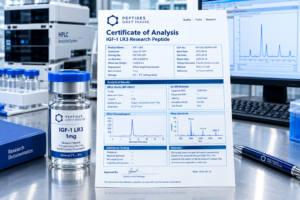
IGF-1 LR3 Purity: HPLC Analysis, LC-MS Testing & Peptide Quality
IGF-1 LR3 purity is an important consideration when evaluating IGF-1 LR3 research material for laboratory and analytical applications. A purity percentage can provide useful information, but researchers should look beyond a single number and consider the analytical method, chromatographic profile, molecular identity, batch documentation, and Certificate of Analysis (COA).
IGF-1 LR3 is a modified IGF-1 research peptide that is commonly described in scientific and biochemical research literature and catalogs as Long R3 IGF-1 or IGF-1 LR3. When evaluating a research peptide, analytical testing can help characterize the material and provide information about its composition and identity.
For this reason, HPLC purity, LC-MS analysis, molecular characterization, and batch-specific documentation are important subjects when discussing IGF-1 LR3 quality.
Research-use notice: IGF-1 LR3 discussed on this page is intended solely for laboratory research and analytical purposes. It is not intended for human or veterinary consumption, self-administration, diagnosis, treatment, cure, or prevention of disease.
What Is IGF-1 LR3 Purity?
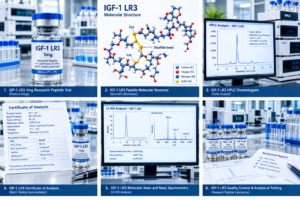
IGF-1 LR3 purity refers to an analytical measurement of the target peptide relative to other detectable components under a specified testing method.
For peptide research materials, high-performance liquid chromatography (HPLC) is commonly used as an analytical technique for separating peptide-related components. The resulting chromatogram can provide information about the primary peak and other detectable peaks within the tested sample.
A reported HPLC purity percentage should therefore be understood as an analytical result obtained under defined testing conditions.
This distinction matters because purity is not an absolute number that exists independently of the testing method.
An analytical report may include:
- Product name
- Batch or lot number
- Analytical method
- HPLC purity
- Retention time
- Chromatographic data
- Molecular-mass information
- Testing date
- Appearance
- Laboratory observations
The most reliable way to determine the purity associated with a particular research material is to review the current batch-specific Certificate of Analysis.
Why IGF-1 LR3 Purity Matters
Researchers working with synthetic peptides may need to control as many variables as possible within an experiment.
The presence of unidentified or unexpected components can introduce additional variables into an analytical workflow. Consequently, researchers may examine peptide purity together with identity, molecular characteristics, storage history, and batch traceability.
However, purity alone does not establish every aspect of research-material quality.
A broader evaluation can include:
Identity + chromatographic purity + molecular characterization + batch traceability + documentation
This provides a more complete framework for assessing a laboratory research material.
For example, an HPLC result may indicate that the target-related chromatographic peak represents the majority of the detected signal, while LC-MS analysis can provide additional information about molecular mass.
These techniques answer different analytical questions and can therefore complement each other.
IGF-1 LR3 HPLC Purity Analysis
High-performance liquid chromatography, commonly called HPLC, is an analytical separation technique widely used in chemical and biochemical laboratories.
During HPLC analysis, a sample passes through a chromatographic column under controlled conditions. Different components interact with the stationary and mobile phases differently, allowing them to separate.
The analytical system records detector response over time, producing a chromatogram.
For peptide analysis, the chromatogram may show:
- A primary peak
- Smaller related peaks
- Retention times
- Relative peak areas
- Other detectable components
The resulting data can then be interpreted according to the analytical method used by the laboratory.
What Does the HPLC Chromatogram Show?
An HPLC chromatogram normally displays retention time on the horizontal axis and detector response on the vertical axis.
A major peak can indicate the principal detectable component under the selected chromatographic conditions.
Additional peaks may indicate other detectable components.
However, chromatographic retention alone does not necessarily establish the exact chemical identity of every peak. This is one reason complementary analytical methods can be useful.
For an IGF-1 LR3 research material, a transparent analytical record may therefore include both the HPLC chromatogram and supporting molecular characterization.
What Does IGF-1 LR3 HPLC Purity Mean?
A reported HPLC purity percentage is generally calculated from chromatographic data according to the laboratory’s analytical procedure.
For example, the analytical documentation may report:
HPLC Purity: [Batch-specific result]
The actual value should be taken from the current COA rather than permanently hard-coded into general website copy.
This is an important SEO and trust consideration.
Instead of writing:
“Every IGF-1 LR3 batch is exactly XX% pure.”
a more accurate statement is:
“HPLC purity is evaluated on a batch-specific basis. Refer to the current Certificate of Analysis for the applicable analytical result.”
This wording avoids making an unsupported universal claim while still targeting relevant searches such as:
- IGF-1 LR3 purity
- IGF-1 LR3 HPLC purity
- IGF-1 LR3 purity testing
- peptide HPLC analysis
IGF-1 LR3 LC-MS Analysis
LC-MS, or liquid chromatography–mass spectrometry, combines chromatographic separation with mass spectrometric analysis.
The chromatography component separates the sample’s detectable components, while the mass spectrometer measures mass-to-charge information.
For peptide characterization, LC-MS can provide supporting information regarding:
- Molecular mass
- Expected versus observed mass
- Molecular identity
- Related molecular species
- Analytical characteristics of the sample
This makes LC-MS a useful complement to HPLC analysis.
HPLC vs. LC-MS
| Analytical technique | Primary information |
|---|---|
| HPLC | Chromatographic separation and purity assessment |
| LC-MS | Molecular mass and identity characterization |
| HPLC + LC-MS | Complementary analytical characterization |
Neither technique should automatically be interpreted as answering every possible question about a research material.
The analytical method, sample preparation, instrumentation, reference standards, and laboratory procedures all influence how results should be interpreted.
IGF-1 LR3 Molecular Identity
Purity and identity are separate analytical concepts.
Purity addresses the relative amount of target-related material detected by a particular method.
Identity addresses whether the analytical evidence is consistent with the expected material.
This distinction is important when evaluating IGF-1 LR3.
A research material may have a reported HPLC purity result, but researchers may also want supporting evidence for its molecular identity.
Mass spectrometry can contribute to this characterization by comparing observed analytical signals with expected molecular characteristics.
When reviewing a COA, researchers should therefore consider whether the document provides information about both purity and identity.
IGF-1 LR3 Certificate of Analysis
A Certificate of Analysis, or COA, is an important quality-control document associated with a specific material or batch.
For IGF-1 LR3 research material, a COA may contain information such as:
Product Identification
The document should clearly identify the tested material.
Batch Number
The lot number connects the analytical results to a particular production batch.
HPLC Purity
The COA may report the chromatographic purity obtained under the specified analytical conditions.
Molecular Analysis
Mass spectrometry or another analytical method may be reported where performed.
Testing Date
A testing date helps establish when the analytical assessment occurred.
Appearance
Physical appearance may be documented as part of the analytical record.
Storage Information
Applicable storage information may be included according to the material’s specifications.
The most important consideration is traceability.
A generic COA that cannot be associated with the supplied batch provides less useful information than a batch-specific analytical document.
How to Read an IGF-1 LR3 COA
When reviewing an IGF-1 LR3 Certificate of Analysis, researchers can use a simple checklist.
1. Confirm the Product
Make sure the COA identifies the same material being evaluated.
2. Verify the Batch Number
The batch number should correspond to the physical product.
3. Review the HPLC Result
Look for the reported chromatographic purity and testing method.
4. Review Supporting Chromatography
If a chromatogram is available, examine the overall chromatographic profile.
5. Review Molecular Analysis
Check whether supporting mass or identity information is provided.
6. Check the Testing Date
A dated analytical record provides useful traceability.
7. Compare Documentation
Ensure the product description, batch number, analytical results, and supplied material correspond.
This approach is more informative than evaluating a single percentage displayed on a product page.
IGF-1 LR3 Purity and Batch Testing
Batch-specific testing is particularly important for research materials because different production lots may have separate analytical records.
A batch-specific analytical workflow can establish a connection between:
Product → Batch → Analytical Test → Result → Documentation
This traceability can be valuable for laboratory records and quality-control processes.
For an online research-peptide catalog, it is better to avoid presenting one purity percentage as a permanent specification if different batches may have different analytical results.
Instead, the product page can state:
“Current analytical results are available in the batch-specific Certificate of Analysis.”
This also creates a natural opportunity for an internal link to a COA / analytical documentation page.
What Is High-Purity IGF-1 LR3?
The phrase high-purity IGF-1 LR3 is commonly used to describe research material with a high reported chromatographic purity.
However, the phrase should be supported by actual analytical documentation.
A researcher evaluating a high-purity research peptide may want to know:
- What analytical method was used?
- What was the reported result?
- Which batch was tested?
- When was it tested?
- Was molecular identity evaluated?
- Is a chromatogram available?
- Is mass analysis available?
- Does the COA correspond to the supplied batch?
These questions provide greater context than a purity percentage alone.
Why Purity Percentage Should Not Be Used Alone
It can be tempting to compare research peptides by looking only at the number displayed next to “purity.”
That approach can be misleading.
Analytical results depend on the testing conditions and procedures used by the laboratory.
Factors can include:
- HPLC column
- Mobile phase
- Gradient
- Detector
- Sample preparation
- Integration parameters
- Reference standards
- Analytical method
Therefore, two reported purity percentages should not necessarily be treated as directly equivalent without considering how the measurements were obtained.
For this reason, a transparent product page should explain the analytical context surrounding the reported result.
IGF-1 LR3 Peptide Quality Control
Quality control can involve multiple stages.
A general research-material workflow may include:
Material receipt
↓
Batch identification
↓
COA review
↓
HPLC analysis
↓
Molecular characterization
↓
Documentation review
↓
Laboratory research
The exact procedure depends on the laboratory and research application.
Quality control is particularly useful when researchers need reproducible documentation between experiments or production batches.
IGF-1 LR3 Purity and Storage
Storage and handling are additional considerations when evaluating peptide research materials.
Researchers should follow the storage conditions provided with the specific material and use appropriate laboratory procedures.
Potential considerations include:
- Temperature
- Moisture
- Light exposure
- Container integrity
- Storage duration
- Handling frequency
- Sample preparation
Analytical purity does not guarantee indefinite stability.
A purity result describes the tested sample under the specified analytical conditions. It should not automatically be interpreted as a guarantee that the same result will remain unchanged after prolonged or inappropriate storage.
Research Applications of IGF-1 LR3
IGF-1 LR3 may be encountered in laboratory research involving peptide characterization, biochemical investigations, analytical method development, and related experimental systems.
The appropriate research application depends on the laboratory’s objectives, protocols, equipment, and applicable requirements.
This page focuses specifically on analytical quality and purity, rather than providing protocols for administration or therapeutic use.
Researchers should use appropriate institutional procedures and safety practices when handling laboratory materials.
Research-Use Statement
IGF-1 LR3 research material is intended solely for laboratory research and analytical purposes. It is not intended for human consumption, veterinary use, self-administration, diagnosis, treatment, cure, or prevention of disease. Researchers are responsible for following applicable laboratory procedures, institutional requirements, safety practices, and laws or regulations governing the handling and use of research materials.
Information presented on this page describes analytical concepts including HPLC, LC-MS, purity, molecular characterization, and batch documentation. It should not be interpreted as medical advice or as a recommendation for human use.
Frequently Asked Questions About IGF-1 LR3 Purity
What is IGF-1 LR3 purity?
IGF-1 LR3 purity is an analytical measurement describing the proportion of target-related chromatographic material detected under a specified testing method. The applicable batch-specific COA should be used to determine the reported result for a particular lot.
How is IGF-1 LR3 purity tested?
HPLC is commonly used for chromatographic analysis. The sample is separated into detectable components and the resulting chromatogram can be evaluated according to the laboratory’s analytical method.
What is IGF-1 LR3 HPLC purity?
IGF-1 LR3 HPLC purity is the reported chromatographic purity obtained from an HPLC analysis of the tested sample. The result should be interpreted together with the analytical method and supporting documentation.
Is HPLC purity the same as identity?
No. HPLC primarily provides chromatographic information. Additional techniques such as LC-MS can provide supporting information about molecular mass and identity.
What is an IGF-1 LR3 COA?
A Certificate of Analysis is documentation describing analytical testing associated with a particular material or batch.
Why is a batch-specific COA important?
A batch-specific COA connects analytical results to a particular production lot, improving traceability and making the information more useful for laboratory documentation.
What should an IGF-1 LR3 COA contain?
Depending on the testing laboratory, a COA may contain product identification, batch number, HPLC purity, analytical method, molecular analysis, testing date, appearance, and other relevant specifications.
Does a high purity percentage guarantee research suitability?
No. Researchers should consider purity together with molecular identity, analytical methodology, documentation, storage history, and the requirements of their specific research application.
What is LC-MS used for?
LC-MS combines chromatography and mass spectrometry. It can provide supporting information about molecular mass and help characterize molecular identity.
Can peptide purity change during storage?
Storage and handling conditions can affect research materials. Researchers should follow the applicable storage requirements and laboratory procedures.
Is IGF-1 LR3 intended for human use?
The material described on this page is intended for laboratory research and analytical purposes only and is not intended for human consumption or self-administration.
IGF-1 LR3 Purity: Key Takeaways
When evaluating IGF-1 LR3 purity, researchers should consider the complete analytical record.
The main factors include:
- HPLC purity
- Chromatographic profile
- LC-MS analysis
- Molecular identity
- Batch number
- Certificate of Analysis
- Testing date
- Storage documentation
- Quality-control procedures
A purity percentage is useful, but it should be interpreted in context.
The most useful question is therefore not simply:
“What is the IGF-1 LR3 purity percentage?”
Instead, researchers can ask:
“What analytical evidence supports the purity, identity, and traceability of this specific IGF-1 LR3 batch?”
That approach provides a more complete framework for evaluating research peptide quality.