

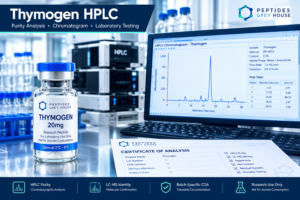
Thymogen HPLC: Peptide Purity Analysis, Chromatography & Laboratory Testing
Thymogen HPLC analysis is a laboratory testing approach used to evaluate the chromatographic profile and reported purity of Thymogen research material. HPLC, or high-performance liquid chromatography, can separate components within a sample and provide analytical data that laboratories use to characterize peptide purity.
For researchers evaluating Thymogen, HPLC documentation can be an important part of a broader quality-control process. A useful analytical record may include the sample identification, lot or batch number, chromatographic method, retention time, chromatogram, reported purity, testing date, and laboratory information.
Thymogen is commonly described as the short peptide Glu-Trp, also referred to as glutamyl-tryptophan. Because HPLC purity and molecular identity answer different analytical questions, a comprehensive laboratory evaluation may combine HPLC with a complementary identity technique such as mass spectrometry.
This page explains what Thymogen HPLC testing means, how chromatographic purity is interpreted, what researchers can look for on a chromatogram, how an HPLC Certificate of Analysis can be reviewed, and why batch-specific analytical documentation matters.
What Is Thymogen HPLC?
Thymogen HPLC refers to the analysis of Thymogen using high-performance liquid chromatography.
HPLC is an analytical separation technique widely used in chemistry, pharmaceutical analysis, biotechnology, and peptide research. During an HPLC analysis, a prepared sample passes through a chromatographic system containing a stationary phase. Different components interact with that stationary phase differently and therefore move through the system at different rates.
The instrument records the resulting detector response as a chromatogram.
For peptide analysis, the chromatogram can help a laboratory evaluate:
- The primary chromatographic peak
- Additional peaks
- Retention time
- Relative peak areas
- Separation quality
- Potential related components
- Reported chromatographic purity
The exact HPLC method depends on the laboratory, instrument, column, mobile phase, detector, and validated analytical procedure.
Therefore, an HPLC percentage should always be interpreted together with the method used to obtain it.
Why HPLC Testing Matters for Thymogen
A product description alone does not provide the same analytical information as a laboratory chromatogram.
For example, a website might describe a material as “high purity,” but that phrase does not identify:
- Which analytical method was used
- Which sample was tested
- Which batch was tested
- When testing occurred
- What the chromatogram looked like
- How the reported percentage was calculated
An HPLC report provides substantially more analytical context.
A professional Thymogen HPLC record can connect a reported purity result to a particular sample and laboratory method.
This is particularly useful when maintaining laboratory documentation and comparing analytical results between batches.
Thymogen HPLC Purity
One of the most common reasons for performing HPLC analysis is to determine a reported chromatographic purity percentage.
The result is generally calculated from the relative chromatographic peak areas detected under the laboratory’s specified conditions.
However, HPLC purity should not automatically be interpreted as a universal measurement of every aspect of material quality.
For example, an HPLC purity result does not necessarily establish:
- Molecular identity by itself
- Biological activity
- Sterility
- Endotoxin status
- Stability under every storage condition
- Performance in a biological experiment
- Absence of every possible impurity
This distinction is important for accurate scientific communication.
A better website statement is:
Thymogen purity is evaluated using the analytical method stated on the applicable laboratory report.
Rather than:
Thymogen is always 99.9% pure.
The second statement could be misleading if it is not supported by the current batch-specific documentation.
How a Thymogen HPLC Chromatogram Works
A chromatogram is the visual output generated during chromatographic analysis.
The horizontal axis commonly represents retention time, while the vertical axis represents detector response.
As different components pass through the detector, peaks appear on the chromatogram.
A simplified chromatogram might contain:
Retention Time →
Small peaks → Main peak → Additional small peaks
The main peak is generally associated with the target compound under the analytical method.
Additional peaks may represent other detectable components, depending on the sample and method.
The laboratory interprets the chromatogram according to its validated analytical procedure.
Understanding the Main Thymogen HPLC Peak
When reviewing a Thymogen chromatogram, one important feature is the primary peak associated with the target compound.
Researchers may examine:
Retention Time
Retention time indicates when a detected component elutes from the chromatographic system.
A consistent retention time under the same analytical conditions can contribute to analytical characterization.
Peak Area
Peak area represents the integrated detector response associated with a chromatographic peak.
Relative peak areas can be used in calculating chromatographic purity.
Peak Shape
Peak shape can provide information about chromatographic separation and analytical performance.
A well-resolved peak is easier to interpret than a poorly separated or heavily overlapping signal.
Additional Peaks
Additional peaks can indicate other detectable components within the sample.
Their significance depends on the analytical method, relative abundance, retention time, and laboratory interpretation.
Thymogen HPLC and Related Impurities
Peptide synthesis can potentially produce related substances.
Depending on the synthesis and purification process, analytical laboratories may investigate:
- Incomplete synthesis products
- Deletion sequences
- Related peptide components
- Oxidized material
- Degradation products
- Residual process-related components
HPLC can help separate detectable chromatographic components.
However, the identity of an individual impurity should not be assumed solely from its position on a chromatogram.
Additional analytical techniques may be necessary to determine what a particular peak represents.
This is one reason why HPLC and mass spectrometry are often considered complementary analytical tools.
Thymogen HPLC vs LC-MS
HPLC and LC-MS should not be treated as identical tests.
HPLC
HPLC primarily provides chromatographic separation and can be used to calculate a reported purity result according to the laboratory’s method.
LC-MS
LC-MS combines chromatographic separation with mass spectrometry. The mass-spectrometric component provides mass-based information that can support molecular identity.
In simple terms:
HPLC:
“How does the sample separate chromatographically?”
LC-MS:
“Does the observed mass information support the expected molecular identity?”
A laboratory may therefore use HPLC and LC-MS together to provide a more complete analytical picture.
Why Thymogen HPLC and Identity Testing Work Together
A purity result alone does not necessarily prove that the principal peak is the intended compound.
Likewise, identity confirmation alone does not provide a complete picture of chromatographic purity.
Combining the two approaches can provide complementary information.
A technical Certificate of Analysis might therefore contain sections such as:
Product: Thymogen
Lot: [LOT NUMBER]
HPLC Method: [LABORATORY METHOD]
HPLC Purity: [ACTUAL BATCH RESULT]
Identity Method: [LC-MS / OTHER METHOD]
Identity Result: [ACTUAL RESULT]
Analysis Date: [DATE]
Testing Laboratory: [LABORATORY NAME]
Only the values supported by the actual laboratory report should be published.
What Is a Thymogen HPLC COA?
A Thymogen HPLC COA is a Certificate of Analysis containing analytical information associated with a specific Thymogen sample or batch.
The certificate may include:
- Product name
- Batch or lot number
- Certificate number
- Laboratory identification
- Testing date
- HPLC method
- HPLC purity
- Chromatogram
- Identity analysis
- Additional analytical testing
- Analyst or quality-control approval
The exact contents depend on the laboratory and scope of testing.
For a research-material website, the strongest documentation is a COA that can be directly associated with the specific lot being described.
How to Read a Thymogen HPLC COA
Researchers can approach a COA systematically.
1. Check the Product Name
Confirm that the certificate identifies the intended research material.
2. Check the Batch Number
The batch or lot number should correspond to the material being documented.
3. Check the Testing Laboratory
Identify the organization responsible for the analytical testing.
4. Check the Analysis Date
Determine when the sample was analyzed.
5. Identify the HPLC Method
Look for information about the chromatographic method.
The certificate may identify the column, detector, mobile phase, or other analytical parameters.
6. Review the Chromatogram
Examine the main peak, retention time, peak shape, and additional detectable peaks.
7. Review the Reported Purity
Use the actual percentage reported by the laboratory.
Do not substitute a generic website specification for a batch-specific analytical result.
8. Review Identity Testing
If LC-MS or another identity method is included, review the corresponding result separately from the HPLC purity value.
Thymogen HPLC Retention Time
Retention time is the amount of time required for a chromatographic component to reach the detector after injection.
Retention time is method-dependent.
That means a Thymogen retention time reported by one laboratory should not automatically be treated as a universal retention time for every HPLC system.
Differences can arise from:
- Column chemistry
- Mobile-phase composition
- Gradient conditions
- Flow rate
- Temperature
- Detector configuration
- Instrument characteristics
- Sample preparation
- Laboratory method
Therefore, a website should avoid publishing a single retention-time number as though it applies to every analytical method.
The correct approach is to report the retention time from the actual COA or analytical report.
Thymogen HPLC Column Selection
Reverse-phase chromatography is commonly used for peptide analysis.
A laboratory may use a C18-type stationary phase or another chromatographic configuration appropriate to its validated method.
Column selection can affect:
- Retention
- Resolution
- Peak shape
- Separation of related components
- Overall chromatographic performance
Because analytical methods differ, the column used for a particular Thymogen test should be identified from the laboratory documentation rather than assumed.
Thymogen HPLC Method Development
Analytical laboratories may develop or validate chromatographic methods according to their internal procedures and applicable analytical requirements.
Method development can involve evaluating variables such as:
- Stationary phase
- Mobile phase
- Gradient
- Flow rate
- Detection wavelength
- Injection volume
- Sample concentration
- Column temperature
- Run time
The goal is to establish an analytical procedure capable of producing useful and reproducible separation under defined conditions.
For website documentation, however, it is better to publish the actual method used by the testing laboratory rather than presenting a hypothetical method as though it were the laboratory’s procedure.
Thymogen HPLC Quality Control
HPLC can form one component of a broader analytical quality-control program.
A comprehensive research-material documentation package may include:
Identity
An analytical technique used to support identification of the compound.
Purity
A chromatographic purity result generated using the specified HPLC method.
Batch Traceability
A lot number connecting the analytical result to a particular material batch.
Appearance
A physical description recorded by the laboratory where applicable.
Additional Testing
Depending on the testing scope, additional analytical parameters may be documented separately.
The presence or absence of these tests should always be stated accurately.
Why Batch-Specific Thymogen HPLC Results Matter
A major principle in analytical documentation is traceability.
A purity number without a lot number provides less useful information than a purity result directly connected to an identified batch.
For example:
Weak documentation:
Thymogen — 99% purity
Stronger documentation:
Thymogen — Lot [XXXX] — HPLC Purity [Actual Result] — Tested [Date] — Laboratory [Name]
The second format gives researchers substantially more context.
It also creates stronger SEO content because it naturally answers multiple search questions:
- What is Thymogen HPLC?
- What is Thymogen purity?
- What is a Thymogen COA?
- How is Thymogen tested?
- What does a Thymogen chromatogram show?
- How is Thymogen identity verified?
Should You Publish a Thymogen Purity Percentage?
Yes, if the number is supported by the applicable laboratory documentation.
However, the number should be clearly associated with the relevant batch.
Do not use an arbitrary purity percentage simply because another supplier or laboratory reports that value.
For example:
HPLC Purity: [ACTUAL BATCH-SPECIFIC RESULT]
is safer and more scientifically accurate than:
HPLC Purity: 99.9%
unless the 99.9% result actually appears on the applicable laboratory report.
Different publicly documented Thymogen tests demonstrate that analytical results can vary between samples and batches. Therefore, batch-specific reporting is preferable to a universal purity claim.
Thymogen HPLC and Research Documentation
For laboratories, analytical documentation can become part of the research record.
A useful documentation package may include:
- Product identification
- Supplier information
- Lot number
- COA
- HPLC chromatogram
- Identity report
- Testing date
- Laboratory information
- Internal sample identification
- Relevant laboratory records
Maintaining this information helps researchers understand which analytical material was associated with a particular experiment.
Thymogen HPLC for Research-Only Materials
Thymogen research material should be presented clearly as laboratory research material.
An analytical HPLC result is a characterization result. It should not be presented as evidence of clinical efficacy, safety, therapeutic effectiveness, or suitability for human use.
Likewise, a high HPLC purity result should not be interpreted as a clinical-quality designation.
The appropriate language is technical and analytical:
- HPLC purity
- Chromatographic profile
- Analytical testing
- Batch documentation
- Identity testing
- Laboratory characterization
- Certificate of Analysis
- Research material
This language is also valuable for SEO because it targets researchers searching for analytical information rather than relying exclusively on commercial terminology.
Thymogen HPLC Research-Use Statement
Thymogen research material is intended solely for laboratory research and analytical purposes. It is not intended for human or veterinary consumption, self-administration, diagnosis, treatment, cure, or prevention of disease. Analytical results apply only to the sample, lot, or batch identified in the applicable laboratory documentation. Researchers are responsible for following appropriate laboratory procedures, institutional requirements, safety practices, and applicable laws and regulations governing research materials.
Frequently Asked Questions About Thymogen HPLC
What is Thymogen HPLC?
Thymogen HPLC is high-performance liquid chromatography analysis performed on Thymogen research material. It can be used to characterize the chromatographic profile and calculate a reported purity result according to the laboratory’s analytical method.
What does HPLC purity mean for Thymogen?
HPLC purity is a chromatographic measurement calculated according to the laboratory’s stated method. It should be interpreted together with the analytical conditions and should not automatically be considered a measurement of every aspect of material quality.
Does HPLC confirm Thymogen identity?
HPLC alone should not automatically be treated as definitive molecular identity confirmation. A complementary technique such as LC-MS can provide mass-based information supporting identity.
What does a Thymogen HPLC chromatogram show?
A chromatogram displays detector response against retention time. It can show the principal chromatographic peak and other detectable peaks associated with the analyzed sample.
What is Thymogen retention time?
Retention time is the time required for a chromatographic component to reach the detector. The value depends on the specific HPLC method, column, mobile phase, flow rate, temperature, and instrument.
Can Thymogen HPLC purity vary between batches?
Yes. Analytical results can differ between samples and batches. For this reason, a batch-specific COA should be used when reporting the purity of a particular research material.
What should a Thymogen HPLC COA contain?
A useful COA may contain the product name, batch number, laboratory, analysis date, HPLC method, chromatogram, purity result, identity testing, and additional quality-control information where applicable.
Is a high HPLC purity percentage proof of biological activity?
No. HPLC purity is an analytical measurement. It should not be interpreted as proof of biological activity, therapeutic effectiveness, or clinical suitability.
Why is LC-MS useful alongside HPLC?
HPLC provides chromatographic information, while mass spectrometry provides mass-based analytical information. Using complementary methods can provide a broader characterization of the analyzed material.
Should I publish another supplier’s Thymogen HPLC result?
It is better to use the actual analytical result associated with your own material and batch. Another laboratory’s result should not be represented as the result for your own batch.
Can an HPLC image be used as a COA?
An illustrative chromatogram should not be represented as an authentic laboratory COA. If you publish a COA, use the original laboratory document associated with the applicable batch.
Thymogen HPLC — Key Takeaways
Thymogen HPLC is an important analytical topic for researchers interested in peptide purity and laboratory characterization.
The most useful information includes:
- HPLC method
- Chromatogram
- Retention time
- Main peak
- Additional peaks
- Reported purity
- Batch number
- Testing laboratory
- Testing date
- Complementary identity testing
The most important principle is traceability.
A purity result should be connected to the specific sample or batch that was tested. When HPLC is combined with appropriate identity testing and batch documentation, researchers can obtain a more complete analytical record of the material being evaluated.
Recommended Internal Linking Structure
For your Peptides Grey House website, connect this page naturally to related resources:
- Thymogen 20mg
- Thymogen COA
- Thymogen Purity
- Thymogen Molecular Structure
- HPLC Tested Peptides
- Peptide HPLC Analysis
- Peptide Certificate of Analysis
- LC-MS Peptide Analysis
- Research Peptide Quality Standards
- Laboratory Peptides Supplier
Recommended anchor text should vary naturally rather than repeatedly using “Thymogen HPLC.”