

Thymosin Alpha-1 5mg Research Peptide
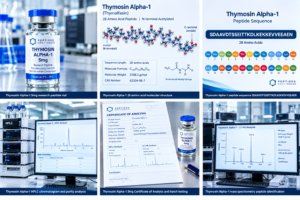
Thymosin Alpha-1 5mg is a research peptide material associated with Thymosin Alpha-1 (Tα1), also known by the name thymalfasin. It is a synthetic, N-terminally acetylated peptide consisting of 28 amino-acid residues.
For laboratory researchers, Thymosin Alpha-1 is particularly relevant to peptide characterization, analytical chemistry, molecular identification, chromatographic testing, and research involving peptide structure and biological signaling.
The compound listed by PubChem as Thymalfasin has the molecular formula C129H215N33O55, a molecular weight of approximately 3,108.3 g/mol, and CAS Registry Number 62304-98-7. PubChem lists the sequence as SDAAVDTSSEITTKDLKEKKEVVEEAEN, with an N-terminal acetyl modification.
The 5mg designation refers to the quantity of material supplied and should not be confused with molecular weight, concentration, or analytical purity.
This page is designed to provide an evidence-based overview of Thymosin Alpha-1 5mg, including chemical identity, molecular weight, sequence, purity, HPLC analysis, COA documentation, analytical considerations, and research-use information.
Research-use statement: Thymosin Alpha-1 5mg discussed on this page is presented for laboratory research and analytical purposes only. It is not intended for human or veterinary administration, self-treatment, diagnosis, or prevention or treatment of disease.
What Is Thymosin Alpha-1?
Thymosin Alpha-1 is a 28-amino-acid peptide originally characterized from thymic material. Early structural research established that the peptide contains 28 amino-acid residues and has an acetylated serine at its N-terminus.
Modern chemical databases identify the compound as thymalfasin. PubChem describes thymalfasin as a chemically synthesized form of Thymosin Alpha-1 and provides its chemical formula, molecular weight, sequence, and structural identifiers.
Unlike small dipeptides such as Thymogen, Thymosin Alpha-1 is a substantially larger peptide. This difference is important when comparing research materials because the two compounds have different sequences, molecular formulas, molecular weights, and analytical profiles.
The peptide’s sequence is:
SDAAVDTSSEITTKDLKEKKEVVEEAEN
The biologically relevant structure includes an N-terminal acetyl group, commonly represented as:
Ac-SDAAVDTSSEITTKDLKEKKEVVEEAEN-OH
PubChem lists this modified sequence and identifies Thymalfasin as an acetylated polypeptide.
Thymosin Alpha-1 5mg Key Specifications
| Property | Information |
|---|---|
| Product | Thymosin Alpha-1 5mg |
| Common name | Thymosin Alpha-1 |
| Synonym | Thymalfasin |
| Abbreviation | Tα1 / TA1 |
| Peptide length | 28 amino acids |
| Sequence | SDAAVDTSSEITTKDLKEKKEVVEEAEN |
| N-terminal modification | Acetylated |
| Molecular formula | C129H215N33O55 |
| Molecular weight | Approximately 3,108.3 g/mol |
| CAS Registry Number | 62304-98-7 |
| Physical research material | Typically supplied as a lyophilized peptide where specified |
| Intended context | Laboratory research and analytical use |
The chemical information above corresponds to the parent Thymalfasin record in PubChem.
Researchers should always verify the specific product specification and batch documentation supplied with the material.
Thymosin Alpha-1 Molecular Weight
, is approximately 3,108.3 g/mol. The molecular formula is C129H215N33O55.
Molecular weight is an important reference point for analytical research because it helps researchers evaluate expected mass-spectrometry signals, calculate molecular quantities, compare reference data, and distinguish Thymosin Alpha-1 from related peptides.
It is important to distinguish between:
- Molecular weight
- Average molecular mass
- Exact or monoisotopic mass
- Observed mass-to-charge ratio
- Protonated or adducted MS ions
A mass-spectrometry result should therefore not be evaluated simply by comparing one observed m/z value with the molecular weight. Ionization state, charge state, adduct formation, instrument settings, and sample preparation can all affect the observed spectrum.
Molecular Weight vs. 5mg Quantity
The terms 3,108.3 g/mol and 5mg describe completely different properties.
The molecular weight describes the mass of one mole of the compound.
The 5mg specification describes the nominal quantity of material in the product.
Keeping these concepts separate is important when preparing technical product documentation and laboratory records.
Thymosin Alpha-1 Peptide Sequence
The established Thymosin Alpha-1 sequence is:
SDAAVDTSSEITTKDLKEKKEVVEEAEN
PubChem identifies this as the sequence for Thymalfasin and specifies the N-terminal acetylation in the structural representation.
The sequence contains 28 amino-acid residues and includes acidic and basic residues distributed throughout the peptide.
Historical structural research confirmed the primary structure using multiple analytical techniques, including sequence analysis and mass-spectrometric approaches.
For contemporary laboratory research, sequence information can be useful for:
- Reference-standard comparison
- Peptide identification
- LC-MS method development
- Analytical database searches
- Structural characterization
- Synthetic peptide verification
When comparing suppliers or batches, researchers should verify not only the amino-acid sequence but also relevant modifications. For Thymosin Alpha-1, the N-terminal acetylation is an important part of the molecular identity.
Thymosin Alpha-1 Purity
Purity is one of the most important analytical characteristics to review when evaluating a research peptide.
A product described as Thymosin Alpha-1 5mg should ideally have analytical documentation connecting the stated purity to a specific lot or batch number.
A generic statement such as “high purity” provides considerably less information than a batch-specific analytical report showing the method, result, specification, and sample identification.
What Does Peptide Purity Mean?
For peptide materials, purity is generally an analytical measurement reflecting the proportion of the detected target-related material under a defined testing method.
Different analytical methods can measure different aspects of a sample.
For example:
- RP-HPLC can assess chromatographic purity.
- LC-MS/MS can provide molecular identification information.
- Mass spectrometry can help verify expected molecular mass.
- Additional analytical methods can evaluate other attributes such as water, residual solvents, or counterions when applicable.
Therefore, a purity percentage should always be interpreted in the context of the analytical method used.
Why Batch-Specific Results Matter
The purity of one manufacturing batch should not automatically be represented as the purity of every future batch.
For example, a supplier may publish a COA showing a particular HPLC result for one lot. That result supports that particular lot and should not be copied onto another product page as a permanent specification unless the supplier’s documented specification supports that claim.
For SEO and scientific accuracy, the preferred wording is:
“Purity: see current batch-specific COA.”
This is more defensible than presenting an unsupported fixed percentage.
Thymosin Alpha-1 HPLC Analysis
High-performance liquid chromatography (HPLC) is commonly used for analytical characterization of peptide materials.
For Thymosin Alpha-1, reverse-phase HPLC can provide chromatographic separation between the principal peptide component and detectable related substances.
A typical HPLC report may contain:
- Product name
- Batch number
- Sample identification
- Column specification
- Mobile-phase information
- Detection wavelength
- Retention time
- Principal peak
- Related peaks
- Area percentage
- Calculated purity
- Test date
- Laboratory identification
Reviewing a Thymosin Alpha-1 HPLC Chromatogram
When reviewing an HPLC chromatogram, researchers can first confirm that the product name and batch number correspond to the physical sample.
The principal chromatographic peak can then be evaluated along with any additional detectable peaks.
A reported HPLC purity percentage is generally calculated from chromatographic response under the specified method.
However, HPLC should not be treated as a complete identity test by itself.
A chromatogram can demonstrate that a major component behaves consistently with the expected analytical method, but additional characterization may be appropriate to establish molecular identity.
HPLC and Mass Spectrometry Together
For peptide characterization, HPLC and mass spectrometry can provide complementary information.
HPLC addresses chromatographic separation.
Mass spectrometry provides information about molecular mass and potentially fragmentation patterns.
Using both approaches can provide a more informative analytical profile than relying on either method alone.
Thymosin Alpha-1 COA
A Certificate of Analysis (COA) is an important quality document for a research peptide.
A well-structured Thymosin Alpha-1 5mg COA should connect the analytical results to the exact batch supplied.
Recommended COA Information
A comprehensive COA may contain:
- Product name
- Catalog number
- Batch/lot number
- CAS number
- Molecular formula
- Molecular weight
- Peptide sequence
- Appearance
- HPLC purity
- Identity test
- Mass-spectrometry result
- Manufacturing date
- Testing date
- Specification
- Actual result
- Storage information
- Testing laboratory
- Authorized approval
COA and Product Traceability
Batch traceability is particularly valuable for scientific research.
If a researcher records the batch number in an experimental notebook, the analytical documentation can later be connected to the material used in the experiment.
This can improve:
- Reproducibility
- Laboratory documentation
- Quality control
- Sample tracking
- Supplier evaluation
- Research recordkeeping
A product page should therefore encourage researchers to review the current COA rather than relying solely on a generic product description.
Thymosin Alpha-1 Identity Testing
Identity testing answers a different question from purity testing.
Purity asks: How much of the detected material corresponds to the principal chromatographic component under the stated method?
Identity asks: Does the material correspond to the intended chemical compound?
For Thymosin Alpha-1, identity evaluation may involve mass spectrometry or other suitable analytical methods.
PubChem identifies Thymalfasin using multiple chemical identifiers, including its sequence, molecular formula, and structural representations.
Historical research also used sequence analysis and mass spectrometry to confirm the primary structure of Thymosin Alpha-1.
This illustrates why modern peptide quality documentation can benefit from complementary analytical techniques.
Thymosin Alpha-1 Research Background
Thymosin Alpha-1 has been studied extensively in biomedical research.
A peer-reviewed review published in World Journal of Virology summarizes research involving Thymosin Alpha-1 and discusses its reported effects on immune-related processes and signaling.
Another review describes Thymosin Alpha-1 as a 28-amino-acid peptide and summarizes experimental research concerning T-cell, dendritic-cell, antibody, cytokine, and chemokine responses.
These publications provide useful scientific context for researchers, but research findings should not be converted into unsupported product claims.
For a research-product page, appropriate language focuses on:
- Molecular identity
- Peptide sequence
- Analytical characterization
- Research literature
- Experimental context
- Quality documentation
It should avoid claiming that a research product produces a particular therapeutic outcome in humans.
Research Applications of Thymosin Alpha-1
Thymosin Alpha-1 may be encountered in research involving peptide chemistry, analytical characterization, and studies of biological signaling.
Potential research areas include:
Peptide Characterization
Researchers can examine the chemical and structural properties of a defined 28-residue peptide.
Analytical Method Development
Thymosin Alpha-1 can be relevant to chromatographic and mass-spectrometric method-development workflows.
Peptide Identification
The known sequence and molecular formula provide reference information for analytical identification.
Structure-Activity Research
Researchers may investigate relationships between peptide structure, modifications, and experimentally observed biological activity.
Comparative Peptide Research
Thymosin Alpha-1 can be compared analytically with related thymic peptides or peptide analogues, provided the relevant controls and analytical methods are used.
Thymosin Alpha-1 5mg Quality Considerations
When evaluating a research peptide, several characteristics should be considered together.
1. Chemical Identity
The product should have a clearly defined identity and sequence.
2. Molecular Weight
The stated molecular weight should correspond to the correct molecular form, including relevant modifications.
3. Purity
Purity should be supported by an appropriate analytical method.
4. HPLC Documentation
The chromatogram should correspond to the relevant batch whenever supplied.
5. Mass-Spectrometry Data
Identity-supporting MS information can provide additional confidence in the reported molecular identity.
6. COA
A batch-specific Certificate of Analysis provides useful documentation and traceability.
7. Physical Description
Where applicable, the product should be clearly described regarding physical form and packaging.
8. Storage Documentation
Researchers should follow the supplier’s documented storage requirements and their institution’s applicable procedures.
Thymosin Alpha-1 5mg Research-Use Statement
Thymosin Alpha-1 5mg is presented strictly as a research-use-only laboratory material. It is intended for qualified scientific and analytical research and is not intended for human or veterinary administration, consumption, diagnosis, treatment, cure, or prevention of disease.
Product specifications should be verified using the current batch-specific documentation.
Literature describing Thymosin Alpha-1 biological activity represents findings from specific experimental or clinical research contexts and should not be interpreted as a guarantee of effects from a particular research material.
Frequently Asked Questions
What is Thymosin Alpha-1 5mg?
Thymosin Alpha-1 5mg refers to a product containing a nominal 5mg quantity of Thymosin Alpha-1, also known as thymalfasin. It is a 28-amino-acid, N-terminally acetylated peptide.
What is the molecular weight of Thymosin Alpha-1?
PubChem lists the molecular weight of Thymalfasin/Thymosin Alpha-1 as approximately 3,108.3 g/mol.
What is the molecular formula?
The molecular formula listed by PubChem is C129H215N33O55.
What is the Thymosin Alpha-1 sequence?
The 28-residue sequence is SDAAVDTSSEITTKDLKEKKEVVEEAEN, with an N-terminal acetyl modification.
What is Thymalfasin?
Thymalfasin is the name used for the chemically synthesized form of Thymosin Alpha-1. PubChem lists Thymalfasin and Thymosin Alpha-1 under the same chemical record.
Is Thymosin Alpha-1 the same as Thymogen?
No. Thymosin Alpha-1 is a 28-amino-acid peptide, whereas Thymogen is associated with the much smaller Glu-Trp dipeptide. They have different molecular structures and analytical properties.
What does Thymosin Alpha-1 HPLC purity mean?
It refers to the chromatographic purity calculated using the stated HPLC method. The reported value should be interpreted alongside the method and batch-specific analytical documentation.
What is a Thymosin Alpha-1 COA?
A COA is a Certificate of Analysis that documents analytical results for a particular batch or lot. It may include purity, identity, molecular information, appearance, and testing details.
Why should I check the batch-specific COA?
Because analytical results can vary between manufacturing batches. A batch-specific COA connects the reported result to the exact material being evaluated.
Is 5mg the molecular weight of Thymosin Alpha-1?
No. 5mg is the nominal product quantity. The molecular weight of Thymosin Alpha-1 is approximately 3,108.3 g/mol.
Is Thymosin Alpha-1 intended for human use on this page?
No. This page positions the material as research-use-only and does not provide instructions for human administration or self-use.