

IGF-DES Peptide Sequence: 67-Amino-Acid Structure & Research Guide
Introduction
The IGF-DES peptide sequence is an important structural identifier for researchers studying truncated variants of insulin-like growth factor 1 (IGF-1). IGF-DES is commonly identified as Des(1-3)IGF-1, Des(1-3)IGF-I, or truncated IGF-1.
Structurally, IGF-DES differs from mature human IGF-1 by the removal of the first three N-terminal amino acids, Gly-Pro-Glu (GPE). This produces a 67-amino-acid peptide corresponding to residues 4–70 of mature IGF-1. The published sequence begins with threonine rather than the glycine found at the beginning of the mature IGF-1 sequence.
For laboratory researchers, knowing the precise sequence is important for peptide identification, molecular characterization, analytical method development, mass-spectrometry interpretation, and comparison with full-length IGF-1.
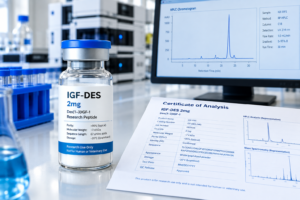
This page provides a research-focused overview of the IGF-DES peptide sequence, sequence length, molecular structure, molecular-weight considerations, analytical characterization, HPLC/COA documentation, and frequently asked questions.
What Is IGF-DES?
IGF-DES is a truncated form of insulin-like growth factor 1. The designation Des(1-3)IGF-1 indicates that residues 1 through 3 of the mature IGF-1 chain have been removed.
The three deleted residues are:
- Glycine (Gly/G)
- Proline (Pro/P)
- Glutamic acid (Glu/E)
Together, these form the N-terminal tripeptide:
GPE
After removal of GPE, the remaining sequence contains 67 amino acids. The literature describes Des(1-3)IGF-I as a truncated form of IGF-I and reports that it occurs naturally in biological systems.
From an SEO and laboratory-identification perspective, the terms IGF-DES, IGF-1 DES, and Des(1-3)IGF-1 are commonly used to refer to the same truncated sequence concept.
IGF-DES Peptide Sequence
Full 67-Amino-Acid Sequence
The commonly reported IGF-DES sequence is:
TLCGAELVDALQFVCGDRGFYFNKPTGYGSSSRRAPQTGIVDECCFRSCDLRRLEMYCAPLKPAKSAThis sequence contains 67 amino acids and corresponds to the mature human IGF-1 sequence after removal of the N-terminal GPE tripeptide.
Sequence in One-Letter Code
TLCGAELVDALQFVCGDRGFYFNKPTGYGSSSRRAPQTGIVDECCFRSCDLRRLEMYCAPLKPAKSA
Sequence Characteristics
| Property | IGF-DES |
|---|---|
| Common name | IGF-DES |
| Literature designation | Des(1-3)IGF-1 / Des(1-3)IGF-I |
| Parent protein | Human IGF-1 |
| Sequence relationship | IGF-1 residues 4–70 |
| Length | 67 amino acids |
| Deleted residues | Gly-Pro-Glu |
| N-terminal residue | Threonine |
| Structural class | Truncated IGF-1 variant |
| Disulfide bonds | Three intramolecular disulfide bonds in the native fold |
| Approximate mass | ~7.4 kDa, depending on molecular form |
The sequence and residue boundaries are the most useful starting points for confirming the identity of an IGF-DES research material.
IGF-DES vs. Full-Length IGF-1 Sequence
One of the easiest ways to understand the IGF-DES peptide sequence is to compare it with mature IGF-1.
The mature IGF-1 sequence begins:
GPE...TLCGAELVDALQFVCGDRGFYFNKPT...IGF-DES begins:
TLCGAELVDALQFVCGDRGFYFNKPT...The difference is therefore concentrated at the N-terminus.
Full-Length IGF-1
GPE + IGF-DES sequenceIGF-DES
IGF-1 residues 4–70This is why the peptide is called Des(1-3)IGF-1: the first three residues of mature IGF-1 are absent.
The scientific literature has specifically described Des(1-3)IGF-I as an IGF-I variant in which the tripeptide Gly-Pro-Glu is absent from the N-terminus.
Why the IGF-DES Sequence Matters in Research
Sequence information is fundamental when working with synthetic or recombinant research peptides.
For IGF-DES, sequence confirmation can support several laboratory activities:
1. Identity Confirmation
A peptide’s amino acid sequence provides its primary structural identity. Analytical laboratories can compare expected molecular characteristics against experimental measurements.
2. Mass-Spectrometry Analysis
The sequence can be used to calculate theoretical molecular masses and expected charge-state distributions. Experimental mass-spectrometry data can then be compared with theoretical values.
3. HPLC Characterization
Reverse-phase HPLC can be used to examine chromatographic purity and related components. Sequence identity and analytical purity are separate measurements and should not be treated as interchangeable.
4. Research Documentation
A precise sequence is useful when documenting experimental materials, analytical methods, reference compounds, or batch-specific characterization.
5. Comparison With Related IGF Peptides
Researchers may compare IGF-DES with:
- Full-length IGF-1
- IGF-1 LR3
- Other IGF-1 analogues
- Truncated IGF-1 variants
- Synthetic peptide fragments
The sequence provides a clear molecular basis for distinguishing related compounds.
IGF-DES Molecular Structure
IGF-DES is derived from the mature IGF-1 structure but lacks the first three N-terminal residues.
The remaining 67-residue chain contains multiple cysteine residues that participate in the characteristic disulfide-bonded structure associated with IGF-1.
For the native-style oxidized form, three intramolecular disulfide bonds are retained. This structural feature is important because simply matching a linear amino acid sequence does not fully establish the three-dimensional or oxidation state of a peptide material.
Consequently, research-grade characterization can involve multiple analytical approaches rather than sequence information alone.
A useful analytical identity package may include:
- Amino acid sequence
- Molecular-mass determination
- HPLC chromatographic profile
- Mass spectrometry
- Batch or lot information
- Certificate of Analysis (COA)
- Appropriate storage documentation
IGF-DES Molecular Weight
Published reference sources report IGF-DES at approximately 7.4 kDa, but the exact numerical value depends on how molecular mass is defined and the molecular form being considered.
Some reference calculations report approximately 7,365 Da for the oxidized three-disulfide form, while other sources report values around 7,371 Da under different molecular assumptions.
This distinction is important when creating an analytical specification.
A laboratory should distinguish between:
- Average molecular weight
- Monoisotopic mass
- Reduced molecular form
- Oxidized/disulfide-bonded form
- Salt or counter-ion form
- Experimentally observed mass
For an SEO product or research page, a safe description is:
“IGF-DES is a 67-amino-acid truncated IGF-1 variant with an approximate molecular mass of 7.4 kDa.”
The exact value for a particular material should be taken from its applicable analytical documentation.
IGF-DES and Disulfide Bonds
Cysteine residues are a significant feature of the IGF-DES sequence.
The sequence contains several cysteine residues that participate in intramolecular disulfide bonding in the folded IGF-1 family structure. Reference descriptions identify three intrachain disulfide bonds in the native-style structure.
This matters for analytical research because the same amino acid composition can produce different observed molecular characteristics depending on oxidation and folding state.
For this reason, researchers evaluating IGF-DES should distinguish between:
Primary sequence:
The order of amino acids.
Secondary/tertiary structure:
How the chain folds.
Disulfide connectivity:
How cysteine residues form intramolecular bonds.
Analytical identity:
Whether experimental measurements correspond to the expected molecular material.
IGF-DES HPLC Analysis
HPLC, particularly reversed-phase HPLC, is commonly used in peptide characterization to assess chromatographic purity and identify related peaks.
For an IGF-DES research material, an HPLC record may show:
- Main peptide peak
- Retention time
- Integrated peak area
- Relative percentage area
- Related impurities
- Chromatographic conditions
Importantly, HPLC purity is not identical to sequence confirmation.
A material can show a dominant chromatographic peak while still requiring mass-spectrometry or another analytical method for stronger identity confirmation.
A comprehensive analytical approach can therefore combine:
HPLC + mass spectrometry + batch documentation.
Some publicly available analytical records for IGF-DES demonstrate the use of chromatographic and mass-spectrometric measurements to characterize the compound and distinguish it from related molecular species.
For a product page, avoid publishing a specific purity percentage unless that number is supported by the applicable batch COA.
IGF-DES COA: What Researchers Should Look For
A Certificate of Analysis (COA) provides batch-specific analytical information.
For IGF-DES, useful documentation may include:
Identity
Documentation showing that the tested material corresponds to the intended research compound.
Purity
A reported analytical purity value, preferably accompanied by the method used to determine it.
Molecular Mass
An experimentally determined mass or mass-spectrum interpretation where applicable.
HPLC
Chromatographic purity data and associated analytical conditions.
Batch Information
A lot or batch number that connects the analytical report to the supplied material.
Testing Date
The date associated with the analytical evaluation.
Storage Information
Appropriate product-specific storage information supplied by the manufacturer or laboratory.
For SEO purposes, the phrase “IGF-DES COA” can be naturally incorporated into a quality-documentation section without making unsupported claims about a specific batch.
IGF-DES Research Applications
IGF-DES has been investigated as a truncated IGF-I variant, particularly in research examining the relationship between IGF-I structure, IGF-binding proteins, and cellular signaling.
The absence of the N-terminal GPE sequence has been associated in the literature with substantially reduced interaction with IGF-binding proteins compared with full-length IGF-I. Research has used the variant to investigate how structural changes can influence the biological behavior of IGF-I-related molecules.
Potential laboratory research areas include:
- IGF-related molecular biology
- Peptide structure-function studies
- Receptor-signaling research
- IGF-binding-protein research
- Comparative peptide characterization
- Cell-based research models
- Analytical chemistry
- Protein and peptide characterization
These descriptions refer to research contexts rather than therapeutic or clinical applications.
IGF-DES Research-Use Wording
For a U.S.-focused research product page, the following wording can be used:
Research Use Only
IGF-DES is supplied as a research-use laboratory material for qualified scientific research, analytical characterization, peptide identification, and controlled in-vitro research workflows. It is not represented as a drug, dietary supplement, diagnostic product, or medical treatment. This material is not intended for human or veterinary use. Researchers are responsible for following applicable institutional, laboratory, safety, and regulatory requirements.
This wording helps maintain a clear distinction between laboratory research information and medical or therapeutic claims.
How to Identify IGF-DES by Sequence
A straightforward sequence-identification workflow can begin with the following reference sequence:
TLCGAELVDALQFVCGDRGFYFNKPTGYGSSSRRAPQTGIVDECCFRSCDLRRLEMYCAPLKPAKSAResearchers can then compare the expected sequence with available analytical information.
Step 1: Confirm the N-Terminal Truncation
Look for the absence of:
GPEThe IGF-DES sequence begins with:
TLC...Step 2: Confirm the 67-Residue Length
The sequence should contain 67 amino acids.
Step 3: Compare Molecular-Mass Data
The expected mass is approximately 7.4 kDa, with the exact value dependent on molecular form and analytical convention.
Step 4: Review HPLC Data
Examine the primary chromatographic peak and reported purity.
Step 5: Review Mass-Spectrometry Data
Where available, compare the experimentally determined mass with the theoretical molecular mass.
Step 6: Connect Results to the Batch
Analytical results should correspond to the actual lot or batch under evaluation.
IGF-DES Sequence and Related Keywords
For search optimization, the main keyword should remain IGF-DES peptide sequence, while related terms can be incorporated naturally.
Recommended keyword cluster:
| Keyword | Search Intent |
|---|---|
| IGF-DES peptide sequence | Informational |
| IGF-1 DES sequence | Informational |
| Des(1-3)IGF-1 sequence | Informational |
| IGF-DES amino acid sequence | Informational |
| IGF-DES molecular weight | Informational |
| IGF-DES molecular structure | Informational |
| IGF-DES 67 amino acids | Informational |
| IGF-DES research peptide | Commercial/informational |
| IGF-DES HPLC | Analytical |
| IGF-DES COA | Commercial/quality |
| IGF-DES purity | Analytical/commercial |
| IGF-1 residues 4–70 | Informational |
The page should prioritize natural usage rather than repeating the exact focus keyword in every paragraph.
Frequently Asked Questions
What is the IGF-DES peptide sequence?
The commonly reported IGF-DES sequence is:
TLCGAELVDALQFVCGDRGFYFNKPTGYGSSSRRAPQTGIVDECCFRSCDLRRLEMYCAPLKPAKSAIt contains 67 amino acids and corresponds to residues 4–70 of mature human IGF-1.
How many amino acids are in IGF-DES?
IGF-DES contains 67 amino acids. It is three residues shorter than mature human IGF-1 because the N-terminal GPE sequence has been removed.
What does Des(1-3)IGF-1 mean?
The designation means that residues 1 through 3 of mature IGF-1 are absent. Those residues are glycine, proline, and glutamic acid.
What is the difference between IGF-1 and IGF-DES?
IGF-DES is a truncated IGF-1 variant. The first three N-terminal amino acids, GPE, are absent from IGF-DES.
What is the molecular weight of IGF-DES?
IGF-DES has an approximate molecular mass of 7.4 kDa. Exact reported values can vary depending on whether the source reports average, monoisotopic, reduced, oxidized, or salt-associated molecular mass.
Does IGF-DES have disulfide bonds?
The native-style folded form contains three intramolecular disulfide bonds, consistent with the IGF-1 family structure.
What is IGF-DES used for in research?
IGF-DES has been studied as a truncated IGF-I variant in research involving IGF structure-function relationships, IGF-binding proteins, receptor signaling, and cellular models.
Is IGF-DES a medicine?
This page describes IGF-DES as a research compound. Research materials should not be represented as approved medicines or as substitutes for clinically approved products.
What does IGF-DES HPLC measure?
HPLC can be used to evaluate chromatographic purity and related components. HPLC results should be interpreted together with identity and mass-spectrometry information when available.
What should an IGF-DES COA contain?
A useful COA may include batch identification, analytical purity, identity testing, molecular-mass information, HPLC results, testing dates, and other applicable quality-control information.