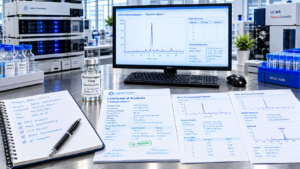
What Is Thymosin Alpha-1 HPLC?
Thymosin Alpha-1 HPLC refers to the use of high-performance liquid chromatography to analyze a sample of Thymosin Alpha-1 and characterize its chromatographic profile.
HPLC is widely used in peptide analytical chemistry because it can separate compounds and related components within a sample. The resulting chromatogram can provide information about the main peptide peak, retention behavior, and detectable secondary peaks.
For research-peptide quality evaluation, HPLC is particularly useful for examining chromatographic purity.
However, HPLC should not be treated as a complete characterization method by itself.
A comprehensive analytical approach may combine:
- HPLC for chromatographic purity
- Mass spectrometry for molecular identity
- COA documentation for traceability
- Lot numbers for batch identification
- Additional analytical methods where appropriate
Historical scientific work also demonstrates the long-standing use of HPLC in Thymosin Alpha-1 research. A 1983 study used high-performance liquid chromatography to isolate and analyze Thymosin Alpha-1 from thymosin fraction preparations.
Why HPLC Testing Matters for Thymosin Alpha-1
When evaluating a research peptide, the product label alone provides limited analytical information.
A label might identify:
Thymosin Alpha-1 — 10mg
But it does not necessarily answer:
- What is the chromatographic purity?
- Which lot was tested?
- Was molecular identity confirmed?
- What analytical method was used?
- When was the material tested?
- Are secondary peaks visible?
- Is the result batch-specific?
HPLC can address one important part of this evaluation: the chromatographic profile.
A researcher reviewing a Thymosin Alpha-1 COA can therefore look beyond a simple purity percentage and examine whether supporting chromatographic information is available.
This makes Thymosin Alpha-1 HPLC a valuable analytical-intent keyword for a research-focused SEO page.
How HPLC Works for Peptide Analysis
High-performance liquid chromatography separates chemical components as a sample passes through a chromatographic system.
A simplified HPLC workflow involves:
- Preparing the analytical sample
- Injecting the sample into the HPLC system
- Passing the sample through a chromatographic column
- Separating components according to their interactions with the stationary and mobile phases
- Detecting separated components
- Recording the resulting chromatogram
- Calculating or reporting chromatographic results
For peptide analysis, reversed-phase HPLC is commonly used because peptide components can be separated according to differences in hydrophobic interactions.
The precise method depends on the analytical laboratory, peptide, column, mobile phase, detector, and validated or qualified procedure.
Thymosin Alpha-1 HPLC Chromatogram
A Thymosin Alpha-1 chromatogram is the graphical output generated during chromatographic analysis.
A typical chromatogram contains peaks corresponding to components detected during the analytical run.
Researchers may examine:
- Main peak
- Retention time
- Peak area
- Secondary peaks
- Baseline
- Resolution
- Detection wavelength
- Total chromatographic profile
The main peak is generally associated with the target compound under the specified analytical method.
However, chromatographic interpretation requires context.
A peak does not automatically identify a compound merely because it appears on the chromatogram. Identity confirmation generally requires complementary analytical evidence, such as mass spectrometry.
What Does Thymosin Alpha-1 HPLC Purity Mean?
One of the most common questions is:
What does HPLC purity actually measure?
HPLC purity generally describes the proportion of chromatographic signal attributed to the target peak under a particular analytical method.
For example, a COA might report a result such as:
Peptide purity by HPLC: ≥X%
The exact result and specification depend on the laboratory and test method.
An important distinction is:
Chromatographic purity is not automatically the same as total peptide content.
The FDA’s published example COA for Thymosin Alpha-1 acetate illustrates this distinction. The document separately reports peptide purity by HPLC and an assay on an anhydrous, acetic-acid-free basis. The example reports 98.3% HPLC peptide purity and 98.0% assay.
This is an important SEO and scientific point.
A page should not describe an HPLC percentage as though it automatically represents every quality attribute of the material.
HPLC Purity vs Peptide Content
Researchers should distinguish between purity and content/assay.
HPLC Purity
This generally relates to chromatographic separation and the relative signal associated with the target peak.
Assay or Content
This may address how much target material is present according to a different analytical calculation or methodology.
The two measurements can therefore produce different values.
The FDA example for Thymosin Alpha-1 acetate demonstrates this distinction directly by reporting separate HPLC purity and assay results.
For research documentation, the best practice is to report exactly what the analytical document says rather than converting one measurement into another.
Thymosin Alpha-1 HPLC and Molecular Identity
HPLC primarily addresses chromatographic behavior and purity.
Molecular identity is a separate analytical question.
Thymosin Alpha-1 is a 28-amino-acid peptide. FDA technical documentation identifies the free-base molecular formula as C129H215N33O55 and molecular weight as approximately 3108.3 g/mol.
A researcher can therefore use complementary mass-spectrometry information to support the expected molecular identity.
A simplified analytical framework is:
| Test | Primary Information |
|---|---|
| HPLC | Chromatographic purity |
| Mass spectrometry | Molecular-mass/identity evidence |
| COA | Documented analytical results |
| Lot number | Batch traceability |
| Additional testing | Other specified quality attributes |
This separation of analytical roles makes research documentation easier to interpret.
Thymosin Alpha-1 HPLC and Mass Spectrometry
Mass spectrometry is particularly useful as a complementary technique for synthetic peptide characterization.
A recent analytical methods publication describes mass spectrometry as an important method for evaluating the authenticity and integrity of synthetic peptides, with approaches including LC-MS and MALDI-TOF-MS.
For Thymosin Alpha-1, researchers may therefore look for:
HPLC → chromatographic purity
MS → molecular identity
This combination provides more information than either result alone.
It is also useful for SEO because it connects the main keyword to related search terms:
- Thymosin Alpha-1 HPLC
- Thymosin Alpha-1 mass spectrometry
- Thymosin Alpha-1 LC-MS
- Thymosin Alpha-1 purity testing
- Thymosin Alpha-1 COA
What Does a Thymosin Alpha-1 HPLC Report Show?
A detailed HPLC report may include several pieces of information.
Product or Sample Identification
The report should identify the analyzed sample.
Sample or Lot Number
A lot number can connect the chromatogram to the specific material tested.
Analytical Method
The document may describe the chromatographic method.
Column
The report may identify the chromatographic column used.
Detection
The detection wavelength or detector type may be specified.
Retention Time
The report can provide the retention time of the principal peak.
Peak Area
Peak areas may be used in purity calculations.
Chromatogram
The graphical chromatogram provides a visual representation of the analytical run.
The exact reporting format differs between laboratories.
How to Read a Thymosin Alpha-1 Chromatogram
A researcher evaluating a chromatogram can begin with several basic questions.
1. Where is the main peak?
Identify the principal chromatographic peak associated with the target material.
2. Is the peak well resolved?
Look at whether nearby peaks are separated from the principal peak.
3. Are secondary peaks visible?
Additional peaks can indicate other detectable chromatographic components, although their identity cannot necessarily be determined from the chromatogram alone.
4. What is the retention time?
Compare the reported retention time with the laboratory’s established reference or method.
5. What detector was used?
Check the detection method and wavelength where reported.
6. How was purity calculated?
Determine whether the report uses area normalization or another analytical approach.
A chromatogram should therefore be interpreted as part of a broader analytical package rather than as a standalone guarantee of material quality.
Does a High HPLC Percentage Mean Higher Overall Quality?
Not necessarily.
A high chromatographic purity result can be useful, but quality involves multiple attributes.
For example, researchers may also need to consider:
- Identity
- Peptide content
- Related substances
- Water content
- Residual solvents
- Counterions
- Aggregation
- Endotoxin
- Microbial characteristics
- Stability
- Batch consistency
The relevant tests depend on the intended laboratory application.
The FDA’s discussion of Thymosin Alpha-1 specifically highlights complexities involving peptide-related impurities and API characterization.
Therefore, an HPLC result should be interpreted according to its actual scope.
Thymosin Alpha-1 HPLC and COA Documentation
A Certificate of Analysis brings analytical results into a traceable document.
A Thymosin Alpha-1 COA may contain:
- Product name
- Lot number
- Manufacturing date
- Testing date
- HPLC purity
- Molecular weight
- Identity result
- Assay/content
- Additional quality tests
- Laboratory information
- Acceptance specifications
The FDA-published example of a Thymosin Alpha-1 acetate COA contains product identity, manufacturing information, lot number, molecular weight, peptide purity by HPLC, assay, water content, acetate content, and other specifications.
This makes the COA an important companion to HPLC data.
How to Verify a Thymosin Alpha-1 HPLC COA
For research documentation, use a simple verification process.
Check the Product Name
Confirm that the COA refers specifically to Thymosin Alpha-1.
Check the Chemical Form
Determine whether the documentation refers to free base, acetate, or another stated form.
Check the Lot Number
Match the lot number to the material being evaluated.
Check the Test Date
Determine when the analytical work was performed.
Check the Laboratory
Look for information identifying the analytical source.
Check the HPLC Result
Review the stated purity and method.
Check Supporting Identity Data
Look for mass spectrometry or other identity information where available.
Check Additional Tests
Determine which other attributes were actually measured.
This process is more informative than simply asking whether a product “has a COA.”
Thymosin Alpha-1 HPLC and Chemical Form
Chemical form is particularly important when evaluating analytical results.
FDA materials identify Thymosin Alpha-1 as a 28-amino-acid peptide and distinguish information concerning the free base from the acetate form. The FDA-published COA example is specifically for Thymosin α1 acetate and reports a molecular weight of 3108.3 for the peptide specification.
Researchers comparing HPLC or mass-spectrometry results should therefore check the exact form named in the documentation.
This can help prevent confusion when comparing:
- Free-base references
- Acetate forms
- Salt-associated material
- Different analytical conventions
Chemical identity should always be tied to the specific material and analytical method.
Thymosin Alpha-1 HPLC Research Applications
HPLC analysis of Thymosin Alpha-1 can support a variety of laboratory research activities, including:
- Peptide characterization
- Analytical method development
- Purity assessment
- Batch comparison
- Stability research
- Reference-material characterization
- Chromatographic method optimization
- Peptide chemistry studies
- Quality-control research
Historical research demonstrates that HPLC has been used to isolate and characterize Thymosin Alpha-1, establishing its relevance to the peptide’s analytical history.
Researchers should select analytical methods according to their specific scientific objectives and laboratory requirements.
Thymosin Alpha-1 HPLC for Batch Comparison
Batch-to-batch comparison can be valuable in research environments.
Suppose two lots are both described as Thymosin Alpha-1.
Researchers can compare documented:
- HPLC purity
- Chromatographic profile
- Retention behavior
- Molecular identity
- Assay/content
- Additional analytical data
The goal is not simply to identify the batch with the largest purity percentage.
Instead, researchers can examine whether the analytical profiles and documentation are consistent with the experimental requirements.
This approach creates a more rigorous quality-control record.
Why HPLC Alone Is Not Complete Characterization
HPLC is powerful, but no single analytical test necessarily answers every quality question.
For example, HPLC may provide chromatographic information while leaving other questions about:
- Molecular identity
- Peptide content
- Aggregate formation
- Residual solvents
- Water
- Endotoxin
- Microbial characteristics
- Elemental impurities
depending on the analytical scope.
The FDA’s Thymosin Alpha-1 documentation is particularly relevant because it discusses peptide-related impurities and aggregation as characterization considerations.
A responsible research page should therefore avoid statements such as:
“HPLC proves the peptide is completely pure.”
A more accurate statement is:
“HPLC provides chromatographic purity information under the stated analytical method.”
Thymosin Alpha-1 HPLC and U.S. Research Content
For a U.S.-targeted research-peptide website, analytical content should distinguish laboratory research from clinical or therapeutic use.
Thymosin Alpha-1 has a substantial scientific history, but the existence of scientific studies does not establish that a particular commercial research material is approved for human use.
FDA currently identifies safety-related uncertainties concerning compounded Thymosin Alpha-1, including concerns about immunogenicity and peptide-related impurities/API characterization.
Accordingly, SEO content should focus on:
- Analytical testing
- Chemical identity
- Chromatographic purity
- COA documentation
- Research literature
- Laboratory characterization
- Batch traceability
rather than making therapeutic or administration claims.
Thymosin Alpha-1 HPLC Quality Checklist
Researchers evaluating an HPLC report can use this checklist:
☐ Correct compound identified
☐ Chemical form identified
☐ Lot or sample number documented
☐ HPLC method identified
☐ Column information available where appropriate
☐ Detector information available
☐ Retention time reported
☐ Main peak identified
☐ Secondary peaks visible or addressed
☐ Purity calculation explained
☐ Chromatogram available
☐ Test date documented
☐ Laboratory identified
☐ Supporting identity testing available
☐ COA corresponds to the same lot
This checklist can also be adapted for individual Peptides Grey House product pages.
Frequently Asked Questions
What is Thymosin Alpha-1 HPLC?
Thymosin Alpha-1 HPLC is a chromatographic analytical method used to evaluate the separation profile and chromatographic purity of a Thymosin Alpha-1 sample.
What does HPLC purity mean?
HPLC purity generally describes the proportion of chromatographic signal associated with the target peak under a specified analytical method.
Does HPLC confirm Thymosin Alpha-1 identity?
HPLC can support characterization, but molecular identity is a separate analytical question. Mass spectrometry can provide complementary molecular-mass evidence.
What does a Thymosin Alpha-1 chromatogram show?
A chromatogram displays detected components as peaks and can show the principal peak, retention time, secondary peaks, and other features of the analytical separation.
Is HPLC the same as an assay?
Not necessarily. HPLC purity and assay/content can represent different analytical measurements. FDA’s published Thymosin Alpha-1 acetate COA provides separate HPLC purity and assay results.
What is the molecular weight of Thymosin Alpha-1?
FDA technical materials identify the free-base molecular weight as approximately 3108.3 g/mol.
Why should HPLC be combined with mass spectrometry?
HPLC primarily provides chromatographic information, while mass spectrometry can provide molecular-mass evidence supporting identity. Using complementary methods can provide a broader analytical picture.
Does a high HPLC purity percentage guarantee complete quality?
No. HPLC purity is one analytical attribute. Other quality questions may require additional testing.
What should I look for on a Thymosin Alpha-1 HPLC report?
Look for the sample or lot identifier, analytical method, chromatogram, retention time, purity calculation, test date, laboratory information, and supporting identity data.
Why is a lot number important?
A lot number connects the analytical result to a particular batch of material, improving traceability.
Does Thymosin Alpha-1 HPLC have a long research history?
Yes. HPLC was used in early research to isolate and analyze Thymosin Alpha-1 from thymosin preparations.
Is a research peptide HPLC report evidence of therapeutic effectiveness?
No. HPLC provides analytical information about the tested material. It does not establish therapeutic efficacy or human-use approval.
Research-Use Wording
Research Use Only
The information on this page is provided for lawful laboratory, analytical, educational, and scientific research purposes. Thymosin Alpha-1 research materials and HPLC testing information are not intended for human or veterinary use, consumption, diagnosis, treatment, cure, or prevention of disease.
HPLC results describe chromatographic characteristics under the stated analytical method. HPLC purity should not automatically be interpreted as total peptide content, complete impurity characterization, sterility, or therapeutic suitability.
Researchers are responsible for evaluating research materials according to their intended laboratory application and for complying with applicable laws, institutional requirements, laboratory procedures, and appropriate safety practices.