

What Is Kisspeptin 10mg?
Kisspeptin 10mg refers to a research-material quantity of Kisspeptin-10 (KP-10), a synthetic decapeptide used in laboratory research involving the kisspeptin/KISS1R signaling system.
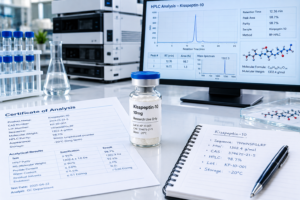
For U.S. researchers searching for Kisspeptin 10mg USA, the most useful product information is generally not simply the quantity listed on a vial. Researchers evaluating peptide material may also need information about identity, sequence, molecular weight, purity, analytical testing, lot traceability, storage, and Certificate of Analysis documentation.
Kisspeptin-10 is a 10-amino-acid peptide. PubChem identifies the human form with the sequence YNWNSFGLRF, molecular formula C63H83N17O14, and calculated molecular weight of approximately 1302.4 g/mol.
The “10mg” designation describes the nominal amount of material in a research package. It should not be interpreted as a recommended human dose, treatment amount, or administration instruct
ion.
For laboratory applications, the distinction between research quantity and clinical dosage is particularly important. Kisspeptin-10 is a subject of scientific investigation, and U.S. regulatory documentation distinguishes investigational or research material from FDA-approved drug products.
Kisspeptin 10mg USA Research Material
Researchers searching for Kisspeptin 10mg USA may use several different phrases when looking for analytical-grade peptide material:
- Kisspeptin 10mg
- Kisspeptin-10 USA
- Kisspeptin research peptide
- Kisspeptin 10mg research
- KP-10 research peptide
- Kisspeptin laboratory research
- Kisspeptin research material
- Kisspeptin COA
- Kisspeptin HPLC
- Kisspeptin purity
- Kisspeptin molecular weight
- Kisspeptin peptide sequence
These searches generally reflect an interest in identity, analytical quality, documentation, and research suitability rather than simply the quantity of peptide.
A high-quality research-material page should therefore provide transparent information about the material being offered, including its chemical identity and available analytical documentation.
For Peptides Grey House, the strongest SEO approach is to build the page around factual laboratory information rather than unsupported claims about biological outcomes.
Kisspeptin-10 Peptide Sequence
The human Kisspeptin-10 sequence is:
YNWNSFGLRF
The corresponding structural description is:
H-Tyr-Asn-Trp-Asn-Ser-Phe-Gly-Leu-Arg-Phe-NH2
PubChem lists Kisspeptin-10 as human metastin 45–54 and provides the decapeptide sequence and C-terminal amide structure.
The sequence is important when researchers compare:
- Peptide identity
- Synthetic material
- Reference standards
- Mass-spectrometry results
- Expected molecular mass
- HPLC profiles
- Different kisspeptin preparations
- Species-specific kisspeptin sequences
Researchers should avoid assuming that all products labeled “Kisspeptin-10” have identical analytical characteristics without checking the actual molecular form.
For example, PubChem separately lists human Kisspeptin-10 associated with trifluoroacetic acid (TFA), which has a substantially different calculated molecular weight because the salt/form composition is different.
This distinction matters when interpreting mass-spectrometry results or comparing a supplier’s specification with a database reference.
Kisspeptin 10mg Molecular Weight
The molecular weight of human Kisspeptin-10 is approximately:
1302.4 g/mol
PubChem reports:
- Molecular formula: C63H83N17O14
- Molecular weight: 1302.4 g/mol
- Exact/monoisotopic mass: 1301.63054039 Da
- Sequence: YNWNSFGLRF
- CAS number: 374675-21-5
Small differences in reported molecular weight can occur depending on whether a source describes the peptide itself, a salt form, counterion, hydration state, or another molecular representation.
For example, PubChem reports a molecular weight of approximately 1416.5 g/mol for human Kisspeptin-10 TFA.
Consequently, a laboratory should compare the molecular form specified on its documentation with the reference material used for analytical testing.
Kisspeptin-10 Molecular Data
| Property | Human Kisspeptin-10 |
|---|---|
| Peptide | Kisspeptin-10 / KP-10 |
| Sequence | YNWNSFGLRF |
| Formula | C63H83N17O14 |
| Molecular Weight | ~1302.4 g/mol |
| Exact Mass | 1301.63054039 Da |
| CAS | 374675-21-5 |
| Structure | C-terminally amidated decapeptide |
Source: PubChem.
Kisspeptin HPLC Testing
High-performance liquid chromatography (HPLC) is one of the most useful analytical techniques for evaluating peptide purity profiles.
For Kisspeptin 10mg research material, HPLC information can help researchers assess the chromatographic profile of a particular lot.
A useful Kisspeptin HPLC report may include:
- HPLC method
- Column information
- Detection wavelength
- Retention time
- Main peak
- Area percentage
- Related peaks
- Reported purity
- Testing date
- Lot number
A published FDA Pharmacy Compounding Advisory Committee document includes an example lot-specific Kisspeptin-10 COA supplied during its evaluation. That example reported 98.9% HPLC purity for the specific lot examined.
Importantly, that value should not be presented as the purity of every Kisspeptin-10 product or as a Peptides Grey House batch result. It is an example from FDA committee materials.
This distinction is essential for responsible SEO and scientific communication.
Why HPLC Matters
HPLC can help researchers investigate whether the principal chromatographic peak corresponds with the expected peptide material and identify additional chromatographic components.
However, HPLC percentage alone does not establish every aspect of peptide quality.
For example, HPLC purity does not automatically establish:
- Correct molecular identity
- Complete sequence confirmation
- Sterility
- Endotoxin status
- Biological activity
- Absence of every possible impurity
- Suitability for human administration
A robust quality program may therefore combine HPLC with additional analytical techniques.
Kisspeptin COA: Certificate of Analysis
A Certificate of Analysis (COA) provides lot-specific analytical information about a material.
For Kisspeptin 10mg USA research material, researchers should look for documentation containing information such as:
- Product name
- Lot or batch number
- Molecular formula
- Peptide sequence
- Molecular-weight result
- HPLC purity
- Appearance
- Testing date
- Analytical methods
- Storage recommendations
- Manufacturer or testing laboratory
- Relevant quality-control information
The FDA committee document cited above includes an example Kisspeptin-10 COA containing molecular-weight testing by mass spectrometry, HPLC retention-time information, HPLC purity, related substances, peptide content, water content, residual-solvent testing, and bacterial-endotoxin testing.
Again, these are example results from a specific lot documented in the FDA material, not universal specifications.
What Researchers Should Check on a Kisspeptin COA
Before using a peptide in laboratory work, researchers can compare the COA against their experimental requirements.
Important questions include:
- Does the product name match the requested peptide?
- Is the sequence clearly identified?
- Is the lot number present?
- Does the molecular-weight result align with the expected molecular form?
- Is an HPLC result provided?
- Are analytical methods identified?
- Is the testing date available?
- Are storage conditions documented?
- Does the documentation correspond to the actual lot being evaluated?
Lot-level traceability is particularly valuable because analytical results can differ between production batches.
Kisspeptin Purity and Analytical Quality
The term “purity” should be interpreted in the context of the analytical method used.
For peptide research, researchers may encounter terms including:
- HPLC purity
- Chemical purity
- Peptide content
- Related substances
- Residual solvents
- Water content
- Mass-spectrometry confirmation
These measurements describe different characteristics.
For example, an HPLC result represents chromatographic purity under the stated analytical conditions. Peptide content can represent another measurement and should not automatically be treated as interchangeable with HPLC purity.
A strong Kisspeptin 10mg USA product page should therefore avoid simplistic statements such as “purity guarantees performance.”
Instead, it should explain which analytical measurements are available and encourage researchers to review the actual batch documentation.
Mass Spectrometry and Kisspeptin-10 Identity
Mass spectrometry can provide molecular-mass information useful for peptide characterization.
For Kisspeptin-10, the expected molecular mass depends on the precise molecular form being tested.
PubChem lists the human Kisspeptin-10 exact mass as 1301.63054039 Da, while its calculated average molecular weight is approximately 1302.4 g/mol.
A laboratory evaluating MS data should therefore consider:
- Expected molecular form
- Theoretical molecular mass
- Observed mass
- Instrument tolerance
- Charge state
- Counterions or salts
- Sample preparation
- Calibration
- Analytical method
Mass spectrometry and HPLC provide complementary information. One can provide molecular-mass evidence while the other provides chromatographic information.
Using multiple analytical methods can provide a more complete picture of a research material than relying on a single measurement.
Kisspeptin and KISS1R Research
Kisspeptin research is closely associated with the KISS1/KISS1R signaling system.
KISS1R, also known as GPR54, is a G-protein-coupled receptor associated with kisspeptin signaling. Scientific literature has investigated the pathway in areas including reproductive neuroendocrinology, gonadotropin signaling, and receptor biology.
Kisspeptin-10 is one of the shorter kisspeptin peptides used in experimental research. Reviews have discussed the relationship between kisspeptin peptides, KISS1R, and neuroendocrine signaling.
For SEO purposes, this creates several useful informational content clusters:
- Kisspeptin-10 peptide sequence
- Kisspeptin molecular weight
- Kisspeptin HPLC
- Kisspeptin COA
- Kisspeptin purity
- Kisspeptin mass spectrometry
- KISS1R research
- Kisspeptin receptor research
- Kisspeptin analytical testing
These supporting pages can build topical authority around the primary Kisspeptin 10mg USA page.
Kisspeptin 10mg USA: Quality Checklist
Researchers evaluating peptide research material can use a documentation-focused checklist.
1. Confirm Identity
Verify that the product is identified as Kisspeptin-10 and that the sequence corresponds to the intended molecular form.
2. Review Molecular Weight
Compare the reported molecular weight with a trusted chemical database and the specified molecular form.
3. Review HPLC Data
Look for an actual chromatographic result rather than relying solely on a generic purity statement.
4. Check the COA
The COA should correspond to the specific lot or batch.
5. Review MS Information
Mass-spectrometry data can provide useful molecular-weight confirmation.
6. Check Storage Documentation
Follow the storage information supplied for the actual material.
7. Maintain Lot Traceability
Record lot numbers and associated analytical documents in laboratory records.
8. Match Material to the Research Application
Researchers should independently determine whether a material meets the analytical requirements of their specific experiment.
Kisspeptin 10mg Storage Considerations
Peptides can be sensitive to environmental conditions, and storage recommendations should be based on the manufacturer’s validated documentation and the characteristics of the specific material.
An FDA committee document containing an example Kisspeptin-10 COA reported storage recommendations of 2–8°C for shorter-term storage and −20°C for longer-term storage for that particular material.
Researchers should not automatically transfer one supplier’s storage protocol to another product.
Instead, review:
- Product-specific storage instructions
- Container closure
- Lyophilized versus other forms
- Exposure to moisture
- Temperature history
- Lot documentation
- Manufacturer recommendations
Proper documentation helps laboratories maintain consistency when evaluating peptide stability.
U.S. Regulatory Context for Kisspeptin-10
The U.S. regulatory status of Kisspeptin-10 should be clearly distinguished from its status as a research compound.
In an October 2024 Pharmacy Compounding Advisory Committee document, FDA stated that Kisspeptin-10 was not a component of an FDA-approved drug and that there was no applicable USP/NF drug-substance monograph for the substance discussed in that evaluation.
FDA’s current information concerning certain bulk drug substances also identifies concerns related to compounded Kisspeptin-10, including potential immunogenicity concerns for certain routes and complexities involving peptide-related impurities and API characterization.
These regulatory considerations reinforce the importance of keeping research-material content separate from medical or therapeutic marketing.
For a U.S.-focused research website, language such as “research use only,” “laboratory research,” “analytical testing,” and “scientific investigation” is more appropriate than presenting a research peptide as an approved medicine.