

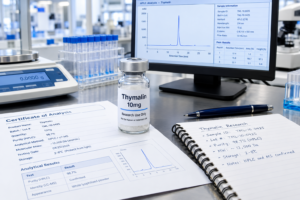
Thymalin 10mg is a research-oriented peptide material associated with laboratory investigations involving peptide chemistry, molecular biology, analytical characterization, and biological research. For researchers evaluating a peptide product, the amount listed on the label is only one part of the quality equation. Identity, purity, analytical documentation, storage conditions, and batch-level traceability can all influence how suitable a material is for laboratory work.
This guide explains the key considerations surrounding Thymalin 10mg, including peptide identity, analytical testing, HPLC documentation, COA review, molecular characteristics, storage considerations, and research-use limitations.
The information is intended for laboratory and scientific research contexts. Thymalin 10mg should not be presented as a medication, dietary supplement, or product for diagnosis, treatment, prevention, or mitigation of disease.
What Is Thymalin 10mg?
Thymalin is a peptide preparation historically associated with thymic peptide research. In modern research settings, materials described as Thymalin may require careful verification because terminology, composition, peptide identity, and product specifications can differ among suppliers.
The 10mg designation generally refers to the nominal quantity of material contained in the product. It does not by itself establish peptide purity, molecular identity, biological activity, sterility, or suitability for a particular experiment.
For researchers, a useful evaluation should therefore consider several independent characteristics:
- Product identity
- Batch or lot number
- Stated quantity
- Purity specification
- Analytical testing
- HPLC results
- Mass spectrometry or another identity method
- Certificate of Analysis (COA)
- Storage information
- Manufacturer or supplier documentation
- Research-use restrictions
A professionally documented research material should provide enough information for a researcher to determine what was supplied and how the batch was characterized.
Thymalin 10mg Research Applications
Research involving Thymalin-related materials can fall into several broad laboratory categories.
Peptide Chemistry
Peptide chemistry research examines characteristics such as molecular structure, composition, analytical behavior, and stability.
Researchers may investigate how peptide materials behave under controlled experimental conditions and compare analytical profiles between batches.
Analytical Research
Analytical laboratories can use chromatographic and spectrometric techniques to characterize peptide materials.
Common analytical approaches include:
- High-performance liquid chromatography (HPLC)
- Liquid chromatography–mass spectrometry (LC-MS)
- Mass spectrometry
- Chromatographic purity assessment
- Molecular-mass confirmation
The exact testing package depends on the supplier and intended research application.
Biochemical Research
Peptide materials may be incorporated into controlled biochemical research where researchers investigate molecular interactions or other experimentally defined characteristics.
Such research should be conducted according to appropriate laboratory procedures and institutional requirements.
Comparative Peptide Research
Thymalin may also be considered within broader research involving peptide materials. Researchers can compare analytical profiles, purity specifications, molecular characteristics, and documentation between different peptide products.
Thymalin 10mg Purity
Purity is one of the most important quality considerations when evaluating a research peptide.
A product labeled “high purity” should ideally be supported by analytical documentation rather than relying solely on marketing language.
For Thymalin 10mg, researchers should look for:
- Reported purity percentage
- Analytical method
- Chromatogram where available
- Lot number
- Testing date
- Sample identification
- Laboratory or testing organization
- Identity confirmation
- Molecular-mass information when applicable
Why Purity Matters in Research
Impurities can complicate experimental interpretation. Depending on the research system, unidentified components may introduce variables that make it harder to determine whether an observed analytical or experimental result is associated with the target material.
For that reason, researchers often evaluate purity alongside identity and batch documentation rather than treating purity as an isolated number.
Thymalin 10mg HPLC Testing
HPLC, or high-performance liquid chromatography, is widely used for analytical characterization of peptide materials.
A typical HPLC analysis separates chemical components according to their interaction with the chromatographic system. Researchers can then examine the resulting chromatogram to evaluate the principal peak and additional detectable components.
For a Thymalin 10mg research product, useful HPLC documentation may include:
- Chromatogram
- Reported purity
- Retention time
- Testing method
- Sample identification
- Batch or lot number
- Testing laboratory
- Date of analysis
A chromatogram should be interpreted together with the accompanying analytical report rather than viewed as an isolated image.
What Does HPLC Purity Mean?
HPLC purity is an analytical measurement associated with the chromatographic profile obtained under specified conditions.
It should not automatically be interpreted as:
- Proof of biological activity
- Proof of sterility
- Proof of endotoxin status
- Proof of suitability for human use
- Proof of stability over an extended period
These are separate quality considerations requiring appropriate testing.
Thymalin 10mg COA
A Certificate of Analysis (COA) is an important document for evaluating a research material.
A useful Thymalin 10mg COA may contain information such as:
| COA Field | Why It Matters |
|---|---|
| Product name | Identifies the tested material |
| Batch/Lot number | Connects the report to a specific production batch |
| Quantity | Documents the supplied amount |
| Purity | Provides analytical purity information |
| Analytical method | Shows how the result was obtained |
| Molecular mass | Can support identity characterization |
| Testing date | Establishes when analysis occurred |
| Laboratory information | Helps establish testing traceability |
Researchers should compare the lot number on the COA with the lot number associated with the actual product.
Why Batch Matching Matters
A generic COA does not necessarily characterize every production batch.
Batch-specific documentation can provide stronger traceability because the analytical result can be connected directly to the material being evaluated.
Thymalin Molecular Characteristics
Molecular information is another important component of peptide research.
Researchers evaluating Thymalin-related material may be interested in:
- Molecular composition
- Molecular mass
- Peptide sequence where applicable
- Chemical identity
- Analytical mass
- Expected chromatographic behavior
One important consideration is that Thymalin terminology may refer to a peptide preparation or peptide complex rather than a single universally defined synthetic peptide sequence. Consequently, researchers should not assume that every product marketed under the same name has identical molecular characteristics.
For this reason, supplier documentation and batch-specific analytical information should be reviewed carefully.
Thymalin 10mg and Mass Spectrometry
Mass spectrometry can complement chromatographic analysis by providing information related to molecular mass.
Where appropriate, LC-MS or another mass-spectrometric method can help researchers investigate whether an observed analytical component is consistent with the expected molecular characteristics of the target material.
A useful analytical report may include:
- Observed mass
- Expected mass
- Mass-to-charge ratio
- Analytical method
- Sample identification
- Instrument information
HPLC and mass spectrometry answer different analytical questions. HPLC primarily provides chromatographic separation and purity-related information, while mass spectrometry can contribute molecular-mass information.
Using complementary methods can provide a more informative characterization profile.
Thymalin 10mg Storage Considerations
Peptides can be sensitive to environmental conditions. Appropriate storage should therefore follow the supplier’s product-specific documentation.
Factors commonly considered in peptide storage research include:
- Temperature
- Moisture
- Light exposure
- Container integrity
- Repeated environmental changes
- Storage duration
Researchers should avoid assuming that one storage protocol applies to every peptide material.
The product documentation and COA should be reviewed for specific storage requirements.
Research Material Handling
Laboratories should maintain appropriate sample identification and documentation throughout the research process.
A useful record may include:
- Product name
- Batch number
- Date received
- Quantity received
- Storage location
- Analytical documentation
- Experimental reference
- Date opened, where applicable
This type of documentation improves laboratory traceability.
Thymalin 10mg Quality-Control Checklist
Before selecting a research peptide, researchers can evaluate the following areas.
1. Identity
Is the material clearly identified?
2. Batch Information
Is a lot or batch number available?
3. Purity
Is the purity value supported by analytical data?
4. HPLC
Is chromatographic testing documented?
5. Mass Spectrometry
Is molecular-mass characterization available where appropriate?
6. COA
Is a certificate of analysis available?
7. Documentation
Are testing methods and dates provided?
8. Storage
Are appropriate storage conditions documented?
9. Traceability
Can the analytical documentation be connected to the supplied batch?
10. Intended Use
Is the material clearly designated for legitimate laboratory research rather than human or veterinary use?
Thymalin 10mg for U.S. Research
Researchers in the United States should pay particular attention to product labeling and intended-use statements.
Research materials are not automatically equivalent to FDA-approved medicines or pharmaceutical products.
A research peptide should therefore not be marketed or represented as:
- A treatment
- A therapeutic product
- A prescription alternative
- A dietary supplement
- A product for self-administration
For U.S. laboratory buyers, product documentation, supplier transparency, labeling, shipping requirements, institutional policies, and applicable regulations should all be considered.
The appropriate compliance requirements can vary according to the laboratory, institution, research activity, and material involved.
Thymalin 10mg vs. Other Research Peptides
Thymalin can be evaluated alongside other research peptides, but researchers should avoid assuming that similarly named peptide products have identical properties.
Important comparison criteria include:
| Evaluation Area | Thymalin 10mg | Other Research Peptides |
|---|---|---|
| Product quantity | 10mg designation | Varies |
| Identity documentation | Should be verified | Should be verified |
| HPLC | Useful for characterization | Common analytical method |
| Mass spectrometry | Useful where applicable | Common complementary method |
| COA | Batch documentation recommended | Batch documentation recommended |
| Molecular information | Depends on material definition | Usually product-specific |
| Research status | Laboratory material | Product-specific |
The goal should be analytical comparability rather than simply comparing label quantities.
Buying Thymalin 10mg for Laboratory Research
When evaluating a Thymalin 10mg research material, researchers should focus on documentation rather than marketing claims.
A practical checklist includes:
Product identification:
Confirm the exact product name and quantity.
Batch traceability:
Check whether a batch or lot number is supplied.
COA availability:
Look for batch-specific analytical documentation.
Purity:
Review the reported purity and analytical method.
HPLC data:
Check whether chromatographic information is available.
Mass analysis:
Where applicable, examine molecular-mass characterization.
Storage:
Review the manufacturer’s storage instructions.
Research-use labeling:
Confirm that the product is clearly intended for laboratory research.
Supplier transparency:
Evaluate whether product specifications and analytical documentation are clearly presented.
Why Analytical Documentation Matters
A research peptide is more than a vial and a label.
For reproducible research, scientists need to understand what material entered an experiment. Documentation can help establish a connection between the product, batch, analytical result, and experimental record.
This is particularly important when research results need to be:
- Repeated
- Compared
- Audited
- Documented
- Published
- Investigated for unexpected variation
COA, HPLC, and mass-spectrometry documentation can therefore form part of a broader research-quality workflow.
Research-Use-Only Statement
Thymalin 10mg described on this page is discussed strictly in the context of laboratory and scientific research. It is not presented as a drug, medicine, dietary supplement, or therapeutic product. It is not intended for human or veterinary consumption, diagnosis, treatment, cure, or prevention of disease.
Researchers are responsible for following applicable laboratory procedures, institutional requirements, safety practices, and relevant laws and regulations.
Frequently Asked Questions
What is Thymalin 10mg?
Thymalin 10mg refers to a research material labeled as Thymalin with a nominal quantity of 10mg. Researchers should verify the exact composition and identity through supplier documentation and analytical testing.
Is Thymalin 10mg a research peptide?
It may be offered as a research peptide or peptide-related research material, but the exact nature of a product depends on its formulation and supplier documentation. Researchers should review the product specifications and COA.
What is Thymalin 10mg used for?
This page discusses Thymalin 10mg for laboratory research and analytical characterization. It does not provide instructions for human or veterinary use.
Does Thymalin 10mg come with a COA?
COA availability depends on the supplier and product. Researchers should look for batch-specific documentation containing product identification, purity, analytical methods, and lot information.
What is Thymalin purity?
Purity is an analytical measurement describing the proportion of the characterized target material relative to detected impurities under a specified testing method. The reported percentage should be interpreted alongside the analytical method.
Is HPLC testing important for Thymalin?
HPLC can be useful for chromatographic characterization and purity assessment. Researchers should review the complete chromatogram and associated analytical report where available.
Does mass spectrometry test Thymalin identity?
Mass spectrometry can provide molecular-mass information that may support identity characterization. It is generally most useful when interpreted alongside other analytical data.
What does 10mg mean?
The 10mg designation generally indicates the nominal quantity of material in the product. It does not by itself indicate purity, sterility, potency, or biological activity.
How should Thymalin 10mg be stored?
Storage requirements depend on the specific product and supplier instructions. Researchers should follow the documented storage conditions rather than applying a universal peptide-storage protocol.
Can Thymalin 10mg be used by humans?
This page does not recommend human use. The material is discussed strictly as a laboratory research product, and researchers should follow applicable regulations and product labeling.