

What Is the Thymalin Molecular Weight?
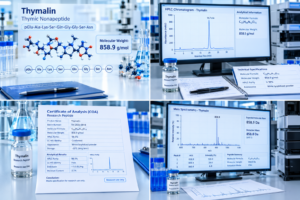
Researchers searching for Thymalin molecular weight will commonly encounter a value of approximately 858.9 g/mol. PubChem reports a molecular weight of 858.9 g/mol for nonathymulin, with the molecular formula C₃₃H₅₄N₁₂O₁₅, an exact mass of 858.38315906 Da, and the peptide sequence pGlu-Ala-Lys-Ser-Gln-Gly-Gly-Ser-Asn. PubChem also lists Thymalin among the synonyms for this compound.
However, there is an important terminology issue for anyone preparing a research database, product page, laboratory record, or certificate-of-analysis reference.
The name Thymalin has historically been used for a thymus-derived polypeptide preparation or complex, while thymulin/nonathymulin refers to a defined nonapeptide. The U.S. National Library of Medicine’s MeSH database separately recognizes “thymalin” as a thymus-related concept, while PubChem’s current chemical record connects the name Thymalin with nonathymulin.
For this reason, researchers should not identify a laboratory material solely by the product name. The molecular formula, sequence, CAS identifier, salt form, analytical report, and batch-specific COA should be checked before interpreting a molecular-weight value.
For the defined nonapeptide commonly associated with the 858.9 g/mol figure, the key reference values are:
| Property | Research reference |
|---|---|
| Commonly listed name | Thymalin / Nonathymulin |
| Molecular weight | 858.9 g/mol |
| Exact mass | 858.38315906 Da |
| Molecular formula | C₃₃H₅₄N₁₂O₁₅ |
| Sequence | pGlu-Ala-Lys-Ser-Gln-Gly-Gly-Ser-Asn |
| Sequence length | 9 residues |
| PubChem CID | 3085284 |
| CAS associated with PubChem record | 63958-90-7 |
These values are reported by PubChem for nonathymulin.
What Is Thymalin?
Thymalin is a name associated with thymus-derived peptide research. The terminology can be confusing because historical preparations, defined peptide molecules, and related thymic peptides are sometimes discussed under similar names.
A particularly important distinction is between Thymalin and thymulin.
Thymulin is a defined thymic nonapeptide. PubChem identifies its molecular formula as C₃₃H₅₄N₁₂O₁₅ and molecular weight as 858.9 g/mol. Its sequence is represented as XAKSQGGSN, where X represents pyroglutamic acid.
Scientific literature also describes thymulin as a nonapeptide associated with zinc, with zinc contributing to the biologically active complex. A PubMed-indexed review describes thymulin as a nonapeptide component coupled to zinc.
This distinction matters because a researcher looking for Thymalin molecular weight may encounter several different chemical descriptions online.
The safest approach is therefore to identify the exact material being studied rather than relying on the trade or common name alone.
Thymalin Molecular Weight: 858.9 g/mol
For the defined nonapeptide represented by the PubChem nonathymulin record, the reported molecular weight is:
858.9 g/mol
PubChem calculates the exact/monoisotopic mass as 858.38315906 Da. The difference between the rounded molecular weight and the exact mass reflects the different conventions used in chemical mass reporting.
Molecular weight vs. exact mass
These terms are related but are not interchangeable.
Molecular weight is generally presented as a relative molecular mass or average mass value and is commonly expressed numerically in g/mol when discussing laboratory materials.
Exact mass refers to a calculated mass based on the specified isotopic composition of the atoms in the molecular formula.
For the compound represented in PubChem:
- Molecular weight: 858.9 g/mol
- Exact mass: 858.38315906 Da
- Molecular formula: C₃₃H₅₄N₁₂O₁₅
These values are particularly useful when reviewing mass-spectrometry data, analytical specifications, peptide databases, or a research material’s certificate of analysis.
Thymalin Molecular Formula
The molecular formula associated with the defined nonapeptide is:
C₃₃H₅₄N₁₂O₁₅
The formula indicates the elemental composition of the molecular structure:
- Carbon (C): 33
- Hydrogen (H): 54
- Nitrogen (N): 12
- Oxygen (O): 15
PubChem reports the same molecular formula for both its nonathymulin and thymulin records.
When ordering or evaluating a research material, the formula should be considered alongside the sequence and salt/counterion information.
A peptide can have a different reported mass depending on whether the listed value refers to the free form, an acetate, TFA salt, or another preparation. Therefore, a product listing that simply states “Thymalin 858.9 g/mol” without identifying the chemical form may not provide enough information for rigorous analytical comparison.
Thymalin Peptide Sequence
The sequence associated with the 858.9 g/mol compound is:
pGlu-Ala-Lys-Ser-Gln-Gly-Gly-Ser-Asn
In one-letter representation, PubChem gives:
XAKSQGGSN
where the N-terminal X represents pyroglutamic acid.
The nine-residue structure makes this a nonapeptide.
Understanding the sequence is important because peptide identity is not established by molecular weight alone. Two compounds can have similar molecular masses while possessing different sequences and therefore different chemical identities.
For laboratory documentation, a useful identity record should therefore combine:
- Product name
- Peptide sequence
- Molecular formula
- Molecular weight
- Exact mass where relevant
- CAS number when applicable
- Salt or counterion designation
- Batch or lot number
- Analytical testing information
Thymalin vs. Thymulin: Why the Names Cause Confusion
One of the biggest SEO and scientific-content challenges surrounding the keyword Thymalin molecular weight is inconsistent terminology.
The PubChem record for nonathymulin lists Thymalin among its synonyms.
Meanwhile, the National Library of Medicine’s MeSH database maintains a separate supplementary concept for thymalin, associated with thymus hormones.
This means a researcher should not assume that every website using the word “Thymalin” is referring to exactly the same chemical entity.
Practical research rule
When a supplier lists Thymalin molecular weight = 858.9 g/mol, researchers should verify that the product’s:
- formula is C₃₃H₅₄N₁₂O₁₅,
- sequence corresponds to pGlu-Ala-Lys-Ser-Gln-Gly-Gly-Ser-Asn,
- molecular mass is approximately 858.9 g/mol,
- and analytical documentation corresponds to the same material.
If the supplier instead describes Thymalin as a complex or extract, a single molecular weight may not be scientifically appropriate.
This is one reason a batch-specific COA is more useful than a generic product-page specification.
Why Molecular Weight Matters in Peptide Research
Molecular weight is an important reference point in analytical chemistry and peptide research.
1. Mass spectrometry
Mass spectrometry can be used to evaluate whether an observed molecular-ion signal is consistent with an expected molecular mass.
For a defined peptide, the expected mass provides an important starting point for interpreting LC-MS or related analytical data.
2. Chromatographic analysis
High-performance liquid chromatography, particularly reversed-phase HPLC, can be used to evaluate peptide-related materials.
HPLC primarily provides information about chromatographic purity and related components. It should not be interpreted as a complete identity test by itself.
3. Certificate of Analysis review
A COA can connect a specific batch with analytical results.
A useful research-material COA may include:
- Batch number
- Product identification
- Molecular formula
- Molecular weight
- HPLC purity
- LC-MS or MS identity
- Appearance
- Water content
- Residual solvents where applicable
- Counterion information
- Test date
- Laboratory identification
Researchers should compare these values with the material actually received.
Thymalin HPLC and Purity Considerations
For a defined research peptide, HPLC is commonly used to assess chromatographic purity.
A reported purity percentage should always be interpreted in context. For example, 98% HPLC purity does not automatically mean that the material has been verified for every possible impurity or contaminant.
HPLC purity, identity confirmation, assay, residual-solvent testing, endotoxin testing, and other analytical endpoints answer different questions.
A stronger analytical record may combine chromatographic testing with mass spectrometry.
Example analytical workflow
Sample → HPLC separation → chromatographic profile → LC-MS identity check → COA documentation
This approach provides more information than relying on a product name or molecular-weight field alone.
For a Peptides Grey House research page, the recommended content should therefore emphasize batch-level documentation and analytical transparency rather than making unsupported claims about biological performance.
Understanding Thymalin COA Documentation
A Certificate of Analysis can help researchers verify that a supplied material corresponds to the advertised specification.
When reviewing a Thymalin COA, consider checking:
Product identity
Does the product name match the material ordered?
Batch number
Does the lot number on the vial match the COA?
Molecular weight
Is the reported mass consistent with the claimed molecular identity?
Molecular formula
Does the formula correspond to the stated compound?
HPLC purity
What analytical method and acceptance criterion were used?
Mass spectrometry
Does the observed mass support the stated molecular identity?
Testing laboratory
Is the analytical laboratory identified?
Date of testing
Is the COA current enough for the intended research documentation?
These checks can reduce ambiguity when different online sources use the same or similar terminology.
Thymalin Research Use
For a U.S.-targeted research-product page, the safest positioning is to describe the material strictly in terms of laboratory and biochemical research.
Thymalin-related materials may appear in scientific discussions involving thymic peptides, peptide chemistry, analytical characterization, and immunology research. However, laboratory research terminology should not be converted into claims that a product is proven to diagnose, prevent, treat, or cure a human disease.
The FDA has previously taken enforcement action involving a company that marketed products labeled “Thymalin” with therapeutic claims. The agency stated that those products were unapproved new drugs and objected to claims concerning treatment and physiological effects.
Accordingly, research-product content should avoid:
- Human dosing instructions
- Injection instructions
- Treatment protocols
- Disease-treatment claims
- Claims of guaranteed immune enhancement
- Anti-aging promises
- Disease-prevention claims
- Claims that a research product is FDA-approved
Instead, appropriate wording includes:
For laboratory research use only. Not for human or veterinary use.
This distinction is particularly important for U.S.-targeted SEO content.
Thymalin Molecular Structure
The defined 858.9 g/mol peptide is a nine-residue molecule containing amino-acid-derived components and an N-terminal pyroglutamate residue.
Its sequence is:
pGlu-Ala-Lys-Ser-Gln-Gly-Gly-Ser-Asn
The peptide’s chemical structure can be represented using specialized molecular formats such as SMILES, InChI, or HELM. PubChem provides structural identifiers and a peptide representation for the compound.
For researchers working with molecular visualization, structural databases, computational chemistry, or mass-spectrometry workflows, using the defined chemical identity is preferable to relying solely on the generic name “Thymalin.”
How to Verify Thymalin Molecular Weight
A simple verification workflow can help prevent errors.
Step 1: Identify the exact compound
Determine whether the material is being described as:
- Defined nonapeptide/nonathymulin
- Thymulin
- Thymalin complex
- Another thymic peptide
Step 2: Check the sequence
For the 858.9 g/mol reference compound, compare the sequence against:
pGlu-Ala-Lys-Ser-Gln-Gly-Gly-Ser-Asn
Step 3: Check the formula
Compare the COA or technical documentation against:
C₃₃H₅₄N₁₂O₁₅
Step 4: Check molecular mass
The reference molecular weight is:
858.9 g/mol
Step 5: Review analytical evidence
Where available, compare HPLC and MS information.
Step 6: Check the chemical form
Free peptide and salt forms can have different reported masses.
Step 7: Match the batch
The lot number on the product should correspond with the lot number on the analytical documentation.
Thymalin Molecular Weight: Key Research Facts
For quick reference:
| Research characteristic | Reference value |
|---|---|
| Molecular weight | 858.9 g/mol |
| Exact mass | 858.38315906 Da |
| Formula | C₃₃H₅₄N₁₂O₁₅ |
| Peptide length | 9 amino-acid residues |
| Sequence | pGlu-Ala-Lys-Ser-Gln-Gly-Gly-Ser-Asn |
| One-letter sequence | XAKSQGGSN |
| PubChem CID | 3085284 |
| Research consideration | Verify exact identity and chemical form |
Source values are based primarily on PubChem’s current nonathymulin record.
Frequently Asked Questions
What is the molecular weight of Thymalin?
The molecular weight commonly reported for the defined nonathymulin/thymulin compound associated with the name Thymalin is 858.9 g/mol. PubChem reports an exact mass of 858.38315906 Da.
What is the molecular formula of Thymalin?
For the defined 858.9 g/mol compound, the molecular formula is C₃₃H₅₄N₁₂O₁₅.
What is the Thymalin peptide sequence?
The sequence associated with the PubChem nonathymulin record is pGlu-Ala-Lys-Ser-Gln-Gly-Gly-Ser-Asn, represented in one-letter notation as XAKSQGGSN.
Is Thymalin the same as thymulin?
The terminology is inconsistent. PubChem lists Thymalin as a synonym in its nonathymulin record, while NLM MeSH separately recognizes thymalin as a concept. Researchers should therefore verify the exact chemical identity of the material rather than relying on the name alone.
Is 858.9 g/mol the exact mass?
No. 858.9 g/mol is the reported molecular weight, while PubChem gives an exact/monoisotopic mass of 858.38315906 Da.
Why does a Thymalin product sometimes have a different molecular weight?
Possible explanations include different chemical identities, salt or counterion forms, or the use of the name Thymalin for a peptide complex rather than a defined molecule. The batch-specific COA should be checked before comparing values.
How is Thymalin purity evaluated?
For a defined research peptide, HPLC can be used to evaluate chromatographic purity, while mass spectrometry can provide supporting molecular-identity information. These analytical measurements address different aspects of material characterization.
Does molecular weight prove peptide purity?
No. Molecular weight is an identity-related specification, not a complete purity measurement. HPLC, MS, assay, residual-solvent analysis, water content, and other testing may provide additional information.
Is Thymalin FDA approved for human use?
The FDA has issued enforcement information concerning products marketed under the Thymalin name with drug-related claims. The agency stated that the products involved were unapproved new drugs.
Is this information intended for medical use?
No. This page is intended as a chemical and laboratory research reference. Research materials should not be presented as approved medicines or as substitutes for professional medical care.
Research-Use Disclaimer
Thymalin-related research materials discussed on this page are presented for scientific and laboratory reference only. Research materials are not intended for human consumption, veterinary use, diagnosis, treatment, cure, mitigation, or prevention of disease. No dosing, administration, or therapeutic instructions are provided or implied. Researchers are responsible for following applicable laws, institutional requirements, laboratory safety procedures, and supplier documentation.
Conclusion
The keyword “Thymalin molecular weight” requires more than simply publishing a number because the terminology surrounding Thymalin and related thymic peptides is inconsistent.
For the defined compound represented by PubChem’s nonathymulin record, the commonly reported molecular weight is 858.9 g/mol, with an exact mass of 858.38315906 Da, molecular formula C₃₃H₅₄N₁₂O₁₅, and sequence pGlu-Ala-Lys-Ser-Gln-Gly-Gly-Ser-Asn.
For laboratory purchasing and analytical work, researchers should go one step further: verify the sequence, formula, chemical form, molecular weight, batch number, HPLC data, MS identity, and COA before treating a product listing as a definitive chemical specification.
That approach creates a more scientifically responsible resource while also giving searchers a clear answer to one of the most common questions surrounding Thymalin research materials.