

TB-500 Certificate of Analysis: COA, HPLC, Purity & Research Documentation Guide
A TB-500 certificate of analysis (COA) is an important document for laboratories evaluating TB-500 research material. A well-prepared COA can provide lot-specific information about product identity, analytical testing, purity, molecular characterization, and other specifications relevant to laboratory research.
For researchers searching for TB-500 COA, TB-500 certificate of analysis, or TB-500 purity testing, understanding how to evaluate analytical documentation is just as important as understanding the product name itself.
This guide explains what a TB-500 COA is, what information researchers should look for, how HPLC and mass spectrometry may support characterization, why lot numbers matter, and how to build a more reliable research-material documentation process.
Research-use notice: This article discusses TB-500 solely in the context of legitimate laboratory and scientific research. It does not provide human or veterinary dosing, administration, injection, treatment, or therapeutic-use instructions.
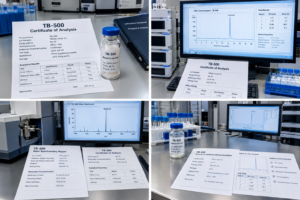
What Is a TB-500 Certificate of Analysis?
A TB-500 Certificate of Analysis is a document intended to summarize analytical testing and quality specifications for a particular TB-500 research-material lot.
Depending on the supplier and testing program, a COA may include:
- Product name
- Lot or batch number
- Testing date
- Appearance
- Identity testing
- Purity result
- Analytical method
- HPLC information
- Mass-spectrometry information
- Molecular characterization
- Storage specifications
- Specification limits
- Testing laboratory information
The value of a COA depends heavily on whether it is specific to the actual lot being evaluated.
A generic TB-500 specification sheet can provide useful background information, but it does not necessarily demonstrate the analytical characteristics of every individual batch.
For research procurement, lot-specific documentation is therefore an important quality consideration.
Why a TB-500 COA Matters for Research
Research materials require traceability.
When a laboratory conducts an experiment, researchers may need to document exactly which material was used, including its lot number and relevant analytical characteristics.
A TB-500 COA can help connect:
Research material → lot number → analytical results → laboratory records
This becomes particularly useful when researchers are:
- Comparing different lots
- Repeating an experiment
- Investigating unexpected analytical results
- Developing analytical methods
- Performing peptide characterization
- Maintaining laboratory inventory records
- Reviewing supplier documentation
- Establishing procurement specifications
A COA should therefore be viewed as part of a broader documentation system rather than as a standalone guarantee of experimental performance.
TB-500 Identity: What Exactly Is Being Tested?
Correct identification is essential because the term TB-500 can appear in different material forms.
PubChem identifies TB-500 as the N-acetylated peptide LKKTETQ, with molecular formula C38H68N10O14 and a listed molecular weight of approximately 889.0 g/mol.
PubChem also separately lists TB-500 acetate and a TB-500 trifluoroacetic-acid salt, demonstrating why researchers should verify the exact material form instead of assuming that every TB-500 listing represents the same molecular composition.
This distinction is particularly important when comparing a COA with expected molecular-mass data.
A researcher reviewing a TB-500 certificate of analysis should therefore confirm:
- Exact product identity
- Sequence or structural designation
- Chemical form
- Molecular formula where applicable
- Molecular weight
- Lot number
- Analytical method
TB-500 Molecular Weight and COA Verification
Molecular-weight information can be useful when evaluating analytical results.
For the TB-500 parent compound, PubChem reports:
Sequence: LKKTETQ
N-terminal modification: Acetylated
Molecular formula: C38H68N10O14
Molecular weight: 889.0 g/mol
Exact mass: 888.49164688 Da
Monoisotopic mass: 888.49164688 Da
However, the expected molecular mass can differ when the material is supplied as a salt or another chemical form.
For example, PubChem lists:
- TB-500 parent compound: approximately 889.0 g/mol
- TB-500 acetate: approximately 949.1 g/mol
- TB-500 trifluoroacetic salt: approximately 1003.0 g/mol
This is why researchers should never interpret a mass value without first confirming the material’s stated chemical form.
What Should a TB-500 Certificate of Analysis Include?
A useful COA should contain enough information for a qualified researcher to understand what was tested and what the results represent.
1. Product Name
The document should clearly identify the material.
For example:
TB-500 Research Material
The name should correspond to the product documentation and laboratory records.
2. Lot Number
The lot number is one of the most important pieces of information on a COA.
A researcher should be able to match:
Product vial → packaging → COA → lot number
If the lot number does not correspond, the COA may not document the specific material received.
3. Test Date
A testing date helps establish when the material was analyzed.
This can become useful when reviewing storage history, retesting requirements, or changes between production lots.
4. Purity Result
The COA may report a purity percentage based on a specified analytical method.
For peptide research materials, HPLC is commonly used for chromatographic characterization.
However, a percentage should not be interpreted without considering:
- Analytical method
- Detection method
- Sample preparation
- Chromatographic conditions
- Reference standard
- Reporting convention
5. Identity Testing
Identity testing helps determine whether the tested material is consistent with the declared compound.
Depending on the laboratory, identity may be evaluated using techniques such as mass spectrometry or other validated analytical approaches.
6. Analytical Method
A strong COA should provide information about the method used for important tests.
This allows researchers to understand what the reported result actually represents.
7. Specifications
Specifications establish the criteria against which a material may be evaluated.
Examples may include:
- Purity specification
- Appearance
- Identity
- Molecular characterization
- Other relevant quality attributes
8. Testing Laboratory
Where applicable, the COA may identify the laboratory or organization responsible for testing.
This can provide additional context when assessing documentation.
TB-500 HPLC and Certificate of Analysis
TB-500 HPLC is one of the most commercially relevant analytical search terms associated with TB-500 research material.
High-performance liquid chromatography separates components within a sample under defined chromatographic conditions.
A TB-500 HPLC report may provide information such as:
- Main peak
- Retention time
- Secondary peaks
- Reported chromatographic purity
- Column information
- Mobile phase
- Detection wavelength
- Analytical conditions
The primary value of the chromatogram is that it gives researchers analytical information about the sample under a particular method.
However, an HPLC chromatogram should not be interpreted in isolation.
Different analytical methods can produce different chromatographic profiles, and a chromatographic purity value does not necessarily answer every question about molecular identity.
For this reason, HPLC is most useful when considered alongside identity testing and other documentation.
TB-500 Mass Spectrometry and COA Documentation
Mass spectrometry can provide additional information about molecular characterization.
For TB-500, PubChem reports an exact/monoisotopic mass of approximately 888.4916 Da for the parent compound.
When evaluating a mass-spectrometry report, researchers should consider:
- Expected molecular form
- Charge state
- Ionization method
- Adducts
- Instrument calibration
- Sample preparation
- Matrix effects
- Reported observed mass
A salt form can have a different molecular weight from the parent compound, which reinforces the importance of verifying the exact chemical form before comparing analytical data.
TB-500 Purity: How Should It Be Evaluated?
The phrase TB-500 purity is frequently used in research-material searches.
Purity should be treated as an analytical measurement rather than a general statement of product quality.
For example, a reported HPLC purity value may describe chromatographic composition under the conditions of that method.
It does not necessarily establish:
- Complete structural identity
- Absence of every impurity
- Sterility
- Endotoxin status
- Stability
- Biological activity
- Suitability for a particular experiment
Researchers should therefore review the complete analytical package instead of relying on a single purity percentage.
How to Read a TB-500 COA
A simple COA review can follow this process.
Step 1: Confirm the product
Check that the COA identifies TB-500 and corresponds to the purchased material.
Step 2: Check the lot number
Make sure the lot number on the COA matches the physical product documentation.
Step 3: Review purity
Identify the reported purity and the analytical method used to obtain it.
Step 4: Review identity
Determine whether identity testing is documented.
Step 5: Check molecular information
Compare the reported molecular information with the expected chemical form.
Step 6: Review analytical reports
If HPLC or mass-spectrometry reports are supplied separately, confirm that they correspond to the same lot.
Step 7: Check dates
Review testing dates and any relevant retest or expiration information.
Step 8: Maintain laboratory records
Keep the COA associated with the corresponding research-material lot in the laboratory documentation system.
Generic COA vs. Lot-Specific COA
There is an important difference between a generic certificate and a lot-specific certificate.
Generic documentation
A generic document may describe:
- Expected molecular information
- Typical specifications
- General product characteristics
It can be useful for reference but may not demonstrate the actual characteristics of a specific batch.
Lot-specific documentation
A lot-specific COA connects analytical results to a particular production batch.
This makes it more useful for:
- Research traceability
- Procurement review
- Quality documentation
- Batch comparison
- Experimental recordkeeping
For laboratories, lot-specific TB-500 COA documentation is generally more informative than generic marketing specifications.
TB-500 Certificate of Analysis and Research Reproducibility
Reproducibility is a central consideration in scientific research.
If researchers repeat an experiment months later, they may need to determine whether the same research material was used.
Lot-specific documentation can help establish:
- Which batch was tested
- Which purity result was reported
- Which analytical method was used
- When the material was tested
- Which molecular form was supplied
This information can become valuable when interpreting differences between experimental runs.
TB-500 Research Material: Documentation Checklist
Before accepting a research material into a laboratory inventory, researchers can use the following checklist:
Identity
☐ Product identity clearly stated
☐ Chemical form identified
☐ Sequence or structural information available
Analytical testing
☐ HPLC data available where appropriate
☐ Mass-spectrometry information available where appropriate
☐ Purity result documented
☐ Analytical method identified
Traceability
☐ Lot number documented
☐ Testing date recorded
☐ COA corresponds to the lot
☐ Supplier documentation retained
Laboratory records
☐ Storage information documented
☐ Product specification retained
☐ Relevant analytical reports archived
This approach can create a more consistent research-material procurement workflow.
TB-500 Certificate of Analysis for U.S. Research
For U.S.-targeted research websites, it is important to distinguish analytical information from claims about human use.
FDA’s current materials identify TB-500 as the thymosin beta-4 fragment LKKTETQ and state that the agency has not identified human exposure data for drug products containing the fragment. FDA also notes potential concerns involving peptide-related impurities and aggregation in certain administration contexts.
In its July 2026 Pharmacy Compounding Advisory Committee materials, FDA stated that it did not find clinical evidence where TB-500 had been administered to patients to treat a disease or condition and concluded that there was insufficient evidence to evaluate effectiveness for the nominated wound-healing use.
These facts make accurate research-use positioning especially important for U.S. SEO content.
A research page should concentrate on:
- Analytical characterization
- Product identity
- COA documentation
- HPLC
- Mass spectrometry
- Purity
- Laboratory research
- Material traceability
It should not turn laboratory information into unsupported therapeutic claims.
TB-500 Research Use Only
“Research use only” should describe the intended laboratory context of the material.
It should not be used as a substitute for applicable regulatory requirements.
FDA has recently emphasized this distinction in enforcement actions involving peptide products. In a March 2026 warning letter, FDA stated that “research use only” labeling did not resolve concerns where website evidence indicated that products were intended for human use.
For a U.S.-focused research-material page, the safest SEO structure is therefore to keep the product description centered on legitimate laboratory research and analytical documentation.
TB-500 COA: What Does a High-Quality Document Look Like?
A professionally organized certificate can make laboratory procurement easier.
An ideal research-material documentation package may contain:
Product specification
Defines the material and expected characteristics.
Lot-specific COA
Documents analytical results for the particular batch.
HPLC chromatogram
Provides chromatographic information.
Mass-spectrometry report
Provides molecular-characterization information where appropriate.
Storage information
Documents recommended laboratory storage conditions.
Traceability information
Connects the material to its lot and documentation.
The combination provides a stronger quality record than a single purity number displayed on a product page.
Common Mistakes When Evaluating a TB-500 COA
Mistake 1: Checking only the purity percentage
A high reported purity value does not replace identity or traceability documentation.
Mistake 2: Ignoring the lot number
A COA without a matching lot number may not demonstrate the characteristics of the material received.
Mistake 3: Confusing chemical forms
TB-500 parent material, acetate, and TFA salt can have different molecular compositions and molecular weights. PubChem separately catalogs these forms.
Mistake 4: Treating TB-500 as identical to full-length thymosin beta-4
The molecular characteristics are substantially different.
Mistake 5: Treating “research use only” as a regulatory guarantee
Intended use depends on the broader context of product marketing and distribution.
Mistake 6: Using a generic chromatogram as proof of every batch
Analytical evidence should ideally correspond to the specific lot being evaluated.
TB-500 COA: Frequently Asked Questions
What is a TB-500 certificate of analysis?
A TB-500 certificate of analysis is a document summarizing analytical testing and specifications for a particular TB-500 research-material lot.
What should a TB-500 COA contain?
A useful COA may contain product identity, lot number, purity, analytical method, identity testing, testing date, specifications, and relevant laboratory information.
What is the TB-500 molecular weight?
PubChem lists the TB-500 parent compound at approximately 889.0 g/mol, with molecular formula C38H68N10O14.
What is the TB-500 sequence?
PubChem lists the sequence as LKKTETQ with an N-terminal acetyl modification for the parent TB-500 structure.
Why is TB-500 HPLC important?
HPLC can provide chromatographic information about a peptide research material under defined analytical conditions and may support purity assessment.
Is a COA enough to prove research-material quality?
No. A COA is one part of a broader quality-assurance process. Researchers may also consider identity testing, analytical methods, lot traceability, storage history, and other relevant documentation.
Why does the TB-500 lot number matter?
The lot number connects the analytical results to a specific batch, improving laboratory traceability.
Can TB-500 acetate have a different molecular weight?
Yes. PubChem lists TB-500 acetate separately at approximately 949.1 g/mol, illustrating why the exact chemical form should be verified before interpreting analytical data.
Can TB-500 TFA salt have a different molecular weight?
Yes. PubChem lists a TB-500 trifluoroacetic-acid salt at approximately 1003.0 g/mol.
Is TB-500 FDA-approved for human therapeutic use?
This article does not present TB-500 as an FDA-approved human therapeutic product. FDA’s current materials state that important safety and clinical evidence gaps remain for TB-500-related substances.
Is TB-500 research material intended for human use?
No. The research-use positioning of this page is limited to legitimate laboratory research. No human administration or dosing instructions are provided.
What is the difference between a COA and an HPLC report?
A COA is a broader quality document that may summarize several tests. An HPLC report or chromatogram focuses specifically on chromatographic analysis.
Why should HPLC and mass spectrometry be considered together?
HPLC provides chromatographic information, while mass spectrometry can provide molecular-characterization information. Together, they can provide complementary analytical evidence.
Conclusion
A TB-500 certificate of analysis is an important component of research-material documentation because it can connect a specific TB-500 lot with analytical results and quality specifications.
When evaluating a TB-500 COA, researchers should look beyond a single purity number. Important considerations include:
- Product identity
- Chemical form
- Sequence
- Molecular information
- Lot number
- Purity
- HPLC analysis
- Mass spectrometry
- Testing date
- Analytical method
- Storage documentation
- Laboratory traceability
PubChem identifies the TB-500 parent compound as the acetylated LKKTETQ peptide and reports a molecular weight of approximately 889.0 g/mol. It separately identifies acetate and trifluoroacetate forms, which reinforces the importance of confirming the exact chemical form represented by a COA.
For U.S.-focused research content, documentation should remain clearly separated from human-use claims. FDA’s 2026 materials identify significant gaps in clinical and safety information for TB-500-related substances.
The strongest research-material pages therefore focus on transparent analytical documentation, lot-specific testing, HPLC, molecular characterization, COA traceability, and legitimate laboratory research.
Research Use Only. Not for human or veterinary use. Not intended to diagnose, treat, cure, mitigate, or prevent any disease or condition.