

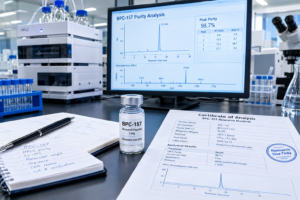
BPC-157 Purity: Why Analytical Testing Matters
BPC-157 purity is an important consideration when evaluating BPC-157 research material for laboratory and analytical work. A product label alone cannot establish chemical identity, chromatographic purity, molecular characterization, or lot-to-lot consistency.
For researchers, a more complete evaluation involves examining analytical documentation such as HPLC chromatograms, LC-MS or mass-spectrometry results, certificates of analysis (COAs), lot numbers, reported specifications, and testing dates.
BPC-157 is a 15-amino-acid peptide. PubChem identifies the parent compound with the sequence GEPPPGKPADDAGLV, molecular formula C62H98N16O22, and molecular weight approximately 1419.5 g/mol.
Importantly, the molecular identity of BPC-157 should not be confused with measured purity. Molecular databases can establish reference information about a compound, while laboratory analytical testing is used to characterize an actual sample.
For Peptides Grey House, a strong BPC-157 purity page should therefore focus on transparent analytical information rather than unsupported quality or therapeutic claims.
What Does BPC-157 Purity Mean?
The term BPC-157 purity generally refers to the proportion of material associated with the intended peptide under a specified analytical method.
In peptide research, purity is not simply a statement that a vial contains BPC-157. Researchers need to consider whether the analytical result demonstrates the presence of the intended peptide and whether detectable related substances are present.
Potential sources of unwanted material can include:
- Incomplete synthesis products
- Truncated peptide sequences
- Side-reaction products
- Degradation products
- Residual starting materials
- Solvents or reagents
- Counterions or salt-associated components
- Peptide aggregates
- Other process-related impurities
FDA materials discussing BPC-157 specifically identify concerns involving peptide-related impurities, aggregates, and challenges associated with physicochemical characterization.
This makes analytical characterization a central consideration when discussing BPC-157 purity.
BPC-157 Purity vs BPC-157 Identity
Purity and identity are related but different analytical questions.
Identity asks:
“Is this material consistent with the intended BPC-157 molecule?”
Purity asks:
“How much of the analyzed material is represented by the intended chromatographic or chemical species under the specified method?”
A sample can therefore require both identity confirmation and purity assessment.
For example, a chromatographic method may show a dominant peak associated with the target peptide, while mass spectrometry can provide additional information about molecular mass.
This is why a comprehensive research-quality evaluation should avoid relying on a single number printed on a product page.
BPC-157 Molecular Information
Reference chemical information is useful when interpreting analytical results.
| Property | BPC-157 Parent Compound |
|---|---|
| Compound | BPC-157 |
| Peptide length | 15 amino acids |
| Sequence | GEPPPGKPADDAGLV |
| Molecular formula | C62H98N16O22 |
| Molecular weight | 1419.5 g/mol |
| Exact mass | 1418.70415882 Da |
| CAS | 137525-51-0 |
PubChem currently lists BPC-157 with molecular weight of 1419.5 g/mol and exact mass of 1418.70415882 Da.
Why This Matters for Purity Testing
Molecular information gives researchers a reference point for analytical characterization.
Mass-spectrometry data can be compared against expected molecular characteristics, while chromatographic data can be used to investigate the sample’s separation profile.
However, researchers should account for chemical form when interpreting molecular-mass data.
For example, PubChem separately identifies BPC-157 TFA salt with a molecular weight of approximately 1647.6 g/mol.
BPC-157 acetate is also separately represented in PubChem.
Therefore, the molecular weight of the parent compound should not automatically be applied to every BPC-157-associated material.
BPC-157 HPLC Purity Testing
High-performance liquid chromatography (HPLC) is one of the most useful analytical concepts associated with peptide purity.
HPLC separates compounds according to their interaction with the chromatographic system. The resulting chromatogram can provide information about the primary peptide peak and other detectable peaks.
A BPC-157 HPLC report may include:
- Sample identification
- Retention time
- Main peak
- Additional peaks
- Peak areas
- Calculated purity
- Analytical method
- Testing date
- Sample or batch identification
What Does an HPLC Chromatogram Show?
A chromatogram typically displays detector response against retention time.
Researchers may examine:
Primary peak:
The principal chromatographic species associated with the target material.
Secondary peaks:
Additional detectable components that may represent impurities, degradation products, synthesis-related species, or other substances.
Retention time:
The time required for a component to pass through the chromatographic system under the specified conditions.
A reported purity percentage should therefore always be interpreted together with the analytical method.
Why “99% Purity” Alone Is Not Enough
A common marketing statement for research peptides is a high numerical purity value.
However, the number itself does not answer every analytical question.
Researchers should ask:
- What analytical method produced the percentage?
- Was HPLC used?
- What detection wavelength or analytical conditions were used?
- Is the chromatogram available?
- Is the result lot-specific?
- Was molecular identity independently assessed?
- Does the COA identify the tested sample?
- What chemical form was tested?
- Are relevant impurity categories addressed?
A purity percentage without analytical context provides less information than a documented analytical result accompanied by traceable testing information.
BPC-157 COA: Certificate of Analysis
A Certificate of Analysis (COA) is an important document for evaluating research-material quality.
For BPC-157, a useful COA may contain:
- Product name
- Lot or batch number
- Testing date
- Appearance
- HPLC purity
- Identity information
- Molecular-mass information
- Analytical method
- Specification
- Observed result
- Laboratory or testing information
Lot Matching Is Critical
A COA should correspond to the actual material being evaluated.
The following identifiers should ideally agree:
Product label → Lot number → COA → Analytical report
If a document describes a different lot, it should not automatically be treated as evidence for the current sample.
This simple verification step can substantially improve research-material traceability.
BPC-157 LC-MS Analysis
LC-MS combines liquid chromatographic separation with mass spectrometry.
This can provide two complementary forms of analytical information:
- Chromatographic behavior
- Molecular-mass information
For BPC-157 research, LC-MS can therefore complement HPLC purity analysis.
The parent BPC-157 compound has a PubChem-listed exact mass of approximately 1418.704 Da.
Observed mass-spectrometry data should be interpreted according to the instrument, ionization method, charge state, adducts, sample preparation, and chemical form.
HPLC vs LC-MS
| Method | Primary Information |
|---|---|
| HPLC | Chromatographic separation and relative purity |
| MS | Molecular-mass information |
| LC-MS | Chromatographic + mass information |
| COA | Documentation and traceability |
Using complementary analytical methods can provide a more complete picture than relying on one measurement.
BPC-157 Peptide Sequence and Purity
PubChem lists the BPC-157 sequence as:
GEPPPGKPADDAGLV
The sequence contains 15 amino-acid residues.
Sequence information is important because peptide identity can be evaluated against expected molecular characteristics.
For analytical researchers, the sequence can support:
- Molecular-mass calculations
- Reference-standard comparisons
- Mass-spectrometry interpretation
- Peptide identification
- Structural documentation
However, knowing the expected sequence does not prove that an individual sample meets a particular purity specification.
That requires analytical testing of the sample itself.
What Can Affect BPC-157 Purity?
Several stages of peptide production and handling can influence the analytical profile of a peptide material.
1. Peptide Synthesis
Incomplete coupling or side reactions can produce related peptide species.
2. Purification
Insufficient separation can leave detectable related compounds.
3. Residual Process Materials
Starting materials, reagents, solvents, or other process-related substances may remain if not adequately controlled.
4. Storage Conditions
Environmental conditions can influence peptide integrity and may contribute to degradation or aggregation.
5. Chemical Form
Parent BPC-157 and salt-associated forms can have different molecular compositions and molecular weights.
6. Analytical Method
Different analytical methods can produce different types of information and are not necessarily interchangeable.
FDA’s 2026 BPC-157 materials specifically discuss potential impurities arising from incomplete coupling, truncation, side reactions, synthesis-process materials, residual solvents, and peptide-related aggregates.
BPC-157 Purity and Peptide Aggregation
Aggregation is an important analytical consideration for peptide materials.
Individual peptide molecules can potentially associate into larger assemblies under certain conditions. The resulting material may behave differently from the intended molecular species during analytical testing.
FDA materials discussing BPC-157 identify potential concerns involving peptide aggregation and immunogenicity in certain proposed routes of administration.
For a laboratory-focused SEO page, the appropriate takeaway is straightforward:
Purity should be evaluated as part of broader peptide characterization rather than treated as a single marketing percentage.
BPC-157 Purity Testing Checklist
Researchers evaluating a BPC-157 research material can use the following checklist.
Identity
Confirm the material is identified as BPC-157 and compare the stated chemical characteristics with authoritative reference data.
Sequence
Compare the reported sequence with the expected sequence:
GEPPPGKPADDAGLV
Molecular Weight
Check whether the stated molecular mass corresponds to the chemical form being evaluated.
HPLC
Look for a lot-specific chromatogram or analytical result.
LC-MS
Where available, review mass-spectrometry information for molecular characterization.
COA
Confirm that the certificate contains the relevant analytical results.
Lot Number
Match the product’s lot number with the COA and testing report.
Testing Date
Check when the analytical evaluation was performed.
Chemical Form
Determine whether the material is described as parent BPC-157, acetate, TFA-associated material, or another form.
Documentation
Retain analytical records in accordance with laboratory procedures.
How to Evaluate a BPC-157 COA
A useful COA review can be organized into five questions.
Question 1: What Was Tested?
Confirm the product and material identity.
Question 2: Which Lot Was Tested?
Match the lot number to the material under evaluation.
Question 3: What Method Was Used?
Identify whether the reported result came from HPLC, MS, LC-MS, or another analytical method.
Question 4: What Was the Result?
Look for the measured result rather than only a specification.
Question 5: Can the Result Be Traced?
Determine whether the report identifies the laboratory, testing date, analytical method, and sample.
This process creates a stronger basis for evaluating BPC-157 purity than relying solely on advertising language.
BPC-157 Purity for U.S. Research
U.S. researchers should distinguish research-material characterization from pharmaceutical approval or clinical use.
FDA’s current materials state that it has identified limited or insufficient safety information for proposed routes of administration involving BPC-157 and notes concerns involving immunogenicity, peptide-related impurities, and API characterization.
FDA’s 2026 committee materials also noted a lack of adequate impurity-limit/testing information in publicly available COA material reviewed for BPC-157 and highlighted potential peptide-related and process-related impurities.
Accordingly, BPC-157 should not be presented on a research website as an FDA-approved therapeutic product.
A responsible U.S.-focused research page should emphasize:
- Analytical characterization
- Research documentation
- Lot traceability
- Laboratory investigation
- Scientific literature
- Appropriate regulatory awareness
BPC-157 Purity vs Research Grade
The phrase research grade can be useful commercially, but it should not replace analytical evidence.
A stronger quality framework asks whether the material has supporting documentation for:
Identity + Purity + Molecular Characterization + Traceability
Rather than:
Marketing claim alone
For Peptides Grey House, this distinction can become an important part of the site’s topical authority around research peptide quality.
BPC-157 Purity and Analytical Documentation
A comprehensive research-material documentation package may include:
Product Specification
Defines the material and relevant specifications.
Certificate of Analysis
Documents analytical results for a specific lot.
HPLC Report
Provides chromatographic information.
Mass-Spectrometry Report
Provides molecular-mass information.
Lot Documentation
Connects the analytical records to the specific material.
Storage Documentation
Provides laboratory handling and storage information appropriate to the material.
Together, these documents can provide a much stronger quality-control record than a single purity percentage.
Common Mistakes When Evaluating BPC-157 Purity
Mistake 1: Treating Purity as Identity
A purity percentage does not independently establish molecular identity.
Mistake 2: Ignoring Chemical Form
Parent BPC-157, acetate, and TFA-associated materials can have different molecular weights.
Mistake 3: Using a Generic COA
A generic document may not demonstrate the characteristics of the specific lot being evaluated.
Mistake 4: Ignoring the Chromatogram
A reported HPLC number provides less context when the underlying chromatographic information is unavailable.
Mistake 5: Assuming Research Literature Establishes Therapeutic Efficacy
Preclinical or experimental research should not be represented as established clinical efficacy.
Mistake 6: Confusing Research Material With an Approved Drug
Scientific interest and regulatory approval are separate concepts.