

Introduction to Vesugen 20mg
Vesugen 20mg is a research-material format associated with Vesugen, a short synthetic peptide commonly identified by the amino acid sequence Lys-Glu-Asp (KED).
Vesugen is discussed within the short-peptide bioregulator research literature associated with the Khavinson peptide research program. Modern research-product references generally identify the compound as a three-residue peptide consisting of lysine, glutamic acid, and aspartic acid.
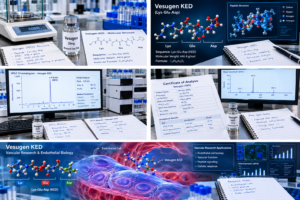
For laboratories researching short peptides, vascular biology, endothelial-cell models, peptide chemistry, or analytical characterization, Vesugen provides an example of how a small peptide sequence can be evaluated through chemical identity, chromatographic purity, mass spectrometry, and batch-specific documentation.
The 20mg designation refers to the quantity of research material supplied. It does not, by itself, establish purity, identity, biological activity, or suitability for any particular experiment.
For that reason, researchers evaluating Vesugen should consider the complete analytical profile, including:
- peptide identity
- amino acid sequence
- molecular formula
- molecular weight
- HPLC purity
- mass-spectrometry information
- lot number
- Certificate of Analysis (COA)
- physical form
- storage documentation
- research-use labeling
Research Use Only: Vesugen 20mg research material is intended solely for qualified laboratory and scientific research. It is not intended for human consumption, self-administration, diagnosis, treatment, prevention, or cure of any disease.
What Is Vesugen Peptide?
Vesugen is generally identified as the short peptide Lys-Glu-Asp, abbreviated KED.
It is a tripeptide, meaning that the molecule contains three amino-acid residues.
The sequence is:
Lys-Glu-Asp
or:
KED
The chemical record associated with Lys-Glu-Asp identifies the compound as lysyl-glutamyl-aspartic acid. Public chemical references associate this structure with CAS 204271-66-9 and PubChem CID 87571363.
Reported molecular characteristics include:
| Property | Vesugen / KED |
|---|---|
| Common designation | Vesugen |
| Sequence | Lys-Glu-Asp |
| One-letter sequence | KED |
| Peptide length | 3 residues |
| Molecular formula | C₁₅H₂₆N₄O₈ |
| Molecular weight | ~390.39 g/mol |
| CAS | 204271-66-9 |
| Physical research format | Commonly supplied as lyophilized material |
These values should be compared against the lot-specific COA and analytical documentation for any research material being evaluated.
Vesugen KED: Understanding the Peptide Sequence
The term Vesugen KED is useful because it connects the commercial/research designation with the underlying chemical identity.
K — Lysine
Lysine is a basic amino acid containing a positively charged side chain under many biological conditions.
E — Glutamic Acid
Glutamic acid contains a carboxyl-containing side chain and contributes acidic character to the peptide.
D — Aspartic Acid
Aspartic acid is another acidic amino acid containing a carboxyl-containing side chain.
Together, these three residues create the short sequence:
Lys-Glu-Asp
This simple sequence is particularly relevant to analytical peptide chemistry because a three-residue molecule can be characterized using molecular-mass and chromatographic techniques.
Vesugen 20mg Research Material
The term Vesugen 20mg describes a quantity of material rather than a biological effect.
A laboratory purchasing 20mg of Vesugen may evaluate the material according to its intended analytical or experimental workflow.
A professional research-material listing should clearly communicate:
Product identity
The material should be identified as Vesugen/KED with its sequence clearly stated.
Quantity
The nominal amount should be specified as 20mg.
Purity
Purity should be connected to a defined analytical method such as HPLC.
Identity testing
Mass spectrometry can provide supporting evidence for molecular identity.
Batch documentation
The lot number should correspond to the associated COA.
Physical form
The material may be supplied as a lyophilized peptide powder.
Research designation
The product should be clearly labeled for research use only.
These details provide significantly more useful information than a product name and quantity alone.
Vesugen Molecular Weight
Vesugen molecular weight is one of the most important technical search terms associated with this compound.
For the Lys-Glu-Asp structure, commonly reported molecular characteristics give a molecular weight of approximately:
390.39 g/mol
The corresponding molecular formula is:
C₁₅H₂₆N₄O₈
The chemical record for Lys-Glu-Asp is associated with PubChem CID 87571363.
Molecular-weight information is useful in analytical research because it provides an expected reference value for mass-spectrometry interpretation.
Researchers should distinguish between:
- calculated molecular weight
- average molecular weight
- monoisotopic mass
- observed mass-spectrometry signal
- mass associated with salts or counterions
When interpreting an analytical report, the expected molecular mass should always be compared with the actual testing method and sample conditions.
Vesugen Peptide Sequence
The commonly reported Vesugen peptide sequence is:
Lys-Glu-Asp
One-letter notation:
KED
This is an extremely short linear peptide consisting of three amino acids.
Sequence information is particularly important for research-material verification because different short peptides may have similar names or may belong to related peptide families.
For example, changing one amino acid can create a chemically distinct peptide with different molecular mass and potentially different experimental properties.
Therefore, laboratories should verify the sequence, not simply the product name.
Vesugen Purity and Analytical Quality
Vesugen purity is an important consideration when selecting research material.
A reported purity percentage should ideally be supported by an identifiable analytical method.
For peptide materials, reverse-phase HPLC is commonly used for chromatographic characterization. Supplier examples for Vesugen report HPLC-based purity testing, although actual specifications and results should always be confirmed against the batch-specific COA.
A meaningful analytical report may include:
- sample identification
- chromatographic method
- column information
- retention time
- peak area
- purity percentage
- testing date
- lot number
A numerical purity claim without supporting analytical information provides considerably less information to a research laboratory.
Vesugen HPLC Testing
Vesugen HPLC refers to chromatographic analysis of the KED peptide.
Reverse-phase HPLC can separate peptide-related components according to their interactions with the chromatographic stationary and mobile phases.
A typical analytical report may display a principal peptide peak alongside any detectable secondary peaks.
Researchers can examine:
- retention time
- main peak area
- secondary peaks
- integrated chromatogram
- calculated purity
- analytical method
- sample identification
HPLC is particularly valuable for short peptides because it can help characterize the chemical profile of the supplied material.
However, HPLC purity alone does not necessarily establish molecular identity.
That is where complementary analytical techniques become important.
Vesugen Mass Spectrometry
Mass spectrometry provides another important analytical layer.
For Vesugen/KED, the expected molecular weight can be used as a reference when evaluating mass-spectrometry data.
A mass-spectrometry report may provide information about:
- observed molecular ion
- expected molecular mass
- ionization state
- mass-to-charge ratio
- analytical method
- sample identity
For example, one commercial analytical specification reports an ESI-MS result consistent with the approximately 390.39 g/mol molecular weight of KED.
The combination of chromatographic and mass-spectrometric information is useful because the two techniques answer different analytical questions.
HPLC: What chromatographic components are present?
Mass spectrometry: Does the detected molecular mass correspond to the expected compound?
Vesugen COA: Certificate of Analysis
A Vesugen COA provides batch-specific documentation that can help researchers evaluate the material they receive.
A well-organized COA may contain:
- product name
- lot number
- sequence
- molecular formula
- molecular weight
- HPLC purity
- mass-spectrometry result
- test date
- analytical laboratory
- specifications
- pass/fail status
The most important feature is lot traceability.
The lot number on the COA should correspond to the vial or package being evaluated.
A generic COA that does not identify the actual batch is less useful for laboratory quality documentation.
What Should a Vesugen COA Show?
When reviewing a Vesugen certificate of analysis, researchers can look for five core elements.
1. Correct identity
The document should identify Vesugen/KED or Lys-Glu-Asp.
2. Correct molecular characteristics
The stated molecular formula and molecular weight should be internally consistent with the reported peptide identity.
3. HPLC information
The purity value should identify the analytical method.
4. Mass-spectrometry confirmation
Where available, MS data can provide additional molecular-identity support.
5. Lot-specific documentation
The COA should be traceable to the exact batch.
This is particularly important for short peptides because similarly named materials can sometimes appear in online catalogs with inconsistent sequence or molecular specifications.
Current online research references specifically emphasize checking sequence, molecular weight, and analytical documentation because inconsistent commercial listings exist.
Vesugen and Vascular Research
Vesugen is frequently described in research contexts as a vascular-associated short peptide.
The research literature surrounding the broader Khavinson short-peptide program has investigated relationships between short peptides, tissue-specific biology, gene expression, and cellular models.
However, researchers should distinguish between:
- studies involving Vesugen/KED specifically,
- studies involving related short peptides,
- studies involving peptide mixtures or tissue extracts, and
- broader hypotheses about short-peptide bioregulators.
These categories should not automatically be treated as equivalent.
Some contemporary evidence reviews note that the compound-specific evidence for Vesugen itself is limited and that claims made for the broader peptide-bioregulator program should not automatically be interpreted as proof of a specific effect of isolated KED.
This distinction is especially valuable for an SEO product page because it keeps the content scientifically responsible while still providing relevant research information.
Vesugen and Endothelial Research
Endothelial cells form the inner lining of blood vessels and are an important model system in vascular biology.
Research involving vascular biology may examine:
- endothelial-cell behavior
- cellular signaling
- gene-expression patterns
- cell proliferation markers
- cellular stress responses
- vascular tissue models
- age-associated cellular changes
Vesugen/KED has been discussed in relation to vascular and endothelial research, but findings from experimental models should not be presented as established clinical effects.
For a research-product page, appropriate language includes:
“studied in experimental models”
“investigated in laboratory research”
“used as a research compound”
rather than therapeutic or disease-treatment claims.
Vesugen and Gene-Expression Research
Another research area associated with the short-peptide bioregulator literature is the investigation of gene-expression regulation.
Some publications from this research tradition propose inter
actions between short peptides and gene-regulatory systems.
This area remains scientifically specific and should be interpreted according to the experimental model, assay, peptide identity, and study methodology.
Researchers interested in Vesugen can therefore use it as part of broader investigations involving:
- peptide-gene interactions
- molecular biology
- transcriptional regulation
- cellular signaling
- tissue-specific gene expression
- peptide structure-function relationships
These are research categories rather than claims of established therapeutic activity.
Vesugen as a Short-Peptide Research Compound
One advantage of studying short peptides such as KED is the relatively simple molecular architecture.
A tripeptide contains only three amino-acid residues, making sequence identity especially important.
Researchers can investigate:
- peptide synthesis
- peptide purification
- molecular mass
- chromatographic behavior
- peptide stability
- sequence-specific interactions
- structure-function relationships
Vesugen therefore fits naturally into laboratory workflows focused on short peptide chemistry and biochemical research.
Why 20mg Vesugen Is Relevant to Laboratory Research
The 20mg format can be relevant when laboratories need a defined quantity of material for planned analytical work.
Quantity can be considered alongside:
- assay requirements
- analytical testing
- sample preparation
- reference-material needs
- experimental design
- repeat measurements
However, the amount supplied should never be confused with potency, purity, or biological efficacy.
A 20mg vial simply communicates the nominal quantity of material supplied.
Vesugen Storage and Handling
Lyophilized peptide materials should be stored according to the supplier’s current product documentation and laboratory quality procedures.
Commercial Vesugen research listings commonly describe cold, dry storage and protection from light and moisture, with some suppliers specifying approximately −20°C for lyophilized material.
Researchers should prioritize the current lot-specific documentation rather than applying a generic storage rule.
Important considerations include:
- container integrity
- temperature
- moisture exposure
- light exposure
- lot identification
- laboratory records
- freeze-thaw exposure after preparation
- supplier handling documentation
This page intentionally does not provide a human-use or self-administration protocol.
How to Evaluate High-Purity Vesugen
Before purchasing Vesugen research material, laboratories can use the following checklist.
Identity
Does the material clearly state Lys-Glu-Asp/KED?
Molecular weight
Does the stated molecular weight correspond to the identified compound?
Sequence
Is the three-residue KED sequence documented?
HPLC
Is chromatographic purity reported?
Mass spectrometry
Is molecular identity supported by MS where appropriate?
COA
Is a lot-specific Certificate of Analysis available?
Quantity
Is the vial clearly labeled as containing 20mg?
Traceability
Does the lot number connect the vial to the analytical documentation?
Research-use designation
Is the product clearly identified as laboratory research material?
This quality framework can help researchers distinguish documented research material from listings with incomplete or internally inconsistent specifications.
Vesugen Identity Verification: Why It Matters
Identity verification deserves special attention with Vesugen because current online listings do not all use identical specifications.
The KED identity is generally represented by:
Lys-Glu-Asp
C₁₅H₂₆N₄O₈
~390.39 g/mol
CAS 204271-66-9
When evaluating a research product, researchers should compare these characteristics with the actual COA and analytical results.
A mismatch between the product name, sequence, molecular formula, molecular weight, and analytical data should be investigated before the material is incorporated into experimental work.
This is a particularly useful quality-control point for Vesugen SEO content because it provides genuine scientific value rather than simply repeating a supplier description.
Research-Use-Only Statement
Vesugen 20mg is supplied for research use only.
This material is intended solely for qualified laboratory and scientific research.
It is not intended for human consumption, self-administration, diagnosis, treatment, cure, mitigation, or prevention of any disease or medical condition.
Vesugen research material should not be represented as an FDA-approved drug, dietary supplement, food, cosmetic, or medical product.
Experimental findings from cell, biochemical, computational, or preclinical research should not be interpreted as evidence of clinical efficacy or safety.
Frequently Asked Questions About Vesugen 20mg
What is Vesugen?
Vesugen is commonly identified as the short synthetic tripeptide Lys-Glu-Asp (KED) and is associated with vascular-focused short-peptide bioregulator research.
What is the Vesugen peptide sequence?
The commonly reported sequence is Lys-Glu-Asp, abbreviated KED.
What is the molecular weight of Vesugen?
The commonly reported molecular weight for Lys-Glu-Asp is approximately 390.39 g/mol.
What is Vesugen 20mg?
Vesugen 20mg refers to a research-material format containing a nominal 20mg quantity of Vesugen/KED peptide.
What does KED mean?
KED represents the three amino acids in the sequence: K = Lysine, E = Glutamic acid, D = Aspartic acid.
What is Vesugen HPLC testing?
Vesugen HPLC testing refers to chromatographic analysis used to characterize the peptide and assess chromatographically detectable components.
Why is a Vesugen COA important?
A lot-specific COA can document identity, purity, molecular characteristics, analytical testing, and batch traceability.
Is Vesugen a tripeptide?
Yes. Vesugen/KED is commonly identified as a three-amino-acid peptide.
What is Vesugen used for in research?
Research discussions associate Vesugen/KED with short-peptide, vascular, endothelial, molecular-biology, and gene-expression research. The strength of evidence varies by experimental model, and compound-specific evidence should not be confused with research on related peptides or peptide preparations.
Is Vesugen FDA approved?
Vesugen/KED should not be represented as an FDA-approved medicine. It is positioned in research contexts as a laboratory research compound.
How should Vesugen purity be evaluated?
Researchers can review HPLC results, mass-spectrometry data, sequence identity, molecular-weight information, and a lot-specific COA.
Is Vesugen intended for human use?
Research-grade Vesugen should be labeled Research Use Only and should not be marketed for human consumption or self-administration.
Conclusion
Vesugen 20mg provides a research-material format for laboratories investigating the short peptide commonly identified as Lys-Glu-Asp (KED).
Its small three-residue structure makes analytical identity particularly important. Researchers evaluating Vesugen should look beyond the product name and quantity and examine the sequence, molecular formula, molecular weight, HPLC purity, mass-spectrometry information, COA, and lot traceability.
The commonly reported KED reference profile is C₁₅H₂₆N₄O₈, approximately 390.39 g/mol, with the sequence Lys-Glu-Asp.
Vesugen is discussed within vascular and short-peptide bioregulator research, but the evidence base should be interpreted carefully. Research involving related peptides, peptide mixtures, or broader theoretical mechanisms should not automatically be presented as evidence for isolated Vesugen/KED.
For a professional research-peptide website, the strongest product presentation is therefore one centered on chemical identity, analytical transparency, batch documentation, and research-use-only positioning.
Research Use Only. Not for human consumption. Not for diagnostic or therapeutic use.