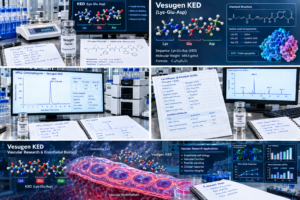
The Vesugen peptide is a short synthetic tripeptide commonly identified by the sequence Lys-Glu-Asp, abbreviated KED. It is associated with the short-peptide research program developed by Vladimir Khavinson and colleagues and has been described within that research tradition as a vascular-associated peptide.
From a laboratory perspective, Vesugen is particularly interesting because its small molecular structure makes peptide identity and analytical characterization important. Researchers evaluating KED material may need to confirm the amino-acid sequence, molecular formula, molecular weight, chromatographic purity, mass-spectrometry results, and lot-specific documentation.
Public chemical references identify the KED structure as C₁₅H₂₆N₄O₈, with a commonly reported molecular weight of approximately 390.39 g/mol.
However, scientific evidence surrounding Vesugen should be described carefully. Much of the published work comes from the research group associated with its development, while independent and controlled evidence is limited. Some sources also differ in how they characterize the available literature.
This page focuses on the chemistry, analytical testing, research context, and documentation surrounding Vesugen peptide rather than making therapeutic claims.
Research Use Only: Vesugen research material is intended solely for qualified laboratory and scientific research. It is not intended for human consumption, self-administration, diagnosis, treatment, prevention, or cure of any disease or medical condition.
What Is Vesugen Peptide?
Vesugen is commonly identified as the synthetic tripeptide:
Lys-Glu-Asp
Its one-letter sequence is:
KED
The compound consists of three amino-acid residues:
- Lysine (K)
- Glutamic acid (E)
- Aspartic acid (D)
Chemical reference data for Lys-Glu-Asp lists a molecular formula of C₁₅H₂₆N₄O₈ and molecular weight of approximately 390.39 g/mol.
The peptide is associated with the Khavinson short-peptide bioregulator research family. Some research references describe Vesugen as the vascular-associated member of that family. That terminology should be understood as a description of the research program rather than an established clinical classification.
For SEO purposes, researchers may encounter several related terms:
- Vesugen
- Vesugen peptide
- Vesugen KED
- KED peptide
- Lys-Glu-Asp peptide
- Lysyl-glutamyl-aspartic acid
- Vesugen research peptide
These terms can refer to the same underlying sequence when the chemical identity is correctly specified.
Vesugen KED Peptide Sequence
The Vesugen peptide sequence is:
Lys-Glu-Asp
KED
This three-residue sequence is one of the most important identifiers to verify when evaluating a research material.
Sequence information is particularly valuable with short peptides because a single amino-acid substitution or a different residue order creates a chemically different molecule.
For laboratory documentation, researchers should therefore verify:
- Product name
- Amino-acid sequence
- Molecular formula
- Molecular weight
- Analytical results
- Lot number
A product name by itself is not sufficient chemical identification.
Vesugen Molecular Weight
The commonly reported Vesugen molecular weight is approximately:
390.39 g/mol
The associated molecular formula is:
C₁₅H₂₆N₄O₈
Public chemical references identify the KED structure with PubChem CID 87571363.
Molecular-weight information is particularly useful when interpreting mass-spectrometry data.
A laboratory can compare:
Expected molecular characteristics
with
Observed mass-spectrometry results
This provides one component of an analytical identity check.
Researchers should also be aware that the mass associated with a supplied material can differ from the free-peptide reference value when salts, counterions, adducts, or other chemical forms are involved. One current research reference specifically notes that terminal modifications, salts, and counterions require separate specification.
For that reason, the lot-specific COA should remain the primary document for a particular research material.
Vesugen 20mg Research Peptide
Vesugen 20mg is a product-format search term associated with research-grade KED material.
The number 20mg describes the nominal quantity supplied. It does not independently establish:
- purity
- identity
- biological activity
- stability
- analytical quality
- suitability for an experimental system
A properly documented research product should provide information connecting the stated quantity with a defined product identity and batch.
When evaluating a Vesugen 20mg research material, laboratories can look for:
Product identity
Vesugen / KED / Lys-Glu-Asp.
Sequence
Lys-Glu-Asp.
Quantity
20mg nominal material quantity.
Purity
An HPLC-based purity result where applicable.
Identity confirmation
Mass-spectrometry data where available.
Documentation
A lot-specific Certificate of Analysis.
Research designation
Clear Research Use Only labeling.
Vesugen Purity
Vesugen purity is an important consideration for laboratories evaluating KED research material.
Purity should not be treated as an isolated marketing number.
A meaningful purity statement should ideally identify:
- analytical method
- sample identity
- lot number
- test date
- chromatographic result
- reported purity
- laboratory or testing facility
HPLC is commonly used for peptide purity characterization.
Some commercial Vesugen listings report HPLC purity specifications of 99% or greater, but researchers should verify the actual result against the COA supplied with the specific lot rather than assuming that a catalog specification applies universally.
This distinction is important for professional SEO content because “high purity” should be supported by analytical documentation rather than used only as promotional language.
Vesugen HPLC Testing
Vesugen HPLC is a valuable technical keyword for laboratories searching for analytical information about KED peptide.
High-performance liquid chromatography can separate components according to their chromatographic behavior and provide a chromatogram for evaluation.
A Vesugen HPLC report may contain:
- retention time
- primary peak
- secondary peaks
- peak area
- integrated purity
- analytical method
- sample identification
- lot number
The chromatogram provides more context than simply stating a percentage.
For example:
HPLC purity: 99%+
is a numerical claim.
A chromatogram showing the major peptide peak and associated analytical information provides supporting evidence for that claim.
Laboratories should also recognize that chromatographic purity and molecular identity are different analytical questions.
Vesugen Mass Spectrometry
Mass spectrometry can provide complementary information about peptide identity.
For Vesugen/KED, the commonly reported molecular weight of approximately 390.39 g/mol provides a reference point for interpreting analytical mass data.
A mass-spectrometry report may include:
- mass-to-charge ratio
- observed molecular ion
- expected molecular mass
- ionization state
- sample identification
- analytical method
Mass spectrometry is therefore particularly useful when paired with HPLC.
HPLC
Primarily provides chromatographic separation and purity information.
Mass spectrometry
Provides molecular-mass information useful for identity assessment.
Together, these techniques can create a stronger analytical profile than either measurement alone.
Vesugen COA: Certificate of Analysis
A Vesugen COA is an important quality-documentation component for research material.
A batch-specific Certificate of Analysis can provide information about the exact lot supplied to a laboratory.
A useful COA may contain:
- product name
- sequence
- lot number
- molecular formula
- molecular weight
- HPLC purity
- mass-spectrometry result
- test date
- analytical laboratory
- specification
- pass/fail status
Why lot traceability matters
The COA should correspond to the specific batch being evaluated.
For example:
Vial lot: VG-2026-001
COA lot: VG-2026-001
This provides a direct documentation link between the analytical result and the research material.
A generic certificate that does not identify the supplied batch provides less useful quality information.
Vesugen Analytical Testing
A comprehensive analytical approach can include several complementary measurements.
1. Chemical identity
Confirm the KED/Lys-Glu-Asp sequence.
2. Molecular characteristics
Compare expected molecular formula and molecular weight.
3. HPLC
Evaluate chromatographic purity.
4. Mass spectrometry
Evaluate molecular-mass consistency.
5. COA
Document batch-specific results.
6. Traceability
Connect the product, lot, test results, and laboratory documentation.
This type of analytical framework is especially relevant for short peptides because a small difference in sequence can create a different compound.
Vesugen and Vascular Research
Vesugen is frequently described within the Khavinson peptide literature as a vascular-associated or endothelial-focused short peptide.
Research discussions have included experimental work involving:
- vascular endothelial cells
- cellular proliferation markers
- gene-expression studies
- molecular docking
- vascular tissue models
- cellular differentiation
- experimental aging models
However, the strength of evidence varies considerably by study type.
Some published research has examined KED in cell or animal models, while current evidence reviews emphasize that the overall Vesugen-specific evidence base is limited and concentrated within the originating research program.
Therefore, research-product content should describe these as experimental research areas, not established clinical effects.
Vesugen and Endothelial Research
Endothelial cells are an important model system in vascular biology.
Experimental endothelial research can examine:
- cellular proliferation
- gene expression
- cell adhesion
- oxidative processes
- endothelial signaling
- cellular aging
- vascular tissue organization
Some publications associated with the Khavinson research program have reported KED-related findings in vascular-cell models.
At the same time, independent evidence remains limited. Current reviews describe much of the published literature as originating from the same research network, which is an important limitation when interpreting experimental findings.
This makes careful wording essential:
Appropriate:
“Vesugen has been investigated in experimental vascular and endothelial research.”
Avoid:
“Vesugen is proven to improve vascular health.”
The first is a description of research. The second would be an unsupported therapeutic claim.
Vesugen and Gene-Expression Research
Another area associated with the Vesugen research program involves gene-expression regulation.
Research from the originating group has proposed that short peptides may interact with DNA-associated systems and influence gene-expression patterns.
Some of these proposed mechanisms have been explored using molecular docking and cellular experiments. However, computational docking should not be treated as direct experimental proof of molecular binding.
This distinction is particularly important for scientific SEO content.
A responsible research article can state:
Vesugen has been investigated in experimental studies examining gene-expression-related mechanisms.
It should not transform a computational hypothesis into an established biological mechanism.
Vesugen Research Evidence
The available evidence should be considered according to the type of study.
Cell research
Some reports investigate KED in cellular models.
Animal research
Some studies from the broader research program have investigated KED in experimental animal models.
Computational research
Molecular-docking approaches have been used to investigate proposed peptide interactions.
Human research
Current evidence reviews identify small, uncontrolled human reports but no established randomized controlled clinical evidence for Vesugen.
Consequently, laboratory researchers should distinguish between:
chemical identity
experimental observations
proposed mechanisms
and
clinical evidence
These are not interchangeable categories.
Vesugen Regulatory and Research Status
Vesugen should be positioned as a research compound, not as an approved therapeutic product.
Current research references report no FDA-approved indication for Vesugen.
There is also an important difference between research material and pharmaceutical products:
Research-grade Vesugen ≠ an approved medicine
A research product may be chemically characterized while still lacking the regulatory documentation, clinical-development history, and approval status associated with an approved pharmaceutical.
This distinction should be maintained throughout product descriptions, landing pages, metadata, and advertising.
How to Evaluate High-Purity Vesugen Peptide
A laboratory considering Vesugen research material can use a straightforward documentation checklist.
Identity
Is the material explicitly identified as Vesugen/KED?
Sequence
Does the documentation state:
Lys-Glu-Asp?
Molecular weight
Is the stated reference approximately 390.39 g/mol for the free peptide?
HPLC
Is chromatographic purity reported?
Mass spectrometry
Is molecular identity supported by MS?
COA
Is a batch-specific certificate available?
Lot number
Does the COA lot match the product lot?
Physical form
Is the material described accurately, such as lyophilized research material?
Research-use labeling
Is the product clearly marked for laboratory research only?
This checklist gives researchers a practical way to assess documentation without making unsupported assumptions about biological performance.
Vesugen Peptide Storage and Handling
Research peptides should be handled according to the current supplier documentation and the laboratory’s own quality procedures.
Commercial research listings for Vesugen commonly describe the material as a lyophilized powder and recommend cold, dry storage protected from light. One current 20mg listing specifies storage at −20°C or below.
Because storage specifications can differ according to formulation, salt form, packaging, and supplier, laboratories should follow the documentation associated with their specific material.
Important documentation points include:
- storage temperature
- moisture protection
- light protection
- container integrity
- lot number
- testing date
- retest or expiration information
- supplier instructions
This article does not provide human-use reconstitution or administration instructions.
Vesugen Peptide USA Research
For U.S.-targeted research SEO, the phrase “Vesugen peptide USA” can capture searches from laboratories looking for research-material information within the United States.
A U.S.-focused research page should emphasize:
- transparent product identity
- research-use-only status
- analytical documentation
- HPLC information
- COA availability
- molecular-weight information
- lot traceability
- scientific documentation
It should not imply FDA approval merely because the product is available for laboratory research.
The distinction between commercial availability and regulatory approval is important.