

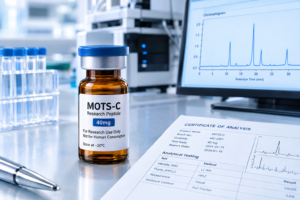
MOTS-C 40mg: Research Background, Quality Testing, and COA Guide
MOTS-C 40mg is a product-search term associated with MOTS-C, a mitochondria-derived peptide investigated for its potential role in cellular metabolism and metabolic signaling. For readers researching this material, understanding its scientific background, analytical testing, batch documentation, and research-use limitations is important before evaluating any laboratory product.
This guide explains what MOTS-C is, why researchers study it, how to interpret documentation such as a Certificate of Analysis (COA), and which quality questions matter when assessing a research peptide.
Research-use notice: MOTS-C discussed on this page is presented in a laboratory research context. This content is not medical advice and does not establish that any product is safe or effective for human use. Do not use research-labeled materials as medicines or for self-administration.
What Is MOTS-C?
MOTS-C is a short peptide encoded within the mitochondrial genome. It has attracted scientific interest because mitochondria do more than produce cellular energy: they also participate in signaling pathways connected to cellular stress responses and metabolism.
Researchers have investigated MOTS-C in experimental systems to understand how mitochondrial signals may interact with metabolic regulation. This work has generated interest in areas such as glucose metabolism, cellular energy balance, and responses to metabolic stress.
However, a biological mechanism observed in laboratory or animal studies does not automatically translate into a proven treatment or an established benefit in humans. The evidence must be evaluated according to the type of study, the model used, the measured outcomes, and whether the findings have been independently reproduced.
Why Does MOTS-C Attract Research Interest?
MOTS-C is relevant to research into communication between mitochondria and the rest of the cell. This area of biology is sometimes described as mitochondrial signaling.
Scientists study these signaling pathways to better understand how cells adapt to changing energy demands and other biological stresses. MOTS-C has been investigated in experimental research related to metabolic processes, but the field remains an area of investigation rather than a basis for broad clinical claims.
For a scientifically responsible product page, distinguish between three evidence categories:
- Laboratory findings: Observations made in cells or biochemical experiments.
- Preclinical findings: Results from animal or other nonhuman research models.
- Clinical evidence: Results from studies involving human participants.
These categories are not interchangeable. A product description should not present early-stage findings as established outcomes for people.
MOTS-C 40mg: Understanding the Product Specification
The term “40mg” generally refers to the labeled quantity associated with a product presentation. It does not, by itself, establish chemical identity, purity, biological activity, sterility, or suitability for a particular experiment.
Researchers evaluating a MOTS-C 40mg listing should look for clear product identification and supporting documentation. Important information may include the stated material name, lot or batch identifier, analytical methods, test date, and the identity of the laboratory that performed the testing.
Where documentation is available, confirm that it corresponds to the specific batch being evaluated. A generic report, an unrelated sample result, or a marketing statement is not a substitute for traceable analytical evidence.
What Does 40mg Mean?
Milligrams are a unit of mass. A 40mg label is not a measurement of purity, potency, or biological effect.
The stated quantity should be interpreted alongside the manufacturer’s product specification and batch records. If a listing does not clearly explain what its labeled quantity represents, request clarification rather than assuming that the number proves a particular quality standard.
MOTS-C and Mitochondrial Research
Mitochondria are commonly recognized for their role in cellular energy production. They also participate in signaling processes that can influence how cells respond to environmental changes and metabolic demands.
MOTS-C is studied as one possible component of this broader mitochondrial signaling network. Research has explored its relationship with pathways involved in metabolism and cellular stress responses. These findings are scientifically interesting, but they do not establish that a commercially listed MOTS-C material produces a specific effect in humans.
Metabolic Research and Scientific Limitations
The scientific interest surrounding MOTS-C should be considered in context. Experimental results can depend on the model, the method used to study the peptide, the conditions of the experiment, and the outcome being measured.
It is therefore inappropriate to infer that MOTS-C 40mg is a proven weight-management product, muscle-building product, anti-aging intervention, or treatment for a metabolic disorder.
Readers seeking evidence should prioritize peer-reviewed publications, well-described experimental methods, and transparent reporting of limitations. Commercial descriptions should not be treated as a replacement for the scientific literature.
MOTS-C 40mg Purity: What Should Researchers Check?
Purity is a key analytical consideration for research peptides. Yet the word “purity” is meaningful only when the method, sample, and reporting approach are understood.
For example, a chromatographic purity result reflects the interpretation of signals produced by a particular analytical method. It does not automatically establish every aspect of a sample’s quality.
When reviewing a MOTS-C 40mg product, look for documentation that identifies:
- The tested material and lot number.
- The analytical technique used.
- The reported result and its units or calculation basis.
- The test date and laboratory identity.
- Any relevant limitations, exclusions, or qualifications.
- Whether the report can be independently verified.
Do not assume a specific purity percentage without seeing valid, batch-specific evidence. Claims such as “high purity,” “ultra-pure,” or “laboratory verified” should be supported by documentation rather than repeated as unverified marketing language.
Purity Is Not the Same as Identity
A sample may produce a chromatogram with a dominant peak, but that result alone may not conclusively establish the identity of the principal component. Identity assessment and purity assessment are related but distinct questions.
A careful quality review considers whether the analytical techniques collectively support the material’s stated identity and whether the methods are appropriate for the claim being made.
MOTS-C HPLC Analysis
High-performance liquid chromatography, commonly abbreviated as HPLC, is an analytical technique used to separate components in a sample. In peptide analysis, a chromatogram can provide information about the separation profile under the stated testing conditions.
An HPLC report may include a chromatogram, retention times, integrated peak areas, a method description, and a reported area percentage. The meaning of the reported percentage depends on the method and the laboratory’s calculation and reporting practices.
When assessing a MOTS-C HPLC report, check whether the report identifies the sample and batch, describes the method sufficiently, and explains the reported result. Confirm that the document is genuine and corresponds to the material under review.
Important: An HPLC area percentage should not automatically be interpreted as an absolute measurement of all impurities, overall safety, sterility, or biological activity.
Questions to Ask About HPLC Documentation
- Is the sample linked to a traceable batch or lot?
- Is the analytical method identified?
- Are the chromatogram and reported result readable?
- Is the laboratory named and verifiable?
- Does the report explain how the result was calculated?
- Are the method’s limitations acknowledged?
These questions help readers distinguish meaningful analytical documentation from an unsupported quality claim.
MOTS-C Mass Spectrometry and Molecular Identity
Mass spectrometry is an analytical technique that measures ions according to their mass-to-charge ratios. It can support the characterization of a compound and, when used with suitable methods, help assess whether observed data are consistent with an expected molecular identity.
For peptide materials, mass-spectrometric results may be considered alongside chromatographic analysis and other relevant characterization methods. The suitability of the technique depends on the instrument, method, sample preparation, and interpretation of the data.
A product page should not claim that MOTS-C 40mg has passed mass-spectrometry testing unless the relevant report is available and supports that statement.
Molecular Weight and Peptide Sequence
Molecular weight is a property of a defined molecular structure. Before publishing a molecular-weight figure, confirm the peptide sequence, chemical form, and the reference source used for the calculation.
Different reporting conventions can produce different values, particularly when comparing average molecular mass with monoisotopic mass. A scientifically sound page should identify the convention and avoid copying an unverified number from another commercial listing.
The amino acid sequence is also important for peptide identity. Sequence information should be taken from a credible scientific reference or validated specification, not inferred solely from a product name.
MOTS-C 40mg COA: How to Read a Certificate of Analysis
A Certificate of Analysis, or COA, is a document that reports testing or quality-control information for an identified material. Its value depends on authenticity, traceability, method suitability, and the scope of the tests actually performed.
A useful MOTS-C 40mg COA should make it possible to connect the report to the material being assessed. A document without a batch identifier or clear sample identity may provide limited assurance about a specific product.
What Information May Appear on a COA?
A research-material COA may include:
- Product or material name.
- Lot or batch number.
- Sample identifier.
- Test date and report date.
- Analytical method or methods.
- Reported results and units.
- Laboratory identification.
- Authorized review or approval details, where applicable.
- Notes on limitations or test scope.
Not every COA contains every field. The appropriate requirements depend on the material, intended laboratory work, and applicable quality procedures.
How to Evaluate a MOTS-C COA
Start by checking the material name and batch identifier. Confirm that they match the product documentation. Next, review the analytical methods and results. Determine whether the reported tests support the claims being made.
If a page advertises HPLC purity, mass spectrometry, or third-party testing, the evidence should be consistent with those specific statements. A COA should not be presented as proof of sterility, clinical safety, regulatory approval, or effectiveness unless the document and relevant evidence genuinely establish the particular claim.
If the report is unclear, incomplete, or unverifiable, treat the claim cautiously.
Batch Traceability and Research Material Quality
Batch traceability allows a material to be linked to its associated records. It is an important part of responsible laboratory documentation because results from one batch should not automatically be assumed to apply to another.
For MOTS-C 40mg, useful traceability information can include a consistent lot identifier across the product label, COA, and supporting records. Dates, sample identifiers, and laboratory references should be internally consistent.
Researchers should also distinguish between supplier documentation and independent verification. A supplier-issued report may be useful, but the name “third-party tested” should be used only when an independent testing arrangement is documented.
Storage and Handling Documentation
Storage conditions should be based on validated product-specific instructions and applicable laboratory procedures. Do not assume that every MOTS-C preparation has the same stability profile or storage requirements.
A product page should reproduce only supported storage information. It should not invent shelf-life claims, temperature limits, reconstitution instructions, or stability periods without appropriate evidence.
Laboratory personnel should follow the material’s documented handling requirements and their institution’s safety procedures.
MOTS-C 40mg in the United States: Regulatory and Research-Use Considerations
In the United States, a product marketed for laboratory research should not be represented as an FDA-approved medicine unless that status is established for the specific product and intended use.
A “Research Use Only” label is not proof that a product is approved, safe, or suitable for administration to humans. Regulatory status depends on the substance, product, claims, and intended use. Researchers and businesses should consult current official guidance and qualified regulatory counsel where necessary.
This page does not make a determination about the regulatory status of any particular MOTS-C 40mg listing. Buyers should verify current requirements rather than relying on a supplier’s marketing language.
Avoiding Unsupported Health Claims
A scientifically responsible MOTS-C page should not promise weight loss, increased muscle mass, improved insulin sensitivity, anti-aging benefits, or treatment of a disease.
Such claims require appropriate evidence and, where applicable, regulatory authorization. Findings from early-stage research cannot be used as a substitute for established clinical evidence.
How to Evaluate a MOTS-C 40mg Research Supplier
When reviewing a supplier, focus on verifiable information rather than promotional language alone.
1. Product identification: Is the material clearly named and its labeled quantity explained?
2. Batch-specific documentation: Is a COA available for the relevant lot?
3. Analytical transparency: Are HPLC, mass-spectrometry, or other testing claims backed by readable reports?
4. Traceability: Do identifiers match across the product information and documents?
5. Clear limitations: Does the supplier avoid implying that laboratory testing establishes human safety or effectiveness?
6. Research-use wording: Are intended use and limitations stated clearly?
7. Contact and support: Can the supplier clarify documentation questions without making unsupported scientific claims?
These checks provide a more useful basis for evaluating research materials than price or a headline purity percentage alone.
Why Scientific Transparency Matters
Research quality depends on the material, experimental design, measurement methods, and interpretation of results. Incomplete documentation can make it difficult to assess whether an observed result is reproducible or attributable to the material under study.
Transparent documentation does not guarantee that every experiment will produce reliable results. It does, however, make it easier to evaluate the material and understand the limits of the available evidence.
For Peptides Grey House, product information should be specific, traceable, and consistent with available evidence. Publish a purity value, test result, or batch claim only when it can be substantiated.
Frequently Asked Questions About MOTS-C 40mg
1. What is MOTS-C 40mg?
MOTS-C 40mg is a product-search term for a labeled quantity of MOTS-C, a mitochondria-derived peptide studied in experimental research related to cellular metabolism and mitochondrial signaling. The label alone does not establish purity, identity, or suitability for a specific experiment.
2. What is MOTS-C studied for?
Researchers have investigated MOTS-C in relation to metabolic signaling and cellular responses to stress. The evidence base includes experimental research, and findings should not be presented as proof of established benefits in humans.
3. What does 40mg mean on a MOTS-C label?
Milligrams measure mass. The 40mg label refers to the stated quantity associated with the product presentation; it does not independently verify the amount, purity, potency, or biological activity of the material.
4. What is a MOTS-C COA?
A Certificate of Analysis reports specified testing or quality-control results for an identified sample or batch. Its usefulness depends on the document’s authenticity, traceability, test methods, and reported results.
5. Does an HPLC report prove that MOTS-C is safe?
No. HPLC can provide information about sample separation under a stated method, but it does not by itself establish human safety, sterility, regulatory approval, or clinical effectiveness.
6. Why is mass spectrometry relevant to peptide analysis?
Mass spectrometry can help characterize a compound by measuring ion mass-to-charge ratios. Its results should be interpreted using a suitable method and alongside other relevant identity or quality information.
7. Does MOTS-C 40mg have proven weight-loss benefits?
A product label is not evidence of clinical efficacy. Experimental findings should not be treated as proof that MOTS-C produces weight loss or is an approved weight-management treatment.
8. Is MOTS-C 40mg FDA-approved?
Do not assume FDA approval based on a product listing or a research-use label. Verify the current regulatory status of the specific product and intended use through official U.S. sources.
9. What should I check before evaluating a MOTS-C product?
Review product identity, batch traceability, the availability and authenticity of a COA, analytical methods, and the scope of any purity or identity claims. Avoid relying on unsupported claims.
10. Can research-use MOTS-C be used as a medicine?
Research-use labeling does not establish suitability for human administration. Do not use research-labeled materials as medicines or for self-administration. Consult a qualified healthcare professional about medical questions.
Conclusion: MOTS-C 40mg Research Information
MOTS-C is an area of scientific interest because of its relationship to mitochondrial signaling and experimental metabolic research. When evaluating a MOTS-C 40mg listing, focus on accurate product identification, batch-specific COA documentation, appropriate analytical testing, traceability, and evidence-based wording.
A strong research product page should explain both what is known and what remains uncertain. It should never substitute marketing claims for scientific evidence or imply that laboratory testing establishes human safety or effectiveness.
Research-use disclaimer: Information on this page is provided for educational and laboratory research context only. It is not medical advice, does not recommend human use, and does not claim that MOTS-C is approved to diagnose, treat, cure, or prevent any disease.