

The Selank peptide sequence is a central component of the molecule’s scientific identity. Selank is commonly described as a synthetic heptapeptide consisting of seven amino-acid residues.
The standard one-letter representation of the sequence is:
TKPRPGP
In three-letter notation, the sequence is:
Thr–Lys–Pro–Arg–Pro–Gly–Pro
Understanding the
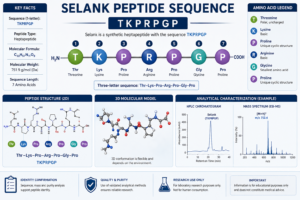
is useful for scientific discussions involving peptide identity, molecular characterization, analytical testing, and published research.
A peptide’s sequence identifies the order of its amino acids. However, sequence information alone does not verify the identity or quality of a specific physical research sample. Comprehensive characterization may also involve analytical testing, molecular-mass confirmation, chromatographic analysis, purity evaluation, and lot-specific documentation.
Research-use statement: Information regarding the Selank peptide sequence is provided for scientific and educational purposes. Molecular identity and published research findings should not be interpreted as establishing clinical safety, therapeutic effectiveness, or regulatory approval. This page does not provide dosing, administration, diagnosis, or treatment instructions.
What Is the Selank Peptide Sequence?
The complete Selank sequence is:
TKPRPGP
Each letter represents a specific amino acid.
| Position | One-Letter Code | Amino Acid |
|---|---|---|
| 1 | T | Threonine |
| 2 | K | Lysine |
| 3 | P | Proline |
| 4 | R | Arginine |
| 5 | P | Proline |
| 6 | G | Glycine |
| 7 | P | Proline |
Therefore, the complete sequence can be written as:
Thr–Lys–Pro–Arg–Pro–Gly–Pro
Selank is classified as a heptapeptide because it contains seven amino-acid residues.
The order of these amino acids is important. Changing the sequence, replacing an amino acid, or altering the structure can produce a different molecular entity with potentially different chemical and biological properties.
For this reason, sequence identity is one of the fundamental characteristics examined during peptide research and analytical characterization.
Breaking Down the TKPRPGP Sequence
The TKPRPGP sequence contains amino acids with different chemical properties.
T — Threonine
Threonine is a polar amino acid containing a hydroxyl group. It contributes to the chemical properties of the peptide chain and may participate in interactions influenced by its molecular environment.
K — Lysine
Lysine is a basic amino acid containing an amino side chain. Its chemical properties can influence peptide charge and interactions under different conditions.
P — Proline
Proline appears multiple times in the Selank sequence.
It occurs at positions:
- 3
- 5
- 7
Proline has a distinctive cyclic structure and can influence peptide conformation.
R — Arginine
Arginine is another basic amino acid. Its side chain contains a guanidino group, contributing to its chemical characteristics.
G — Glycine
Glycine is the smallest standard amino acid. Its relatively simple structure can contribute flexibility within peptide chains.
Together, these residues form the seven-amino-acid sequence:
TKPRPGP
Why Is the Selank Peptide Sequence Important?
The amino-acid sequence is a fundamental part of peptide identity.
For researchers, the sequence can be relevant when discussing:
- Molecular identity
- Peptide synthesis
- Analytical characterization
- Mass calculations
- Chromatographic analysis
- Research reproducibility
- Scientific literature
However, knowing the theoretical sequence does not confirm that a particular vial or sample contains the correct peptide.
For example, a product label may identify a material as Selank, but researchers may still require supporting information such as:
- Molecular characterization
- Chromatographic analysis
- Reported purity
- Mass spectrometry
- Lot identification
- Certificate of Analysis documentation
The strongest research documentation connects the theoretical molecular identity with the analytical results of the actual tested material.
Selank Molecular Identity
The Selank peptide sequence provides the basis for its expected molecular characteristics.
The sequence:
Thr–Lys–Pro–Arg–Pro–Gly–Pro
can also be represented as:
H-Thr-Lys-Pro-Arg-Pro-Gly-Pro-OH
Molecular identity information can be useful when comparing expected peptide properties with analytical results.
Depending on the analytical approach, researchers may examine:
Sequence Information
The expected amino-acid order:
TKPRPGP
Molecular Mass
Mass spectrometry may be used to compare observed molecular characteristics with expected properties.
Chromatographic Behavior
Methods such as HPLC can provide information about sample composition and chromatographic profiles.
Purity
A reported purity value generally reflects the results of a particular analytical method.
Lot Traceability
A batch or lot number can help connect a physical sample with its analytical documentation.
Selank Peptide Structure and Sequence
A peptide consists of amino acids connected through peptide bonds.
For Selank, the amino acids are arranged in the following order:
Threonine → Lysine → Proline → Arginine → Proline → Glycine → Proline
This sequence is not simply a list of ingredients. The order of the residues contributes to the molecular identity of the peptide.
For example:
TKPRPGP
is different from:
KTPRPGP
even though the same amino acids may be present.
Sequence order matters because molecular arrangement can influence:
- Molecular structure
- Chemical properties
- Folding behavior
- Intermolecular interactions
- Biological interactions investigated in research
Therefore, sequence verification is an important part of peptide characterization.
Selank Peptide Sequence and Tuftsin
Selank is often discussed in relation to the naturally occurring tetrapeptide tuftsin.
Tuftsin has the sequence:
TKPR
Selank extends this sequence to:
TKPRPGP
The additional residues are:
PGP
This structural relationship is part of the scientific background frequently discussed in Selank literature.
However, structural similarity between peptides should not automatically be interpreted as proof that they have identical biological properties.
Even relatively small sequence differences can influence:
- Molecular interactions
- Stability
- Distribution
- Receptor interactions
- Experimental outcomes
For scientific accuracy, the relationship between Selank and tuftsin should therefore be described as a structural and research context rather than as proof of equivalent biological activity.
Selank Peptide Sequence in Scientific Research
The Selank peptide sequence is relevant to several areas of scientific research.
Published research has examined Selank in experimental contexts involving:
- Molecular signaling
- GABA-related systems
- Gene expression
- Neurobiology
- Animal models
- Behavioral research
- Limited human studies
The sequence itself provides the molecular identity used when discussing these experiments.
However, scientific findings should always be interpreted according to the type of study performed.
A useful evidence framework is:
Molecular Research
Studies molecular interactions, receptors, and cellular processes.
Cell-Based Research
Examines responses under controlled laboratory conditions.
Animal Research
Investigates biological responses within animal models.
Human Research
Examines defined outcomes in specific human populations and study designs.
Broader Clinical Evidence
Requires substantial evidence, appropriate methodology, and replication.
These evidence categories are not interchangeable.
A molecular finding involving the TKPRPGP sequence does not automatically establish a clinical outcome.
Sequence Identity vs Product Identity
An important distinction in peptide research is the difference between a known theoretical sequence and a verified physical sample.
The theoretical Selank sequence is:
TKPRPGP
But researchers evaluating a specific sample may need to ask:
- Does the sample correspond to the expected sequence?
- Does the observed mass match expected characteristics?
- Is chromatographic testing available?
- What analytical method was used?
- Is purity reported?
- Does the documentation identify the tested lot?
This distinction is important because:
Sequence Information ≠ Sample Verification
A scientific website can accurately describe the Selank peptide sequence while also explaining that individual research materials require their own analytical documentation.
Analytical Methods for Selank Peptide Identification
Several analytical approaches may contribute to peptide characterization.
HPLC Analysis
High-performance liquid chromatography is commonly used in peptide analysis.
Depending on the method, HPLC can provide information about:
- Chromatographic peaks
- Sample composition
- Peak separation
- Relative purity
An HPLC report may be more useful when it includes:
- Sample identification
- Lot number
- Analytical method
- Test conditions
- Reported results
A purity percentage without supporting context provides less information than a documented analytical result.
Mass Spectrometry
Mass spectrometry can provide information about molecular mass.
For peptide research, observed molecular characteristics may be compared with values expected for the documented sequence.
For Selank:
TKPRPGP
Mass characterization can support peptide identification.
However, mass data alone may not always provide complete structural characterization. For this reason, researchers may consider multiple analytical approaches.
Sequence Confirmation
Depending on the research requirements, more detailed methods may be used to investigate peptide sequence and molecular identity.
The purpose of sequence-related analysis is to determine whether the observed material corresponds with the expected peptide structure.
For Selank, the reference sequence is:
TKPRPGP
Understanding Selank Purity
Purity is frequently discussed in peptide research, but it should not be confused with sequence identity.
A reported purity value generally reflects the result of a particular analytical method.
For example, chromatographic analysis may estimate the relative amount of a target component compared with other detectable components.
However:
High Purity Does Not Automatically Confirm Complete Identity
A comprehensive evaluation may consider:
- Expected sequence
- Molecular mass
- Chromatographic profile
- Analytical methodology
- Lot traceability
- Supporting documentation
For this reason, researchers should avoid evaluating a peptide sample based on one number alone.
Selank COA and Sequence Documentation
A Certificate of Analysis, or COA, can provide information associated with a specific peptide sample or batch.
Depending on the testing performed, a Selank COA may include:
- Product identification
- Lot or batch number
- Analytical method
- Reported purity
- Molecular characterization
- Test date
The usefulness of the documentation depends partly on whether it is connected to the actual research material.
A practical traceability structure is:
Selank Research Material
↓
Batch or Lot Number
↓
Analytical Testing
↓
Certificate of Analysis
This helps researchers determine whether analytical data corresponds to the material being studied.
Why Lot Traceability Matters
Reproducibility is an important principle in scientific research.
If different batches of material are used, researchers may need to know:
- Which lot was tested?
- When was it tested?
- What analytical methods were used?
- What were the reported results?
Lot traceability helps maintain a connection between:
Material identity
and
Analytical documentation
This can be particularly useful when comparing results between experiments or research projects.
Selank Sequence and Research Reproducibility
Reproducible research depends on accurately identifying experimental materials.
For peptide studies, documentation may include:
- Peptide name
- Amino-acid sequence
- Molecular characteristics
- Lot number
- Analytical information
- Storage records
- Experimental conditions
For Selank, documenting the sequence:
TKPRPGP
can help establish the theoretical molecular identity of the material under discussion.
Additional analytical documentation can help characterize the specific sample used.
A strong research record may therefore include both:
Molecular Information
and
Sample-Specific Analytical Documentation
Storage and Peptide Documentation
Peptide stability can depend on multiple variables.
These may include:
- Chemical form
- Formulation
- Moisture exposure
- Temperature
- Light
- Storage duration
Storage recommendations should ideally be based on product-specific information rather than assumptions based solely on peptide sequence.
Researchers documenting experimental materials may record:
- Product identification
- Selank sequence
- Lot number
- Date received
- Storage conditions
- Analytical documentation
Accurate records can support research reproducibility and quality control.