

Introduction to Ipamorelin 10mg
Ipamorelin is a synthetic peptide studied for its interaction with the ghrelin receptor and its ability to stimulate growth hormone release. It belongs to a class of compounds known as growth hormone secretagogues. Researchers have investigated its pharmacological properties and potential applications, although the available evidence does not establish that unapproved Ipamorelin products are safe or effective for general human use.
The term Ipamorelin 10mg generally refers to a product labeled as containing 10 milligrams of the compound or a specified preparation. That label alone does not establish the identity, purity, composition, stability, or quality of the material.
For scientific readers, understanding Ipamorelin involves several distinct questions:
-
What is the chemical structure of Ipamorelin?
-
What are its molecular formula and molecular weight?
-
How can researchers evaluate identity and chromatographic purity?
-
What does a Certificate of Analysis (COA) actually establish?
-
What are the limitations of current safety and regulatory evidence?
These topics are useful for a high-quality research information page because they provide context without confusing laboratory characterization with clinical approval.
2. Ipamorelin chemical structure and molecular properties
Ipamorelin is a synthetic pentapeptide, meaning its peptide backbone contains five amino acid-derived residues. Its structure includes nonstandard and stereochemically specified residues, which makes accurate chemical characterization important. PubChem lists the compound’s molecular for
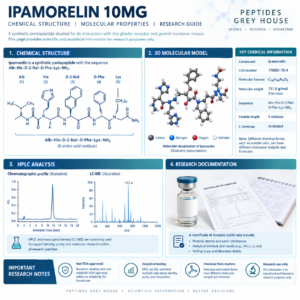
mula as C₃₈H₄₉N₉O₅ and its molecular weight as approximately 711.9 g/mol.
Compound
Ipamorelin
CAS number
170851-70-4
Molecular formula
C₃₈H₄₉N₉O₅
Molecular weight
711.9 g/mol
Condensed sequence
Aib–His–D-2-Nal–D-Phe–Lys–NH₂
These values refer to Ipamorelin free base. Acetate salts or other forms can have different formula and mass values.
What does the molecular formula tell researchers?
The molecular formula identifies the numbers of carbon, hydrogen, nitrogen, and oxygen atoms in the specified molecular form. It provides a reference for comparing theoretical and experimentally measured masses.
However, a formula alone cannot prove that a particular vial contains Ipamorelin. Identity assessment also depends on appropriate analytical evidence, such as mass spectrometry, chromatographic behavior, and reference comparisons.
Why does the chemical form matter?
Ipamorelin free base and Ipamorelin acetate are not interchangeable when reporting molecular mass. The acetate form includes associated acetate, and published databases may describe the salt using a different formula and molecular weight.
A product page should therefore specify the actual chemical form where verified, rather than copying a molecular weight from a different form of the compound.
3. Understanding Ipamorelin’s peptide sequence
The condensed sequence of Ipamorelin is commonly represented as Aib–His–D-2-Nal–D-Phe–Lys–NH₂. Each component contributes specific structural properties.
| Abbreviation | Description | Structural relevance |
|---|---|---|
| Aib | α-Aminoisobutyric acid | Nonstandard amino acid residue |
| His | Histidine | Contains an imidazole side chain |
| D-2-Nal | D-2-naphthylalanine | Aromatic residue containing a naphthyl group |
| D-Phe | D-phenylalanine | Aromatic residue with D stereochemistry |
| Lys | Lysine | Contains a basic amino side chain |
| NH₂ | C-terminal amide notation | Indicates the amidated C-terminus |
The D and L designations describe the stereochemical configuration of an amino acid residue. They are not decorative labels: the spatial arrangement of atoms can influence how a peptide interacts with biological targets.
The presence of nonstandard residues also means that simply counting five residues is not enough to describe the complete chemical structure. Researchers must account for residue identity, stereochemistry, terminal modification, and the order of the residues.
For SEO content, this section supports related searches such as Ipamorelin amino acid sequence, Ipamorelin chemical structure, and Ipamorelin molecular formula without repeatedly inserting the same keyword.
4. How Ipamorelin interacts with biological signaling
Ipamorelin has been investigated as a ghrelin-receptor agonist and growth hormone secretagogue. In scientific terms, this means it has been studied for its interaction with the growth hormone secretagogue receptor, often abbreviated GHSR, and its relationship to growth hormone release.
This mechanism is relevant to pharmacology research, but a mechanistic description should not be confused with proof of a clinical benefit.
Mechanism versus clinical evidence
Three concepts should be distinguished:
-
Receptor interaction: Whether a compound binds to or activates a particular receptor under defined experimental conditions.
-
Physiological response: Whether the interaction produces a measurable biological effect in a specific model or study.
-
Clinical outcome: Whether a treatment has been demonstrated to improve a meaningful health outcome in appropriately designed human studies.
Evidence for one category does not automatically establish the next. Findings from a laboratory model cannot, by themselves, demonstrate that an unapproved product improves muscle growth, sleep, recovery, body composition, or longevity.
For Peptides Grey House, this distinction supports scientifically credible content and reduces the risk of misleading medical or performance claims.
5. What does Ipamorelin 10mg mean?
The label “Ipamorelin 10mg” indicates a stated quantity of 10 milligrams. It does not independently verify the quantity, purity, chemical form, or biological activity of the contents.
The meaning of that label depends on the specific material and its documentation. For example, the label may refer to a stated amount of a peptide in a container, while the actual analytical result may require separate verification.
A responsible research product description should distinguish the following:
-
Labeled quantity: The amount stated on the product label.
-
Identity: Evidence that the material corresponds to the intended chemical.
-
Purity: The proportion attributed to the target component under a defined analytical method.
-
Content or assay: A measurement of how much target substance is present, using an appropriate method.
-
Stability: Evidence about how the material changes over time under specified conditions.
These properties are related but not synonymous. A high HPLC area percentage, for instance, should not be presented as proof that a container contains exactly 10mg of active peptide.
6. Ipamorelin purity and HPLC analysis
High-performance liquid chromatography, or HPLC, is an analytical technique that separates components in a sample. In peptide characterization, a suitable HPLC method can help assess the chromatographic profile and detect peaks associated with other components.
The interpretation depends on the method used, the detector, the reference material, and the way peaks are integrated.
What does an HPLC purity result mean?
A reported chromatographic purity percentage generally describes the relative signal assigned to the target peak under the specified analytical conditions. It does not necessarily equal the weight percentage of the entire sample.
For example, an HPLC result cannot automatically establish:
-
The exact milligrams of peptide in a container.
-
The complete identity of every impurity.
-
The absence of residual solvents or counterions.
-
Sterility or endotoxin status.
-
Safety or suitability for human administration.
A product page should publish a specific purity percentage only when it is supported by a relevant report and the test method is clearly identified.
Why method details matter
A meaningful analytical record identifies the method and gives enough information to interpret its result. Depending on the purpose, this may include the analytical technique, reference standard, sample identification, date, and reported acceptance criteria.
If Peptides Grey House publishes HPLC information, it should ensure that the displayed report belongs to the relevant material and that the result is described within its proper scope.
7. Ipamorelin LC-MS and mass spectrometry
Liquid chromatography–mass spectrometry (LC-MS) combines chromatographic separation with mass analysis. It can support the investigation of molecular mass and help characterize components in a sample.
Tandem mass spectrometry (MS/MS) adds fragmentation analysis, which may provide further evidence about structural features.
For Ipamorelin, theoretical mass values are useful reference points, but observed ions can differ from the neutral molecule’s mass because of protonation, charge state, adduct formation, and instrument conditions.
A responsible interpretation compares the observed data with the expected molecular form and appropriate reference information. A single matching mass does not necessarily establish every aspect of a peptide’s identity or purity.
8. Ipamorelin COA: What should researchers check?
A Certificate of Analysis (COA) reports specified analytical results for a material or batch. It is most useful when it is traceable to the exact material being assessed.
Material identity
The compound name, chemical form, and relevant identifiers should be clear.
Batch traceability
The lot number on the report should correspond to the material being described.
Analytical method and results
Check the method, actual reported results, date, and any stated acceptance criteria.
Testing scope
Determine which attributes were measured and which were not evaluated.
A COA should not be described as independent verification unless the testing arrangement and laboratory support that claim. A generic sample report is not a substitute for actual results for the specific lot.
The FDA has raised concerns about potential aggregation, peptide-related impurities, and immunogenicity risks for compounded Ipamorelin acetate. The agency also notes that the available safety information is insufficient to establish that certain proposed routes of administration are safe.
These concerns make it especially important not to equate a basic purity result with comprehensive safety evidence.
9. Ipamorelin stability, handling, and sample integrity
Peptide stability can be affected by temperature, moisture, pH, oxidation, formulation, packaging, and exposure to environmental conditions. The extent of these effects depends on the material and its chemical form.
A research article should not assign a universal shelf life or storage condition without supporting data. Instead, the material’s documentation should specify any validated storage requirements and relevant stability information.
Researchers evaluating a sample may consider:
-
Whether the material has an identifiable lot number.
-
Whether storage and transport conditions are documented.
-
Whether the container and packaging are appropriate for the specified material.
-
Whether the supplier provides relevant stability data.
-
Whether analytical results are available for the material at the time of testing.
Changes in appearance alone cannot reliably confirm or exclude chemical degradation. When stability is important to a research question, suitable analytical measurements are more informative than visual inspection alone.
10. Research applications and scientific limitations
Ipamorelin has been studied in pharmacological research, including investigations of growth hormone release and gastrointestinal motility. These research areas should be described in the context of the actual evidence rather than converted into broad product-benefit claims.
Potential areas of scientific investigation include:
Peptide characterization. Chemical analysis can help researchers examine identity, molecular mass, and the composition of a material.
Receptor pharmacology. Laboratory studies can investigate how a compound interacts with its target receptor under defined conditions.
Analytical method development. Researchers can develop and evaluate methods for separating and detecting the compound, subject to appropriate laboratory validation.
Structure–activity relationships. Studies may explore how residue identity and stereochemistry relate to measured biological responses.
Reference-material evaluation. Chemical identifiers and analytical measurements can support comparison with an appropriate reference standard.
These are descriptions of research areas, not assurances that a particular commercial product has been validated for any of these purposes.
Claims to avoid in product content
Avoid presenting Ipamorelin 10mg as a proven solution for muscle growth, fat loss, anti-aging, improved sleep, faster recovery, or increased athletic performance unless a specific claim is supported by appropriate clinical evidence and permitted under applicable regulations.
Similarly, avoid describing a research-labeled product as FDA-approved, pharmaceutical-grade, sterile, or independently tested unless the precise claim is substantiated.
11. Regulatory and safety considerations for a U.S. audience
Regulatory status depends on the product, intended use, formulation, and applicable law. A research label does not itself establish that a substance is lawful for every use or that it is suitable for administration to humans.
The FDA lists Ipamorelin acetate among bulk drug substances that may present significant safety risks in certain compounding contexts. Its stated concerns include potential immunogenicity associated with aggregation or peptide-related impurities, challenges in characterizing the compound, and serious adverse events reported in a study involving intravenous administration. The agency also states that information is insufficient to determine safety for certain other proposed injectable routes.
These statements concern the FDA’s evaluation of Ipamorelin acetate in compounding contexts; they should not be inaccurately generalized into a claim that every preparation has the same risk profile.
For a product information page, the safest editorial approach is to:
-
Clearly identify the material and its documented chemical form.
-
Avoid dosage or self-administration instructions.
-
Avoid unsupported therapeutic claims.
-
Distinguish analytical data from clinical evidence.
-
Ensure all regulatory statements reflect the actual product and its applicable status.