

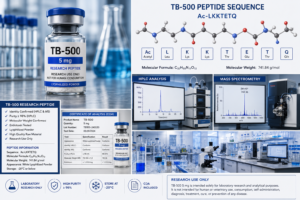
TB-500 5 mg is a synthetic peptide research material associated with the N-terminally acetylated seven-amino-acid fragment of thymosin beta-4. In scientific literature, TB-500 is commonly identified as Ac-LKKTETQ, corresponding to the N-terminally acetylated 17–23 region of thymosin beta-4.
This page provides scientific and analytical information for researchers interested in TB-500 research peptide materials, peptide identity, sequence characterization, analytical testing, and related laboratory research.
TB-500 5 mg is intended strictly for laboratory research and analytical purposes. It is not intended for human or veterinary consumption, self-administration, diagnosis, treatment, cure, or prevention of disease.
TB-500 5 mg at a Glance
| Specification | Information |
|---|---|
| Product | TB-500 |
| Quantity | 5 mg |
| Research category | Synthetic peptide |
| Common research identity | Ac-LKKTETQ |
| Related peptide | Thymosin beta-4 fragment |
| Typical presentation | Lyophilized research material, where applicable |
| Intended application | Laboratory and scientific research |
| Human use | Not intended for human use |
| Documentation | Lot-specific analytical documentation should be reviewed where available |
FDA’s Substance Registration System identifies TB-500 as the N-terminally acetylated 17–23 fragment of thymosin beta-4 and lists the synonym N-Acetyl-Leu-Lys-Lys-Thr-Glu-Thr-Gln. FDA also notes that a UNII record does not itself indicate regulatory approval.
What Is TB-500?
TB-500 is a synthetic peptide fragment associated with thymosin beta-4 research. The compound is commonly represented as Ac-LKKTETQ, consisting of seven amino acids with N-terminal acetylation.
The sequence is:
Ac-Lys? No — the sequence should be represented as:
Ac-LKKTETQ
where the individual residues are:
- L — Leucine
- K — Lysine
- K — Lysine
- T — Threonine
- E — Glutamic acid
- T — Threonine
- Q — Glutamine
Published analytical research has
using high-performance liquid chromatography and high-resolution mass spectrometry.
TB-500 and full-length thymosin beta-4 should not automatically be treated as identical substances. TB-500 represents a much smaller peptide fragment, while thymosin beta-4 is a naturally occurring 43-amino-acid peptide.
That distinction is important when interpreting scientific literature and designing research protocols.
TB-500 Research Peptide Sequence
The commonly reported TB-500 research sequence is:
Ac-LKKTETQ
The Ac- designation indicates N-terminal acetylation.
Scientific identification of TB-500 has relied on analytical techniques including liquid chromatography and mass spectrometry. A published study synthesized and characterized the N-terminally acetylated 17–23 fragment and reported its identification using HPLC/high-resolution mass spectrometry.
For research laboratories, sequence information can be useful when evaluating:
- Peptide identity
- Molecular characterization
- Analytical standards
- Chromatographic profiles
- Mass-spectrometry results
- Structure-related research
- Peptide synthesis verification
Researchers should always compare analytical documentation with the exact material and lot under investigation.
TB-500 and Thymosin Beta-4
Although TB-500 is closely associated with thymosin beta-4 research, the two should be distinguished.
Thymosin beta-4 is a naturally occurring peptide containing 43 amino acids.
TB-500 is commonly described as an N-terminally acetylated seven-amino-acid fragment corresponding to residues 17–23 of thymosin beta-4.
This difference matters because research findings involving full-length thymosin beta-4 cannot automatically be assumed to apply to TB-500.
A 2012 analytical study specifically characterized Ac-LKKTETQ as the N-terminally acetylated 17–23 fragment associated with TB-500.
TB-500 Research Applications
The scientific interest surrounding TB-500 comes from research involving peptide biology, actin-associated pathways, cellular processes, metabolism, and analytical detection.
Research areas associated with TB-500 and related thymosin beta-4 fragments include:
Peptide Characterization
TB-500 can be studied as a defined synthetic peptide using chromatographic and mass-spectrometric methods.
Analytical Chemistry
Researchers can investigate peptide identity, purity profiles, degradation products, and metabolites using appropriate analytical methods.
Peptide Metabolism
Recent research has investigated the metabolism of TB-500 and identified metabolites using UHPLC and high-resolution mass spectrometry.
Cellular Research
Related thymosin beta-4 research has examined biological processes involving cellular migration and actin-associated mechanisms. These findings provide scientific context but should not be interpreted as proof of therapeutic effectiveness for TB-500.
Doping-Control Research
TB-500 has also been investigated in analytical anti-doping research, including methods for identifying the compound and related metabolites.
TB-500 HPLC and Mass Spectrometry Research
Analytical testing is an important consideration when evaluating research peptides.
High-performance liquid chromatography (HPLC) can provide chromatographic information about a peptide sample and help researchers evaluate the presence of major components and related impurities.
Mass spectrometry (MS) can provide molecular-mass information useful for evaluating peptide identity.
Published TB-500 research has demonstrated the use of HPLC combined with high-resolution mass spectrometry for identifying Ac-LKKTETQ.
A separate study developed a UHPLC-Q-Exactive Orbitrap MS/MS approach for simultaneous analysis of TB-500 and its metabolites, demonstrating the relevance of advanced mass-spectrometric techniques to TB-500 analytical research.
For research purposes, analytical results are most useful when they are associated with:
- A defined sample
- A specific lot
- Appropriate analytical methodology
- Traceable documentation
- Clearly reported results
TB-500 5 mg Quality Considerations
A stated peptide quantity does not by itself establish research material quality.
When evaluating TB-500 5 mg, laboratories may consider several categories of documentation.
Identity Testing
Identity testing helps establish whether the material corresponds to the expected peptide.
Mass spectrometry is one analytical method that can contribute to peptide identity characterization.
Purity Testing
Chromatographic analysis can provide information about the major peptide component and detectable related substances.
Purity percentages should always be interpreted in the context of the analytical method used.
Lot Traceability
A lot number allows the physical material to be connected to its analytical documentation.
Certificate of Analysis
A Certificate of Analysis (COA) may include information such as:
- Product name
- Lot number
- Test date
- Identity testing
- Purity testing
- Analytical method
- Laboratory information
- Reported specifications
Researchers should review the COA corresponding to the specific lot rather than relying on a generic or unrelated document.
Why a TB-500 COA Matters
A lot-specific TB-500 COA can provide useful documentation for laboratory purchasing and recordkeeping.
When reviewing a COA, researchers may want to confirm:
- The product name matches the material received.
- The lot number matches the vial or packaging.
- The analytical method is identified.
- The reported purity result is clearly stated.
- Identity testing is documented where applicable.
- The testing laboratory is identified.
- The report date and sample information are available.
A COA should be considered part of a broader quality-control process rather than the sole indicator of material suitability.
TB-500 5 mg Research Material and Storage
Research peptide stability can depend on formulation, packaging, environmental conditions, and the physical form of the material.
Researchers should follow the specific manufacturer’s storage documentation for the product and lot being evaluated.
FDA’s 2026 technical review materials describe reported storage conditions for TB-500 free base in powder form involving sealed, moisture- and light-protected storage under nitrogen at controlled subzero temperatures. FDA also notes that stability can be affected by formulation, processing, and environmental conditions, including aggregation and degradation.
For this reason, storage information should not be generalized across every TB-500 formulation.
General laboratory considerations include:
- Maintaining appropriate temperature control
- Protecting material from unnecessary moisture
- Limiting unnecessary light exposure
- Maintaining container integrity
- Avoiding unnecessary environmental stress
- Recording storage conditions where required
- Following institutional laboratory procedures
TB-500 Research: Metabolism and Analytical Studies
TB-500 has been the subject of analytical research examining both the parent peptide and its metabolites.
A 2024 study developed a method for simultaneously quantifying TB-500 and metabolites using UHPLC-Q-Exactive Orbitrap MS/MS. The researchers investigated metabolism in experimental systems and reported several metabolites, illustrating the importance of distinguishing the parent compound from products formed during metabolism.
This type of research is valuable because peptide metabolism can complicate the interpretation of biological and analytical results.
For researchers, understanding the distinction between:
Parent peptide → Metabolites → Analytical signals
can be important when developing detection or characterization methods.
TB-500 Laboratory Research
A research laboratory evaluating TB-500 may investigate questions involving:
- Peptide identity
- Sequence characterization
- Chromatographic behavior
- Mass-spectrometric detection
- Peptide purity
- Metabolism
- Degradation
- Related peptide fragments
- Analytical reference standards
- Structure-related research
The most appropriate research application depends on the laboratory’s scientific objectives and validated procedures.
TB-500 should not be represented as an established treatment simply because biological activity has been observed in experimental systems.
TB-500 Research Peptide vs. Therapeutic Claims
Scientific research and therapeutic marketing are different categories.
Experimental studies can provide information about molecular mechanisms or biological observations. They do not automatically establish that a compound is safe or effective as a human treatment.
FDA’s current materials state that there is limited safety information concerning TB-500-related substances and identify concerns including potential immunogenicity, aggregation, and peptide-related impurities. FDA also notes a lack of important human safety information.
Therefore, a responsible TB-500 product page should avoid unsupported claims such as:
- Treats injuries
- Heals wounds in humans
- Relieves pain
- Builds muscle
- Accelerates recovery
- Treats inflammation
- Cures disease
Instead, the page should focus on legitimate research topics such as peptide identity, analytical characterization, laboratory research, and scientific literature.
TB-500 and Sports Research
TB-500 is also relevant to sports anti-doping research.
WADA research has examined TB-500 metabolism and the development of analytical detection approaches for TB-500 and its metabolites.
The 2026 anti-doping rules applicable to a particular athlete or sport should always be checked directly against the current governing rules.
Competitive athletes should not interpret a research-use product description as evidence that a substance is permitted for competition.
TB-500 5 mg Product Specifications
For a commercial research-product page, the following specification structure is recommended:
| Product Information | TB-500 5 mg |
|---|---|
| Product type | Research peptide |
| Amount | 5 mg |
| Peptide | TB-500 |
| Common sequence | Ac-LKKTETQ |
| Related peptide | Thymosin beta-4 fragment |
| Form | Lyophilized, where applicable |
| Intended use | Laboratory research |
| COA | Lot-specific documentation where available |
| Human use | Not intended for human use |
The final specification table should be updated to match the actual product’s manufacturer documentation, formulation, and lot-specific analytical report.
Choosing a TB-500 Research Peptide
When selecting a TB-500 research peptide, researchers should evaluate more than the product name.
Important considerations include:
Product Identification
The product should have clear identification and quantity information.
Analytical Documentation
Look for appropriate identity and purity documentation.
Lot Traceability
The lot number should connect the product to its documentation.
Transparent Research-Use Labeling
The product should be clearly identified as a laboratory research material.
Quality Documentation
Where available, researchers should review relevant COA and analytical information before incorporating research material into laboratory work.