
CJC-1295 No DAC 5mg Research Peptide: Specifications & Research Guide
CJC-1295 No DAC 5mg Research Peptide
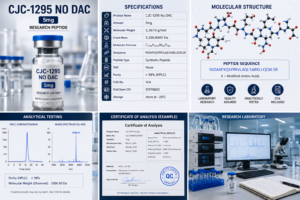
CJC-1295 No DAC 5mg is a research peptide material used in laboratory and scientific research. Researchers evaluating peptide materials may examine chemical identity, amino-acid sequence, molecular weight, analytical purity, batch documentation, and other quality-control characteristics.
CJC-1295 is commonly discussed in connection with growth-hormone-releasing hormone (GHRH) research. The term No DAC distinguishes this material from CJC-1295 formulations containing the Drug Affinity Complex (DAC). Because these forms have different chemical characteristics, researchers should verify the exact material and analytical documentation associated with a particular batch.
For research purposes, the chemical identity of a peptide is more informative than its commercial name alone. Relevant information can include molecular formula, expected molecular mass, peptide sequence, analytical testing, purity measurements, and certificate-of-analysis documentation.
Research-use statement: CJC-1295 No DAC 5mg is presented here for laboratory and scientific research purposes only
. This content does not provide instructions for administration to humans or animals and does not represent CJC-1295 as an approved medical treatment.
What Is CJC-1295 No DAC?
CJC-1295 is a synthetic peptide associated with research involving GHRH-related signaling and peptide characterization. CJC-1295 No DAC refers to the form without the Drug Affinity Complex modification.
The distinction between CJC-1295 with DAC and without DAC is important because the chemical structures and molecular weights are different.
When evaluating a CJC-1295 No DAC research material, researchers should confirm:
- Peptide identity
- Sequence
- Molecular formula
- Molecular weight
- Batch number
- Purity
- Analytical testing
- Certificate of Analysis
- Chemical form
These characteristics can help researchers determine whether the material matches the intended research compound.
CJC-1295 No DAC Molecular Weight
One of the most frequently searched specifications for this peptide is CJC-1295 No DAC molecular weight.
The PubChem record for CJC-1295 Without DAC lists:
Molecular weight: approximately 3,367.9 g/mol
Exact mass: approximately 3,366.8969 Da
Molecular formula: C152H252N44O42
PubChem CID: 91976842
The molecular-weight value should be interpreted according to the exact chemical form represented by the analytical documentation. Researchers should not automatically substitute the molecular weight of CJC-1295 with DAC for a No DAC material.
CJC-1295 No DAC Peptide Sequence
The sequence reported for CJC-1295 Without DAC is commonly represented using modified amino-acid notation.
For research documentation, the sequence should always be verified against the specific supplier’s Certificate of Analysis and analytical data.
Sequence information is useful for:
- Molecular identification
- Mass-spectrometry interpretation
- Peptide characterization
- Research documentation
- Comparative peptide studies
- Quality-control evaluation
A peptide’s sequence and chemical modifications can influence its expected molecular mass and analytical profile.
CJC-1295 No DAC vs. CJC-1295 With DAC
The terms CJC-1295 No DAC and CJC-1295 with DAC should not be treated as interchangeable.
The DAC component is associated with a modification designed to alter the peptide’s interaction and pharmacokinetic characteristics. Consequently, CJC-1295 with DAC has a different molecular structure and molecular weight from the No DAC form.
For SEO and scientific accuracy, product pages should clearly identify which form is being offered.
Key Difference
| Characteristic | CJC-1295 No DAC | CJC-1295 With DAC |
|---|---|---|
| DAC component | No | Yes |
| Chemical form | Different | Different |
| Molecular weight | ~3,367.9 Da | Higher than No DAC |
| Research identification | Verify COA | Verify COA |
| Analytical profile | Form-specific | Form-specific |
A research laboratory should use the analytical documentation corresponding to the exact material rather than relying on the generic CJC-1295 name.
CJC-1295 No DAC 5mg Product Specifications
A clear specifications section helps researchers quickly identify important product information.
| Specification | CJC-1295 No DAC |
|---|---|
| Product | CJC-1295 No DAC 5mg |
| Research classification | Research use only |
| Chemical type | Synthetic peptide |
| Molecular weight | ~3,367.9 g/mol |
| Exact mass | ~3,366.8969 Da |
| Molecular formula | C152H252N44O42 |
| DAC | None |
| PubChem CID | 91976842 |
| Purity | Verify batch-specific COA |
| Physical form | Verify current product documentation |
The molecular information should be presented as compound-level reference information. Batch-specific characteristics should come from the actual Certificate of Analysis.
CJC-1295 No DAC Research Background
CJC-1295 is associated with research into GHRH-related peptide signaling.
GHRH is a peptide hormone involved in the regulation of growth hormone release. Synthetic peptide analogues related to GHRH have therefore been studied as research tools for examining receptor signaling, peptide structure, and endocrine pathways.
However, laboratory findings involving CJC-1295 should be interpreted according to the specific peptide form studied.
Research involving CJC-1295 with DAC should not automatically be described as evidence concerning CJC-1295 No DAC. The presence or absence of the DAC modification can materially change the characteristics of the peptide.
For an accurate research product page, it is preferable to describe the compound’s chemical identity and published research context rather than make broad therapeutic claims.
Why Researchers Examine CJC-1295 No DAC
CJC-1295 No DAC can be relevant to laboratory research involving peptide characterization and GHRH-related biology.
Research interests may include:
- Peptide structure
- Receptor-related research
- Synthetic peptide characterization
- Analytical testing
- Molecular-weight confirmation
- Chromatographic purity
- Comparative peptide studies
- Stability research
- Laboratory assay development
The specific experimental application depends on the research institution, scientific objective, validated methodology, and applicable requirements.
This page intentionally does not provide human or animal administration protocols.
CJC-1295 No DAC Purity
Purity is an important consideration when selecting a research peptide.
A reported purity percentage can provide useful information, but researchers should also consider how purity was measured and whether identity testing was performed.
Analytical methods commonly associated with peptide characterization can include:
HPLC
High-performance liquid chromatography can be used to evaluate chromatographic purity and identify related components.
LC-MS
Liquid chromatography combined with mass spectrometry can provide information about molecular mass and chromatographic behavior.
Mass Spectrometry
Mass spectrometry can help compare the observed molecular mass with the expected molecular mass of the research compound.
Using complementary analytical methods can provide a more comprehensive evaluation than relying on one measurement alone.
CJC-1295 No DAC COA
A Certificate of Analysis (COA) is an important document for evaluating a research-peptide batch.
A useful COA may include:
- Product name
- Batch or lot number
- Test date
- Purity result
- Analytical method
- Molecular-weight or mass-spectrometry information
- Appearance
- Peptide-content information
- Testing laboratory
- Storage information
How to Review a CJC-1295 No DAC COA
Start by checking that the product name and batch number match the material received.
Next, compare the documented molecular characteristics with the expected specifications for CJC-1295 No DAC.
Finally, review the analytical testing method and reported purity.
A batch-specific COA provides substantially more useful information than a generic statement such as “high purity.”
CJC-1295 No DAC Analytical Testing
Analytical characterization is important because peptide names can sometimes be used inconsistently in commercial settings.
Researchers may use analytical testing to investigate:
- Molecular identity
- Molecular mass
- Purity
- Related substances
- Peptide integrity
- Batch consistency
HPLC Analysis
HPLC can provide a chromatographic profile and estimated purity based on the analytical method used.
Mass Spectrometry
Mass spectrometry can provide molecular-mass information that can be compared with the expected mass.
Combined Analytical Approach
HPLC and mass spectrometry can provide complementary information. Chromatography focuses on separation and relative abundance, while mass spectrometry can help evaluate molecular identity.
For research materials, the interpretation of analytical results should be performed by appropriately qualified personnel.
CJC-1295 No DAC Storage Considerations
Research peptide storage requirements can vary according to formulation, packaging, environmental conditions, and supplier specifications.
A product page should therefore avoid presenting one universal storage protocol unless it is supported by the manufacturer’s current documentation.
Researchers should:
- Follow the supplier’s storage instructions.
- Keep research materials appropriately sealed.
- Minimize unnecessary environmental exposure.
- Maintain lot and storage records.
- Follow applicable laboratory procedures.
- Use validated stability information where available.
Storage conditions should be evaluated for the specific formulation rather than assumed from the product name.
CJC-1295 No DAC Quality-Control Checklist
Before evaluating a CJC-1295 No DAC research material, consider the following:
1. Chemical Identity
Is the material clearly identified as CJC-1295 without DAC?
2. Molecular Weight
Does the expected molecular mass correspond to the documented chemical form?
3. Sequence
Does the documented peptide sequence match the intended research material?
4. Purity
Is batch-specific purity testing available?
5. Analytical Testing
Are suitable analytical methods documented?
6. COA
Is a Certificate of Analysis available for the specific lot?
7. Batch Traceability
Does the lot number match between the product and COA?
8. Research Labeling
Is the material clearly identified for laboratory research rather than therapeutic use?
This checklist can help researchers organize the information required for research-material evaluation.
CJC-1295 No DAC 5mg Research Applications
CJC-1295 No DAC may be examined in laboratory settings involving synthetic peptide research and GHRH-related biological investigations.
Potential research areas can include:
- Peptide chemistry
- Structure-function research
- Receptor-related research
- Analytical characterization
- Peptide stability studies
- Chromatographic analysis
- Mass-spectrometry research
- Comparative peptide investigations
These descriptions refer to research contexts and should not be interpreted as evidence that the compound is approved for treatment or that it produces a particular clinical outcome.
Why Chemical Accuracy Matters
A high-quality peptide product page should make it easy for researchers to distinguish:
CJC-1295 No DAC
from:
CJC-1295 With DAC
and from other GHRH-related peptides.
Using precise terminology improves both scientific communication and SEO relevance.
Search engines increasingly evaluate content based on topical coverage rather than simple repetition of a keyword. A page that naturally covers molecular weight, sequence, purity, COA, analytical testing, chemical identity, and research background can provide substantially more useful topical coverage.