

CJC-1295 NO DAC 5mg Overview
CJC-1295 NO DAC is a synthetic peptide commonly studied in laboratory research involving peptide signaling and growth hormone-releasing hormone (GHRH)-related pathways. The NO DAC designation distinguishes this peptide from CJC-1295 variants containing the Drug Affinity Complex, commonly abbreviated as DAC.
For researchers working with synthetic peptides, identifying the exact molecular form is important. Two products may have similar names while possessing different structures, modifications, molecular weights, and experimental characteristics.
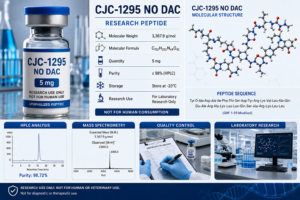
CJC-1295 NO DAC 5mg refers to a research peptide supplied in a 5mg quantity. Researchers evaluating this material should consider product identity, analytical purity, molecular-weight information, batch traceability, Certificate of Analysis (COA) documentation, and appropriate laboratory storage.
The DAC-free form is also commonly associated with modified GRF(1-29) in peptide research literature and commercial research contexts.
This guide explains the basic characteristics of CJC-1295 NO DAC, its research context, analytical considerations, quality-control documentation, and important product information.
Research-use statement: CJC-1295 NO DAC 5mg is intended for laboratory research and analytical purposes only. It is not intended for human or veterinary use, diagnosis, treatment, prevention, or cure of any disease or medical condition.
What Is CJC-1295 NO DAC?
CJC-1295 NO DAC is a synthetic peptide related to the GHRH peptide family. The term NO DAC means that the material does not contain the additional Drug Affinity Complex modification associated with DAC-containing CJC-1295.
The distinction is important for researchers because structural modifications can change the chemical and biochemical characteristics of a peptide.
CJC-1295 NO DAC is frequently discussed in connection with the sequence corresponding to modified GRF(1-29). Researchers should nevertheless verify the precise identity, sequence, modification status, and molecular form using the documentation associated with the specific research material.
A research peptide should not be identified solely by its commercial name. Appropriate analytical documentation provides a stronger basis for confirming the material being studied.
CJC-1295 NO DAC Molecular Weight
The molecular weight is an important specification for peptide research.
For the DAC-free CJC-1295 form, a commonly reported molecular weight is approximately:
3,367.9 g/mol
The molecular formula commonly associated with the DAC-free form is:
C152H252N44O42
Researchers should be aware that molecular-weight values can differ between sources depending on the precise chemical form, calculation convention, terminal modifications, counterions, or other specification details.
For scientific documentation, the molecular-weight value corresponding to the exact material and analytical documentation should take precedence.
Product Specification Table
| Specification | CJC-1295 NO DAC 5mg |
|---|---|
| Product Name | CJC-1295 NO DAC |
| Quantity | 5mg |
| Molecular Weight | Approximately 3,367.9 g/mol |
| Molecular Formula | C152H252N44O42 |
| Material Type | Synthetic peptide |
| Physical Form | Typically lyophilized |
| Research Category | Peptide research |
| Intended Application | Laboratory research |
| Human Use | Not intended |
Why Molecular Weight Matters
Molecular weight is one of the fundamental properties used when characterizing synthetic peptides.
Researchers may use molecular-weight information when:
- Comparing related peptide materials
- Interpreting mass-spectrometry results
- Designing analytical experiments
- Calculating molecular quantities
- Reviewing product specifications
- Evaluating theoretical versus observed mass
- Confirming peptide identity
- Developing laboratory methods
Molecular weight alone does not establish purity, biological activity, or suitability for a particular experiment.
For stronger characterization, researchers may combine molecular-weight information with chromatographic and spectrometric testing.
CJC-1295 NO DAC Peptide Sequence
CJC-1295 NO DAC is frequently described in research contexts as a modified GRF(1-29)-related peptide.
A commonly referenced sequence is:
Tyr-D-Ala-Asp-Ala-Ile-Phe-Thr-Ser-Asp-Tyr-Arg-Lys-Val-Leu-Ala-Gln-Glu-Ala-Arg-Ala-Lys-Leu-Leu-Gln-Ser-Ala-Arg-Lys-Leu-Leu
However, peptide nomenclature and sequence descriptions can vary depending on the exact modification and commercial specification.
For this reason, researchers should use the sequence stated on the specific supplier’s analytical documentation rather than assuming that every product marketed under a similar name has an identical chemical structure.
This is particularly important when comparing CJC-1295 NO DAC with other GHRH-related research peptides.
CJC-1295 NO DAC vs. CJC-1295 With DAC
One of the most important distinctions in CJC-1295 research is the difference between DAC-free and DAC-containing forms.
CJC-1295 NO DAC
The NO DAC form does not contain the Drug Affinity Complex modification.
It is commonly associated with modified GRF(1-29) research and is evaluated as a distinct synthetic peptide.
CJC-1295 With DAC
CJC-1295 with DAC contains an additional chemical modification intended to alter its properties.
The two forms therefore should not automatically be considered interchangeable.
Comparison
| Characteristic | CJC-1295 NO DAC | CJC-1295 With DAC |
|---|---|---|
| DAC modification | No | Yes |
| Chemical structure | Different | Different |
| Research identity | DAC-free | DAC-containing |
| Analytical profile | Distinct | Distinct |
| Interchangeable | No | No |
When ordering research materials, researchers should carefully verify the exact peptide form.
CJC-1295 NO DAC 5mg Research Applications
CJC-1295 NO DAC can be studied within broader laboratory research involving synthetic peptides and GHRH-related signaling.
Potential research contexts include:
Peptide Characterization
Researchers can investigate chemical characteristics and analytical profiles of synthetic peptides.
Structure-Function Research
Scientists may investigate relationships between peptide structure and observed biochemical characteristics.
Analytical Chemistry
CJC-1295 NO DAC may be used as a research material in analytical method-development and characterization studies.
Peptide Stability Research
Controlled experiments can evaluate how peptide materials behave under defined laboratory conditions.
Comparative Research
Researchers may compare DAC-free peptide materials with related compounds or peptide analogues.
Mass Spectrometry
Molecular-weight information can provide a theoretical reference when interpreting mass-spectrometry data.
Chromatographic Research
HPLC and related techniques can be used to evaluate chromatographic profiles and purity under defined analytical methods.
These are examples of scientific research contexts rather than claims of clinical effectiveness.
CJC-1295 NO DAC Purity
Purity is an important consideration when selecting a synthetic research peptide.
A reported purity percentage should always be considered together with the analytical method used to obtain that result.
For example, an HPLC purity result describes the chromatographic profile under a particular testing method. It does not necessarily establish every aspect of chemical identity or biological activity.
Researchers should therefore review:
- Reported purity
- Analytical technique
- Testing date
- Batch number
- Product identity
- Supporting analytical documentation
Where available, lot-specific documentation can improve confidence in research-material traceability.
CJC-1295 COA: Certificate of Analysis
A Certificate of Analysis, or COA, is an important quality-control document for research materials.
A COA may contain information such as:
- Product name
- Batch or lot number
- Purity
- Identity
- Testing method
- Analytical results
- Test date
- Appearance
- Specification limits
Researchers should confirm that the COA corresponds to the exact batch being evaluated.
Why a COA Matters
Scientific experiments depend on reproducibility. If researchers know which specific batch was used, they can better connect experimental results with the characteristics of the research material.
Good documentation can therefore support:
- Traceability
- Quality control
- Research reproducibility
- Laboratory recordkeeping
- Material verification
HPLC Analysis of CJC-1295 NO DAC
High-performance liquid chromatography, or HPLC, is widely used for analytical characterization of peptides.
An HPLC analysis can produce a chromatographic profile that researchers can use to evaluate the relative proportion of detectable components under a defined analytical method.
For CJC-1295 NO DAC, HPLC data can be considered alongside other analytical information when evaluating research-material quality.
Researchers should avoid interpreting a single purity percentage as a complete characterization of the material.
Mass Spectrometry and CJC-1295 NO DAC
Mass spectrometry can provide valuable information about molecular mass and peptide identity.
Researchers can compare an experimentally observed mass with an expected theoretical mass.
For a DAC-free CJC-1295 material, the reported molecular weight provides an important reference point when interpreting analytical results.
However, analytical results can be affected by instrument conditions, ionization state, sample preparation, modifications, and other factors.
Consequently, researchers should interpret mass-spectrometry data according to the appropriate analytical methodology.
CJC-1295 NO DAC 5mg Physical Form
Research peptides are commonly supplied as lyophilized powders.
Lyophilization is a freeze-drying process that removes water from a prepared material under controlled conditions.
The resulting dry material is commonly packaged in a research vial.
Researchers should inspect product documentation for the specific physical form supplied and should not assume that all peptide products have identical formulation or storage requirements.
CJC-1295 NO DAC Storage Considerations
Proper storage is an important component of peptide research.
Environmental factors such as temperature, moisture, light, and repeated exposure to unsuitable conditions can influence the stability of peptide materials.
Researchers should follow the specific storage instructions supplied with the product.
General considerations may include:
- Keeping the research material appropriately sealed
- Minimizing unnecessary exposure to moisture
- Avoiding unsuitable temperatures
- Protecting material from excessive environmental exposure
- Maintaining lot identification
- Following institutional laboratory procedures
Product-specific storage instructions should take priority over generic peptide-storage recommendations.
Handling CJC-1295 NO DAC in Research Laboratories
Researchers should use appropriate laboratory procedures when handling synthetic peptide materials.
Depending on the research environment, this may include:
- Appropriate personal protective equipment
- Proper sample labeling
- Controlled laboratory work areas
- Contamination-control procedures
- Documented sample handling
- Appropriate waste-management procedures
- Accurate laboratory records
Research institutions may have additional requirements. Users should follow applicable institutional safety procedures and regulations.
What Does CJC-1295 NO DAC 5mg Mean?
The 5mg designation refers to the quantity of research material supplied.
It is important to distinguish product quantity from administration or dosing information.
For a research-use product, the quantity should be presented as a material specification rather than a recommended amount for use in humans or animals.
Researchers can use quantity information when planning legitimate laboratory experiments and determining how much material is required for their analytical work.
How to Evaluate a CJC-1295 Research Peptide Supplier
Researchers comparing peptide suppliers should evaluate several factors rather than relying only on product price.
1. Product Identity
The exact peptide and modification status should be clearly stated.
2. Analytical Documentation
Look for appropriate COA and testing information.
3. Purity Information
The reported purity should be accompanied by information about the analytical method where possible.
4. Lot Traceability
Batch numbers help researchers connect experimental results with a specific research material.
5. Packaging
Packaging should be suitable for a laboratory research material and allow clear identification.
6. Transparent Product Information
A strong research product page should provide clear technical specifications without unsupported therapeutic claims.
CJC-1295 NO DAC Research-Use Statement
CJC-1295 NO DAC 5mg is intended strictly for laboratory research and analytical purposes only. It is not intended for human consumption, veterinary use, diagnosis, treatment, prevention, or cure of any disease or medical condition.
Researchers and laboratory personnel are responsible for ensuring that their use of research materials complies with applicable laws, regulations, institutional policies, and safety requirements.