

AOD-9604 10mg Overview
AOD-9604 is a synthetic peptide derived from the C-terminal region of human growth hormone (hGH). It has been investigated in preclinical and clinical research, particularly in connection with metabolic biology and adipose-tissue research.
For
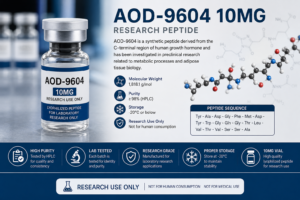
provides an interesting example of how a peptide fragment can be studied independently from the complete parent protein. Research has examined its biochemical and metabolic properties in animal models and, historically, in human clinical-development programs.
AOD-9604 10mg research material can therefore be positioned within a broader category of synthetic peptide research products. When evaluating such material, researchers should focus on verified identity, analytical purity, molecular characteristics, lot-specific documentation, and appropriate laboratory handling.
Importantly, research findings should not be interpreted as evidence that a research-grade AOD-9604 product is an approved medication or that it should be used for self-treatment.
Research-use notice: AOD-9604 10mg described on this page is intended for laboratory research and analytical purposes only. It is not intended for human or veterinary use, diagnosis, treatment, prevention, or cure of any disease or medical condition.
What Is AOD-9604?
AOD-9604 is a synthetic peptide associated with the C-terminal portion of human growth hormone. Scientific literature has investigated AOD-9604 because researchers were interested in whether selected biological properties associated with the growth-hormone molecule could be studied using a smaller peptide fragment.
Early research examined AOD-9604 in animal models of obesity and metabolic function. One published study reported changes in body-weight gain and adipose-tissue lipolytic activity in obese Zucker rats following experimental treatment with AOD-9604. These findings were preclinical and should not be treated as proof of equivalent effects in humans.
Additional animal research examined the relationship between AOD-9604, lipid metabolism, and beta-adrenergic pathways. These experiments provided a basis for continued investigation of the peptide’s biological properties.
AOD-9604 Molecular Weight
The commonly cited molecular weight for AOD-9604 is approximately 1,818.1 g/mol.
For an AOD-9604 10mg product page, the specification can be displayed as:
| Specification | AOD-9604 10mg |
|---|---|
| Product | AOD-9604 |
| Quantity | 10mg |
| Molecular weight | ~1,818.1 g/mol |
| Material type | Synthetic peptide |
| Research category | Peptide research |
| Intended application | Laboratory research |
| Product designation | Research use only |
Researchers should confirm the molecular identity and analytical characteristics of the specific lot using the supplier’s documentation.
Why Molecular Weight Is Important
Molecular weight is an important property in analytical peptide research. It can help researchers:
- Compare theoretical and observed mass
- Interpret mass-spectrometry results
- Identify peptide-related signals
- Perform laboratory calculations
- Evaluate analytical documentation
- Compare related peptide materials
- Design characterization experiments
Molecular weight alone, however, does not establish peptide identity or purity. Researchers requiring analytical confirmation should use appropriate validated laboratory techniques.
AOD-9604 and Its Relationship to Human Growth Hormone
AOD-9604 is commonly described as a synthetic fragment based on the C-terminal region of human growth hormone.
This distinction is scientifically important.
AOD-9604 is not identical to full-length human growth hormone. It represents a specific peptide fragment that has been investigated separately.
Researchers should therefore avoid treating research involving full-length growth hormone as interchangeable with research involving AOD-9604.
The scientific interest in AOD-9604 has historically centered on whether selected biological effects associated with particular regions of the growth-hormone molecule could be investigated without studying the complete hormone.
This makes AOD-9604 relevant to peptide structure-function research, metabolic research, and analytical peptide characterization.
AOD-9604 Research History
AOD-9604 has been studied for several decades.
Early preclinical research investigated its effects in animal models of obesity. Researchers reported changes in body-weight gain and adipose-tissue lipolytic activity in obese Zucker rats. The study also evaluated insulin sensitivity in the experimental animals.
Another study examined AOD-9604 in obese mice and explored potential relationships between its effects and beta-adrenergic receptor pathways. The investigators reported changes in body weight, body fat, and lipolytic sensitivity in the experimental models.
These findings helped establish a scientific rationale for additional investigation.
However, animal research is not equivalent to human clinical evidence. Results observed in rodents cannot automatically be translated into expected effects in people.
AOD-9604 Human Research
AOD-9604 was also investigated in human clinical-development programs.
Historical development focused on its potential metabolic applications. Later clinical-development documentation identifies AOD-9604 as the earlier name associated with LAT8881 and reports that multiple clinical trials involving hundreds of participants were conducted. The same documentation states that development for obesity was discontinued after a later efficacy study failed to meet its primary endpoint.
This history is important when creating accurate SEO content.
AOD-9604 should not be marketed as an established weight-management treatment simply because earlier studies investigated that possibility.
A more scientifically responsible description is:
AOD-9604 is a synthetic peptide that has been investigated in preclinical metabolic research and historical clinical-development programs.
This wording reflects the research history without overstating the evidence.
AOD-9604 Research Applications
AOD-9604 may be of interest to researchers studying synthetic peptide structure, metabolic biology, and peptide characterization.
Potential research contexts include:
Peptide Characterization
Researchers can study the chemical and analytical characteristics of synthetic AOD-9604.
Structure-Function Research
AOD-9604 can be considered in investigations examining how specific peptide regions relate to biological activity.
Metabolic Research
Preclinical studies have investigated AOD-9604 in models involving adipose tissue and lipid metabolism.
Analytical Chemistry
Synthetic peptides can be evaluated using appropriate analytical techniques, including chromatographic and mass-spectrometric methods.
Comparative Peptide Studies
Researchers may compare AOD-9604 with related peptide materials to investigate differences in structure and analytical behavior.
AOD-9604 10mg Product Specifications
For a research product page, clear specifications make it easier for researchers to identify the material.
Product Name
AOD-9604 10mg
Material
Synthetic research peptide.
Quantity
10mg.
Molecular Weight
Approximately 1,818.1 g/mol.
Intended Use
Laboratory research and analytical applications only.
Documentation
Where available, researchers should review lot-specific analytical documentation, including the Certificate of Analysis.
Physical Form
Research peptides may be supplied in a lyophilized format. Product-specific documentation should be consulted for exact formulation and handling information.
AOD-9604 Purity and Quality
Purity is one of the most important quality parameters when evaluating synthetic research peptides.
A stated purity percentage should always be interpreted together with the analytical method used to determine it.
Researchers may want to evaluate:
- Peptide identity
- Purity
- Molecular mass
- Analytical methodology
- Lot number
- Batch information
- Appearance
- Storage requirements
- Packaging integrity
A high-quality research workflow should rely on documented analytical information rather than product descriptions alone.
AOD-9604 COA: Certificate of Analysis
A Certificate of Analysis (COA) provides batch-specific information about a research material.
Depending on the supplier and testing program, a COA may include:
- Product name
- Lot number
- Test date
- Purity result
- Identity testing
- Analytical methodology
- Specification limits
- Appearance
- Other quality-control information
For researchers, lot-specific documentation is particularly useful when reproducibility and traceability are important.
The product label, COA, and physical material should correspond to the same batch whenever possible.
Analytical Testing of AOD-9604
Analytical peptide research may involve several complementary techniques.
HPLC
High-performance liquid chromatography can be used to evaluate chromatographic purity and characterize peptide-related components.
Mass Spectrometry
Mass spectrometry can help researchers compare observed molecular mass with the expected molecular characteristics of the peptide.
Complementary Analytical Methods
Depending on the research question, laboratories may employ additional validated analytical approaches.
No single specification should automatically be interpreted as comprehensive proof of every characteristic of a research material. Researchers should select analytical methods appropriate to their experimental objectives.
AOD-9604 Storage Considerations
Peptides can be sensitive to environmental factors including temperature, moisture, light, and repeated handling.
Researchers should follow the specific storage instructions supplied with the product.
General research-material considerations include:
- Maintain appropriate temperature control.
- Keep containers properly sealed.
- Minimize unnecessary exposure to moisture.
- Protect materials from unsuitable environmental conditions.
- Avoid unnecessary temperature fluctuations.
- Maintain lot identification.
- Record storage conditions when required by the laboratory protocol.
Because formulations can differ between products, generic storage recommendations should not replace the manufacturer’s or supplier’s documented instructions.
Handling AOD-9604 Research Material
Laboratory personnel should follow institutional safety procedures when handling synthetic peptides.
Appropriate practices may include:
- Using suitable laboratory PPE
- Maintaining clean work areas
- Clearly labeling research materials
- Preventing cross-contamination
- Maintaining accurate laboratory records
- Following facility-specific waste procedures
- Using validated analytical methods
AOD-9604 research material should not be presented as a consumer product or as a substitute for an approved pharmaceutical.
AOD-9604 10mg vs. Other Research Peptides
AOD-9604 belongs to a broad class of synthetic peptide research materials.
Researchers comparing peptide products should evaluate the exact identity of each material rather than comparing products solely by their marketing names.
Useful comparison criteria include:
| Research Parameter | Why It Matters |
|---|---|
| Peptide identity | Confirms the intended research material |
| Molecular weight | Supports analytical calculations |
| Purity | Helps characterize material composition |
| Sequence/structure | Establishes molecular identity |
| COA | Provides batch-specific documentation |
| Lot number | Supports traceability |
| Storage information | Helps maintain material integrity |
| Analytical testing | Supports research reproducibility |
Why Lot-Specific Information Matters
Two products carrying the same general peptide name should still be evaluated according to their individual lot documentation.
Lot-specific information can help researchers connect:
Product → Batch → Analytical Results → Experiment
This chain of traceability is valuable in scientific research because experimental results need to be connected to the precise material used.
For long-term research projects, retaining product documentation with laboratory records can make it easier to reproduce or investigate experimental results.
AOD-9604 Research and Scientific Literature
The published literature surrounding AOD-9604 includes both preclinical and clinical-development research.
Early animal research focused on metabolic and adipose-tissue effects. Studies in obese rodents reported changes in lipolytic activity and body-weight-related outcomes.
Later clinical-development efforts investigated the compound in humans. Available clinical-trial documentation indicates that development for obesity was ultimately discontinued after an efficacy study did not meet its primary endpoint.
This distinction between research findings and clinical conclusions is essential.
AOD-9604 has a legitimate history of scientific investigation, but that history does not establish it as an approved treatment for obesity or any other medical condition.
AOD-9604 Research-Use-Only Statement
AOD-9604 10mg is intended solely for laboratory research and analytical purposes. It is not intended for human consumption, veterinary use, diagnosis, treatment, prevention, or cure of any disease or medical condition.
Researchers are responsible for ensuring that their use of synthetic peptide materials complies with applicable laws, institutional policies, laboratory safety requirements, and research protocols.