

AOD-9604 Research Peptide Overview
AOD-9604 is a synthetic peptide that has been investigated in biochemical, metabolic, and peptide-structure research. It is associated with a specific region of human growth hormone and has been studied extensively enough to appear in chemical databases and published scientific literature.
For researchers evaluating an
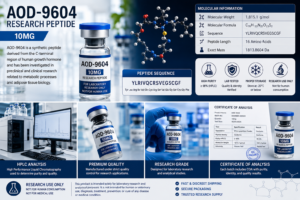
, the most important considerations are molecular identity, sequence, molecular weight, purity, analytical documentation, lot traceability, and appropriate laboratory handling.
AOD-9604 is particularly interesting from a research perspective because early investigations examined its relationship to lipid metabolism and adipose-tissue biology. Published preclinical research investigated AOD-9604 in animal models, while subsequent development programs examined the compound in humans.
However, scientific investigation should not be confused with regulatory approval or established clinical efficacy. A research peptide should be represented accurately as a laboratory research material rather than as a treatment product.
Research-use statement: AOD-9604 research peptide is intended for laboratory research and analytical purposes only. It is not intended for human or veterinary use, diagnosis, treatment, prevention, or cure of any disease or medical condition.
What Is AOD-9604?
AOD-9604 is a synthetic 16-amino-acid peptide associated with the C-terminal region of human growth hormone.
According to PubChem, AOD-9604 has the sequence:
YLRIVQCRSVEGSCGF
PubChem identifies the compound with molecular formula C78H123N23O23S2 and a molecular weight of approximately 1,815.1 g/mol.
The peptide contains two cysteine residues that form an intramolecular disulfide bridge. This structural characteristic is relevant when researchers are considering peptide identity and analytical characterization.
AOD-9604 should not be confused with full-length human growth hormone. It is a substantially smaller synthetic peptide with its own molecular characteristics and research history.
AOD-9604 Molecular Weight
The current PubChem record lists the molecular weight of AOD-9604 as:
1,815.1 g/mol
The corresponding molecular formula is:
C78H123N23O23S2
PubChem also reports an exact mass of approximately 1813.8604 Da.
AOD-9604 Molecular Specifications
| Specification | Information |
|---|---|
| Peptide | AOD-9604 |
| Product quantity | 10mg |
| Molecular weight | 1,815.1 g/mol |
| Molecular formula | C78H123N23O23S2 |
| Sequence | YLRIVQCRSVEGSCGF |
| Residues | 16 amino acids |
| Research category | Synthetic peptide |
| Intended use | Laboratory research |
Researchers should distinguish the molecular weight of the free compound from the total mass of a formulated or salt-form research material. For example, PubChem separately identifies an acetate form with a molecular weight of 1,875.1 g/mol.
Consequently, researchers should use the lot-specific COA and product documentation when an exact material specification is required.
AOD-9604 Peptide Sequence
The documented AOD-9604 sequence is:
YLRIVQCRSVEGSCGF
Expanded:
Tyr–Leu–Arg–Ile–Val–Gln–Cys–Arg–Ser–Val–Glu–Gly–Ser–Cys–Gly–Phe
PubChem identifies AOD-9604 as a 16-residue peptide and documents the disulfide relationship between the cysteine residues.
Why Sequence Information Matters
Peptide sequence is fundamental to research because it helps establish molecular identity.
Researchers can use sequence information when:
- Comparing peptide databases
- Reviewing supplier documentation
- Evaluating mass-spectrometry results
- Comparing related peptide structures
- Designing analytical studies
- Reviewing synthesis specifications
- Investigating structure-function relationships
A product name by itself is not sufficient for rigorous analytical identification. Sequence, molecular weight, analytical data, and batch documentation provide a more complete identity profile.
AOD-9604 and Human Growth Hormone
AOD-9604 is associated with the C-terminal portion of human growth hormone, but it is important to distinguish the peptide from intact human growth hormone.
Human growth hormone is a much larger protein, whereas AOD-9604 is a short synthetic peptide.
The scientific interest in AOD-9604 partly arose from research into whether selected biological properties associated with regions of growth hormone could be investigated using a smaller peptide.
This makes AOD-9604 an interesting material for structure-function research, where investigators examine how particular peptide regions relate to biological or biochemical observations.
Researchers should nevertheless avoid treating evidence concerning full-length growth hormone as evidence concerning AOD-9604.
AOD-9604 Research History
AOD-9604 has been investigated in both preclinical and human research.
One early published study examined the synthetic peptide in obese Zucker rats. The researchers reported effects involving body-weight gain and adipose-tissue lipolytic activity during the experimental period. The study was conducted in an animal model, so its findings should not be directly extrapolated to human outcomes.
Another published investigation examined AOD-9604 in obese mice and investigated relationships involving lipid metabolism and beta-adrenergic pathways. The study reported changes in body weight, body fat, and lipolytic sensitivity in the experimental animals.
These studies provide historical scientific context for AOD-9604 but do not establish the peptide as an approved therapy.
AOD-9604 Human Research
AOD-9604 also progressed into human clinical investigation.
This is an important part of the compound’s research history because it demonstrates that AOD-9604 was not investigated solely in laboratory animals.
However, historical clinical development should be described carefully.
The existence of human trials does not mean that a research-grade AOD-9604 product is an approved pharmaceutical. Researchers and website owners should distinguish between:
- Preclinical research
- Clinical investigation
- Regulatory approval
- Commercial research materials
These are separate concepts.
For SEO content, this distinction also helps maintain scientific credibility while avoiding unsupported medical or therapeutic claims.
AOD-9604 Research Applications
AOD-9604 can be relevant to several categories of laboratory research.
1. Peptide Characterization
Researchers can investigate its molecular and analytical characteristics using appropriate laboratory methods.
2. Structure-Function Research
The peptide provides a research model for investigating relationships between peptide sequence and observed biological activity.
3. Metabolic Research
Historical preclinical studies investigated AOD-9604 in experimental models involving adipose tissue and lipid metabolism.
4. Analytical Chemistry
AOD-9604 can be evaluated using analytical methods appropriate for peptide materials.
5. Comparative Peptide Research
Researchers can compare AOD-9604 with related peptide materials to examine differences in molecular characteristics.
6. Stability Research
Controlled laboratory experiments may examine how peptide materials behave under defined environmental and analytical conditions.
AOD-9604 10mg Research Material
The 10mg designation describes the quantity of material supplied.
For researchers, product quantity can be relevant to experiment planning, analytical characterization, and inventory management.
It is important to distinguish product quantity from dosage.
A research product labeled 10mg should not be interpreted as providing instructions for human administration.
For a research-focused product page, the specification can therefore be presented as:
AOD-9604 — 10mg research material
rather than using language suggesting a therapeutic dose.
AOD-9604 Purity
Purity is an important consideration when selecting synthetic peptide research materials.
A stated purity percentage should always be considered alongside the analytical method used to establish it.
Researchers may want to review:
- Purity percentage
- Analytical method
- Peptide identity
- Molecular mass
- Lot number
- Batch information
- Testing date
- Product specifications
- Certificate of Analysis
A purity value alone does not provide a complete picture of a research material.
For reproducible laboratory work, researchers should maintain appropriate documentation connecting the tested material to the exact batch used in an experiment.
AOD-9604 COA
A Certificate of Analysis (COA) is one of the most useful documents for evaluating a research peptide.
A COA may provide information such as:
- Product name
- Lot number
- Batch number
- Purity
- Identity
- Analytical methodology
- Testing date
- Specification limits
- Physical characteristics
When evaluating an AOD-9604 research peptide, researchers should confirm that the COA corresponds to the specific product lot.
Why COA Documentation Matters
Scientific reproducibility depends partly on knowing exactly what material was used.
A well-maintained research record can connect:
AOD-9604 product → lot number → analytical documentation → experiment
This creates better traceability and makes it easier to investigate unexpected analytical or experimental results.
AOD-9604 Analytical Testing
Synthetic peptide research may involve multiple analytical methods.
HPLC
High-performance liquid chromatography can be used to characterize chromatographic profiles and assess purity according to the applicable analytical method.
Mass Spectrometry
Mass spectrometry can help compare experimentally observed mass with the expected molecular characteristics of AOD-9604.
Complementary Testing
Depending on the research question, laboratories may employ additional analytical methods.
Researchers should select methods appropriate to the purpose of the investigation and use validated procedures where required.
A single analytical result should not automatically be interpreted as confirmation of every characteristic of a research material.
AOD-9604 Storage Considerations
Synthetic peptides can be affected by environmental factors such as temperature, moisture, light, and repeated exposure to unsuitable conditions.
For this reason, researchers should follow the specific storage instructions supplied with the material.
General laboratory considerations include:
- Maintaining appropriate temperature control
- Keeping containers properly sealed
- Minimizing moisture exposure
- Protecting materials from unsuitable environmental conditions
- Limiting unnecessary temperature fluctuations
- Maintaining clear batch identification
- Following institutional laboratory procedures
Storage requirements can differ depending on formulation and packaging, so product-specific documentation should take priority over generic recommendations.
AOD-9604 Laboratory Handling
Research facilities should use appropriate laboratory procedures when working with synthetic peptide materials.
Depending on the laboratory environment, this may include:
- Appropriate personal protective equipment
- Controlled work areas
- Proper sample labeling
- Contamination-control procedures
- Accurate inventory records
- Appropriate waste handling
- Documented experimental procedures
The exact requirements depend on the research environment and institutional safety procedures.
AOD-9604 Research Peptide vs. Full-Length Growth Hormone
One common source of confusion is treating AOD-9604 and human growth hormone as interchangeable.
They are not.
AOD-9604 is a small synthetic peptide associated with a region of human growth hormone. Its molecular identity, sequence, size, and research characteristics differ substantially from those of full-length growth hormone.
This distinction matters when interpreting scientific literature.
Researchers should always determine whether a publication concerns:
- AOD-9604
- A specific growth hormone fragment
- Full-length human growth hormone
- Another synthetic peptide
Correct identification helps prevent inappropriate comparisons.
AOD-9604 vs. Related Peptide Materials
When comparing research peptides, researchers should focus on molecular identity rather than marketing terminology.
Important comparison criteria include:
| Parameter | Importance |
|---|---|
| Peptide identity | Establishes the intended material |
| Sequence | Defines molecular structure |
| Molecular weight | Supports analytical calculations |
| Purity | Characterizes material composition |
| COA | Provides batch-specific information |
| Lot number | Supports traceability |
| Analytical method | Helps interpret quality data |
| Storage information | Supports material management |
This approach is more scientifically useful than comparing products solely by their advertised names.
Why AOD-9604 Research Documentation Matters
Research documentation supports reproducibility.
A researcher should ideally be able to determine:
- What peptide was used?
- Which lot was used?
- What was the documented molecular identity?
- What purity was reported?
- Which analytical methods were used?
- How was the material stored?
- What experimental conditions were applied?
This information can become particularly important when experiments are repeated months or years later.
Scientific Evidence and Responsible SEO
AOD-9604 is a good example of why scientific SEO content should distinguish between research evidence and medical claims.
Published studies provide evidence that researchers have investigated AOD-9604. Early work included animal studies involving metabolic and adipose-tissue endpoints.
However, those findings should not be transformed into claims that AOD-9604 is guaranteed to cause weight loss, burn fat, treat obesity, or provide a particular health outcome.
A scientifically responsible product page can still rank for valuable keywords by emphasizing:
- Molecular characteristics
- Research history
- Laboratory applications
- Analytical testing
- Purity
- COA documentation
- Product specifications
- Research-use status
This approach creates useful content without overpromising results.
AOD-9604 Research-Use-Only Statement
AOD-9604 research peptide is intended strictly for laboratory research and analytical purposes. It is not intended for human consumption, veterinary use, diagnosis, treatment, prevention, or cure of any disease or medical condition.
This product information is provided for scientific and educational purposes. Researchers are responsible for complying with applicable laws, institutional requirements, laboratory safety procedures, and research protocols.