AOD-9604 COA Overview
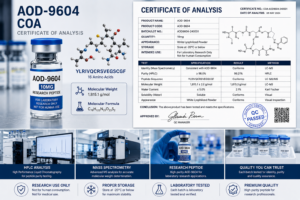
For researchers evaluating synthetic peptides, a COA can be an important part of product documentation. Depending on the laboratory and testing package, an AOD-9604 Certificate of Analysis may include information such as product identity, lot number, molecular weight, peptide sequence, chromatographic purity, mass-spectrometry results, appearance, testing date, and laboratory information.
The most important principle when evaluating a COA is lot-specific traceability. A general product description should not be confused with an analytical certificate for a particular batch.
A professional AOD-9604 product page should therefore clearly distinguish between:
- Published molecular specifications
- Product specifications
- Lot-specific analytical results
- HPLC purity
- Mass-spectrometry identity testing
- Laboratory documentation
- Storage information
- Research-use limitations
This page provides an educational overview of AOD-9604 COA documentation and the types of analytical information researchers may encounter.
What Is AOD-9604?
that has been studied in research involving metabolic and biological processes. It is associated with a region of human growth hormone rather than being equivalent to full-length human growth hormone.
AOD-9604 is a relatively short peptide consisting of 16 amino acids.
The commonly referenced sequence is:
YLRIVQCRSVEGSCGF
Its chemical information is useful when reviewing a Certificate of Analysis because molecular identity can be evaluated against an expected molecular specification.
For the free compound, PubChem lists:
| Property | AOD-9604 |
|---|---|
| Compound | AOD-9604 |
| Molecular formula | C78H123N23O23S2 |
| Molecular weight | 1,815.1 g/mol |
| Sequence | YLRIVQCRSVEGSCGF |
| Peptide length | 16 amino acids |
| PubChem CID | 71300630 |
Researchers should verify the exact chemical form described by their supplier and analytical laboratory because salt or formulation differences can affect reported molecular mass.
What Does an AOD-9604 COA Show?
A Certificate of Analysis can serve as a quality-control record for an individual product lot.
A comprehensive AOD-9604 COA may contain several categories of information.
Product Identification
The certificate should identify the material being tested.
Typical fields include:
- Product name
- Product code
- Lot or batch number
- Quantity
- Sample identification
- Certificate number
Molecular Information
A COA or accompanying specification sheet may provide:
- Molecular formula
- Molecular weight
- Peptide sequence
- Chemical form
Analytical Testing
Depending on the testing package, analytical information may include:
- HPLC
- Mass spectrometry
- Chromatographic purity
- Identity testing
- Appearance
- Other applicable quality tests
Traceability
A useful certificate should establish a connection between the analytical results and the actual lot supplied.
This is one of the most important characteristics of meaningful COA documentation.
Why AOD-9604 COA Documentation Matters
Researchers often need more than a product name when selecting a material for laboratory work.
A product label can identify what a supplier says is inside a container, but analytical documentation provides additional information about the tested material.
A lot-specific COA can help researchers evaluate:
1. Identity
Identity testing can provide analytical evidence that the material corresponds to the intended peptide.
Mass spectrometry is one analytical approach commonly used in peptide characterization.
2. Purity
Purity testing can provide information about the proportion of the analyzed sample associated with the target compound under the specified analytical conditions.
3. Batch Traceability
The lot number allows researchers to associate a COA with a particular production batch.
4. Quality Documentation
Researchers can retain COAs with laboratory records and other material documentation.
5. Supplier Transparency
Providing appropriate analytical documentation can make research-material specifications easier to evaluate.
AOD-9604 Purity
AOD-9604 purity is one of the most important search and research terms associated with a COA.
However, purity should always be interpreted in context.
A statement such as “AOD-9604 is 99% pure” is not sufficient by itself to establish the quality of every vial or batch.
A stronger documentation approach identifies:
Lot number + analytical method + result + testing laboratory + analysis date
For example, a COA might contain a field for:
Purity by HPLC: [actual lot-specific result]
The actual percentage should be taken directly from the laboratory’s report.
It should never be invented or copied from another supplier’s batch.
Understanding AOD-9604 HPLC Testing
High-performance liquid chromatography, commonly called HPLC, is an analytical technique used to separate components within a sample.
For peptide research, chromatographic analysis can help characterize the target compound and related components.
An AOD-9604 COA may report a chromatographic purity result.
When evaluating the result, researchers should consider:
- The stated analytical method
- Chromatographic conditions
- Detection method
- Reported purity
- Sample identification
- Lot number
- Testing laboratory
- Testing date
HPLC results from different laboratories should not automatically be treated as directly interchangeable because laboratories can use different analytical conditions.
Differences may involve:
- Column selection
- Mobile phase
- Gradient
- Detection wavelength
- Sample preparation
- Integration procedures
- Reference standards
Therefore, the analytical method should accompany the reported purity whenever possible.
AOD-9604 Mass Spectrometry
Mass spectrometry can be used to support molecular identity testing.
AOD-9604 has a defined peptide sequence and expected molecular characteristics. Analytical mass-spectrometry testing can therefore provide information that complements chromatographic purity testing.
A strong quality-control document may identify:
- Analytical technique
- Expected molecular mass
- Observed mass
- Sample identification
- Lot number
- Test date
Mass spectrometry and HPLC answer somewhat different analytical questions.
HPLC can provide chromatographic information about sample composition.
Mass spectrometry can provide molecular-mass information supporting identity.
Using complementary analytical methods can provide a more informative characterization of research material.
AOD-9604 Molecular Weight
AOD-9604 molecular weight is another important specification frequently searched by researchers.
The PubChem-listed molecular weight for the free compound is:
1,815.1 g/mol
The molecular formula is:
C78H123N23O23S2
The peptide sequence is:
YLRIVQCRSVEGSCGF
When preparing a product page or COA, these values should be clearly distinguished from lot-specific analytical measurements.
Molecular weight is a chemical property, while an HPLC purity result is an analytical result associated with a tested sample.
They should not be presented as if they represent the same type of information.
AOD-9604 Peptide Sequence
The commonly listed AOD-9604 peptide sequence is:
YLRIVQCRSVEGSCGF
The sequence contains 16 amino acids.
Sequence information can be useful for:
- Compound identification
- Research database searches
- Molecular modeling
- Peptide characterization
- Analytical comparison
- Scientific literature research
When publishing sequence information online, it is good practice to pair it with an authoritative chemical reference and identify the exact molecular form being described.
AOD-9604 and Human Growth Hormone
AOD-9604 is often discussed in connection with human growth hormone because it is associated with a region of the hormone.
However, AOD-9604 is not the same chemical substance as full-length human growth hormone.
This distinction is important for scientific accuracy.
Full-length human growth hormone is a substantially larger protein, whereas AOD-9604 is a shorter synthetic peptide.
A product page should therefore avoid describing AOD-9604 as simply “growth hormone.”
Accurate terminology helps researchers distinguish:
- AOD-9604
- Peptide fragments
- Full-length growth hormone
- Other peptide analogues
AOD-9604 Research Background
AOD-9604 has been investigated in experimental research involving metabolic and lipolytic activity.
Early preclinical research examined a synthetic lipolytic domain associated with human growth hormone in animal models.
One published study investigated AOD9604 in obese Zucker rats and reported effects on lipolytic activity and body-weight gain under the experimental conditions used.
These findings provide historical research context but should not be interpreted as evidence that a research peptide is an approved treatment.
Later human research explored AOD-9604 in the context of obesity research.
The available clinical-development record does not support presenting AOD-9604 as an established or approved weight-loss treatment. Human clinical development for obesity did not demonstrate the desired efficacy endpoint.
This distinction is especially important for an SEO product page.
A research-focused website should describe the scientific history without converting experimental findings into medical claims.
AOD-9604 10mg Research Peptide
AOD-9604 may be offered in research quantities such as 10mg.
The term “10mg” refers to the quantity of material contained in the product.
It does not refer to molecular weight.
For example:
Product quantity: 10mg
Molecular weight: 1,815.1 g/mol for the PubChem-listed free compound
These are separate measurements.
Researchers should also consult the relevant lot-specific documentation when performing calculations because the supplied chemical form and formulation can affect analytical measurements.
How to Read an AOD-9604 COA
A COA can look technical at first, but several fields are straightforward to evaluate.
Step 1: Verify the Product
Confirm that the certificate identifies the intended product as AOD-9604.
Step 2: Verify the Lot Number
The lot number on the COA should correspond to the material being evaluated.
Step 3: Review the Molecular Specification
Check the stated molecular weight, formula, and sequence against an appropriate reference.
Step 4: Review Purity
Look for the reported HPLC or other applicable purity result.
Step 5: Review Identity
Determine whether the certificate includes an identity test such as mass spectrometry.
Step 6: Check the Laboratory
Look for the name or identification of the laboratory responsible for testing.
Step 7: Check the Date
Review the analysis or testing date.
Step 8: Preserve the Documentation
Researchers should retain the applicable COA with their laboratory material records.
Example AOD-9604 COA Specification Table
The following is a website presentation template, not a laboratory certificate.
| Test / Specification | Information |
|---|---|
| Product | AOD-9604 |
| Quantity | 10mg |
| Lot / Batch | Insert actual lot |
| Molecular formula | C78H123N23O23S2* |
| Molecular weight | 1,815.1 g/mol* |
| Peptide sequence | YLRIVQCRSVEGSCGF |
| Appearance | Insert actual result |
| HPLC purity | Insert actual lot result |
| Mass spectrometry | Insert actual lot result |
| Testing laboratory | Insert actual laboratory |
| Analysis date | Insert actual date |
| Certificate number | Insert actual number |
| Research designation | Laboratory research only |
*Applicable to the referenced free compound specification. Confirm the exact chemical form represented by the material and laboratory report.
Never publish placeholder information as an actual COA result.
What Makes a Good AOD-9604 COA?
A useful COA should be:
Lot-specific
The certificate should identify the exact batch tested.
Traceable
The analytical result should be connected to the product supplied.
Clear
Researchers should be able to understand what each test represents.
Method-specific
Analytical results should identify the method used where appropriate.
Verifiable
Laboratory and certificate information should be internally consistent.
Current
The certificate should correspond to the applicable production lot rather than an unrelated historical batch.
What Should Never Be Fabricated?
A research-peptide supplier should never invent analytical data.
Do not fabricate:
- HPLC percentages
- Mass-spectrometry results
- Chromatograms
- Laboratory names
- Certificate numbers
- Batch numbers
- Analysis dates
- Sterility claims
- Endotoxin results
- Third-party laboratory accreditation
- Purity values
If testing has not been performed, the page should not imply that it has.
If a particular test is unavailable, state that clearly.
This approach improves both scientific credibility and long-term customer trust.
AOD-9604 COA vs. Product Specification Sheet
A product specification sheet and a COA are not necessarily the same document.
A specification sheet may provide expected or standard product characteristics.
A COA normally provides analytical results associated with a particular batch or lot.
For example:
Specification sheet:
AOD-9604 — expected molecular information and product specifications.
COA:
Lot ABC123 — actual analytical results for the tested material.
This distinction is important for researchers looking for documentation online.
AOD-9604 Quality Control
Quality control for research peptides can involve multiple stages.
Depending on the supplier and testing program, this may include:
- Raw-material evaluation
- Peptide synthesis
- Purification
- Analytical characterization
- HPLC analysis
- Mass-spectrometry testing
- Batch documentation
- Packaging
- Label verification
- COA generation
The exact testing package varies between suppliers and laboratories.
For this reason, a product page should accurately describe only tests that have actually been performed.
AOD-9604 Storage and Research Handling
Research material should be stored according to the applicable manufacturer’s documentation and laboratory procedures.
Storage considerations can depend on:
- Physical form
- Packaging
- Formulation
- Temperature
- Moisture exposure
- Light exposure
- Reconstitution status
- Stability information
Lyophilized research material and prepared solutions can have different handling requirements.
Researchers should therefore consult the applicable product documentation rather than relying on a generic storage statement.
Research-Use-Only Disclaimer
For Laboratory Research Only
AOD-9604 is offered for laboratory research and analytical purposes only. It is not intended for human or veterinary use, administration, diagnosis, treatment, prevention, or cure of any disease or medical condition.
This information is provided for scientific and educational purposes.
AOD-9604 should not be presented as an approved treatment, dietary product, or medical therapy.
Researchers are responsible for following applicable laws, institutional requirements, laboratory safety procedures, and relevant regulatory requirements.