
What Is Epitalon (Epithalon)?
Epitalon (Epithalon) 10mg is a short synthetic peptide consisting of four amino acids. Its sequence, Ala-Glu-Asp-Gly, is commonly abbreviated as AEDG.
Because of its relatively short sequence, Epitalon provides researchers with a useful model for studying peptide structure, analytical characterization, molecular interactions, and laboratory peptide behavior.
When working with research peptides, researchers should evaluate the identity and quality of the material using appropriate analytical documentation rather than relying solely on product naming or appearance.
Epitalon (Epithalon) 10mg Specifications
| Specification | Details |
|---|---|
| Product Name | Epitalon (Epithalon) |
| Quantity | 10mg |
| Peptide Sequence | Ala-Glu-Asp-Gly (AEDG) |
| Peptide Length | 4 amino acids |
| Molecular Formula | C14H22N4O9 |
| Molecular Weight | 390.35 g/mol |
| CAS Number | 307297-39-8 |
| PubChem CID | 219042 |
| Form | Lyophilized powder |
| Intended Use | Laboratory research and analytical purposes |
Epitalon Peptide Sequence
The Epitalon peptide sequence is:
Ala-Glu-Asp-Gly (AEDG)
The four-letter abbreviation corresponds to the amino acids:
- A — Alanine
- E — Glutamic acid
- D — Aspartic acid
- G — Glycine
Understanding the sequence is important when researchers perform peptide identification, analytical characterization, or comparison against reference materials.
Epitalon Molecular Weight
The reported Epitalon molecular weight is 390.35 g/mol.
Molecular weight is an important analytical parameter for peptide research because it can help researchers evaluate expected molecular characteristics and compare analytical measurements against reference information.
For laboratory identification, molecular weight should be considered alongside other analytical information, including chromatographic and mass-spectrometric data where applicable.
Epitalon Molecular Formula
The molecular formula associated with Epitalon is:
C14H22N4O9
Researchers can use the molecular formula together with the peptide sequence and molecular weight when establishing expected analytical characteristics for the compound.
Epitalon HPLC & Purity Analysis
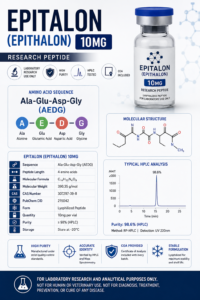
is commonly used in peptide analysis to evaluate chromatographic purity and identify the presence of additional detectable components.
For an Epitalon (Epithalon) 10mg research material, an appropriate analytical documentation package may include:
- HPLC chromatogram
- Reported purity percentage
- Retention time
- Analytical method information
- Batch or lot identification
- Testing date
- Laboratory information
A reported purity value should always be interpreted in the context of the analytical method used. HPLC purity is not necessarily equivalent to absolute chemical purity.
Certificate of Analysis (COA)
A Certificate of Analysis (COA) provides batch-specific information about a research material.
When evaluating an Epitalon COA, researchers should look for information such as:
Product identification: Epitalon / Epithalon
Batch or lot number: Batch-specific
Sequence: Ala-Glu-Asp-Gly
Molecular weight: 390.35 g/mol
Purity: As reported on the applicable batch COA
Testing method: As specified by the testing laboratory
Date of analysis: Batch-specific
Researchers should verify that the COA corresponds to the exact lot being evaluated.
Epitalon Lyophilized Peptide
Epitalon may be supplied as a lyophilized peptide, a dry formulation commonly used for laboratory peptide materials.
Lyophilization can provide a convenient dry format for storage and analytical handling. Researchers should follow the storage and handling conditions supplied with the specific batch and manufacturer documentation.
Avoid relying on generic storage assumptions when a product-specific specification sheet or COA provides different instructions.
Laboratory Research Considerations
Researchers studying Epitalon may be interested in several analytical characteristics, including peptide identity, sequence confirmation, chromatographic behavior, molecular mass, and sample stability.
Depending on the research objective, analytical techniques may include:
- HPLC
- LC-MS
- Mass spectrometry
- Peptide mapping
- Chromatographic comparison
- Spectroscopic characterization
The appropriate analytical method depends on the research question, sample matrix, instrumentation, and laboratory protocol.
Why Researchers Examine Peptide Specifications
Accurate peptide characterization is an important part of laboratory research.
Before using a research material in an experiment, researchers may review:
1. Identity
Confirm that the material corresponds to the intended peptide.
2. Sequence
Compare the documented amino acid sequence with the expected reference sequence.
3. Molecular Weight
Compare the reported molecular weight with the expected molecular characteristics.
4. Purity
Review chromatographic purity information and the associated analytical method.
5. Batch Documentation
Confirm that the COA, analytical results, and product label correspond to the same batch.
6. Storage Information
Follow the handling and storage conditions supplied with the material.