

Introduction
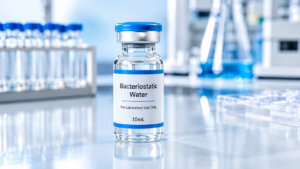
Bacteriostatic water 10mL is a search term used by people looking for a small-volume water preparation, product specifications, quality information, and supplier details. Before comparing products, it is important to understand that the name refers to a specific type of preparation when used to describe Bacteriostatic Water for Injection, USP. It should not be treated as interchangeable with ordinary distilled water, laboratory-grade water, or every product marketed online for peptide research.
A 10mL container describes the nominal volume of the product, not its complete formulation, quality, or intended use. Those details must be confirmed through the product label and manufacturer documentation.
In the United States, DailyMed provides published drug-label information for bacteriostatic water products. One listed product, TM Biowater bacteriostatic water, has a 10mL multiple-dose vial listing. Other labeled products may be supplied in different container sizes and formulations. Always verify the exact product rather than assuming that every 10mL listing is identical. DailyMed product information.
This guide explains the terminology, label information, quality documentation, supplier checks, storage considerations, and research-use wording relevant to bacteriostatic water 10mL.
What Is Bacteriostatic Water 10mL?
Bacteriostatic water is a water-based preparation containing a preservative intended to inhibit the growth of certain bacteria under specified conditions. The term does not mean that a product kills every microorganism or that sterility is guaranteed indefinitely after a container is opened.
Bacteriostatic Water for Injection, USP is a specific pharmaceutical preparation. Official U.S. product labeling describes it as sterile and nonpyrogenic water for injection containing benzyl alcohol as a bacteriostatic preservative. The labeled concentration depends on the specific formulation. DailyMed official labeling.
A 10mL vial may be convenient where a small container volume is appropriate for the intended, authorized purpose. However, the volume alone does not establish that the product is suitable for a particular medication, peptide, experiment, or individual.
What does 10mL mean?
The designation “10mL” indicates the stated volume of the container’s contents. It does not tell you:
- The exact preservative concentration.
- Whether the product meets pharmaceutical specifications.
- Whether the container is single-dose or multiple-dose.
- Which applications the manufacturer authorizes.
- Whether a particular peptide or other material is compatible with it.
- Whether a seller’s claims have been independently verified.
For these reasons, product labels and official documentation are more useful than a short marketplace title.
What Ingredients Does Bacteriostatic Water Contain?
The formulation depends on the exact product.
U.S. labeling for Bacteriostatic Water for Injection, USP identifies water for injection and benzyl alcohol as a bacteriostatic preservative. The Hospira labeling available through DailyMed lists formulations containing 0.9% or 1.1% benzyl alcohol, depending on the product. A separate 10mL product listing also identifies benzyl alcohol. These examples illustrate why the exact label matters. DailyMed labeling.
Do not assume that every product marketed as bacteriostatic water contains the same ingredients or concentration.
Why does the preservative matter?
Benzyl alcohol serves as a bacteriostatic preservative in the labeled pharmaceutical preparation. Its presence is relevant to product selection, warnings, and intended use. It is not a substitute for appropriate manufacturing controls, container integrity, or correct handling.
Official labeling includes important restrictions for products containing benzyl alcohol, including a warning against use in neonates. Product-specific instructions and warnings should always be reviewed before any authorized medical use.
Bacteriostatic Water 10mL vs. Sterile Water
Bacteriostatic water and sterile water are not automatically interchangeable.
| Feature | Bacteriostatic Water for Injection, USP | Sterile Water for Injection |
|---|---|---|
| Formulation | Contains a labeled bacteriostatic preservative | Standard formulation is preservative-free |
| Product identity | Specific pharmaceutical preparation | Different pharmaceutical preparation |
| Container format | Depends on the manufacturer and product | Depends on the manufacturer and product |
| Intended use | Governed by its official labeling | Governed by its official labeling |
| Suitable for every peptide? | No universal compatibility should be assumed | No universal compatibility should be assumed |
The table is a general comparison, not a substitute for the instructions for a particular medicine or research protocol.
For pharmaceutical use, follow the relevant drug labeling and advice from a qualified healthcare professional or pharmacist. For laboratory research, consult the applicable protocol and material specifications. A product should never be selected solely because a seller describes it as suitable for peptides.
How to Evaluate Bacteriostatic Water 10mL Quality
Quality evaluation starts with identifying the exact product and verifying what the available documentation actually supports.
1. Review the full product label
Check the product name, stated volume, ingredients, preservative concentration, manufacturer, lot information, expiration details, and intended-use statements.
The label should be consistent with the manufacturer’s published documentation. If key details are missing or contradictory, request clarification from the supplier before purchasing.
2. Verify the manufacturer or supplier
Look for a clearly identified business and manufacturer, reliable contact information, and transparent product descriptions. For pharmaceutical products intended for patient care, use an appropriate authorized supply channel.
A professional-looking website or product image does not independently verify the quality of its contents.
3. Check lot and batch traceability
Lot or batch information helps connect a container to the manufacturer’s production and quality records. Verify that the information is legible and consistent across the label and any associated documentation.
Avoid products with altered, missing, or inconsistent identifying information.
4. Understand sterility claims
A claim that a product is sterile should be supported by appropriate product labeling and manufacturing controls. Visual clarity alone does not prove sterility, and a photograph of sealed packaging cannot establish the condition of the contents.
If packaging is damaged or product identity is uncertain, do not rely on assumptions about its integrity.
5. Review storage instructions
Storage requirements vary by product. Use the temperature, light-protection, expiration, and handling information supplied with the specific product rather than applying generic instructions from another brand.
Do not assume that a container remains suitable for use indefinitely after opening.
What Is a Certificate of Analysis (COA)?
A Certificate of Analysis is a document that reports specified test results for an identified product or batch. It can help readers understand what was tested and whether the reported results met the listed specifications.
Depending on the product and testing program, documentation may include:
- Product identity.
- Manufacturer or laboratory identification.
- Lot or batch number.
- Test methods.
- Acceptance criteria.
- Reported results.
- Date of testing.
A COA should be interpreted according to its scope. For example, a chemical identity result does not automatically demonstrate sterility, container integrity, or suitability for a particular application.
Does a COA prove that a product is sterile?
Not necessarily. The document must explicitly support the relevant claim, and the testing and manufacturing controls must be appropriate to the product. A generic certificate or report for a raw ingredient should not be presented as proof that every finished container meets pharmaceutical requirements.
Buyers should also check that the document relates to the exact product and batch being offered.
HPLC, Mass Spectrometry and Peptide Research
HPLC and mass spectrometry are analytical techniques used in many peptide research settings. They can help characterize a peptide material, depending on the methods used and the question being investigated.
However, these techniques do not establish every quality attribute of a separate water product.
For example:
- HPLC can be used to assess chromatographic profiles and, with an appropriate method, evaluate aspects of a sample’s purity.
- Mass spectrometry can help characterize molecular mass and support identity assessment.
- Batch documentation can connect analytical results with an identified sample or production lot.
- Sterility-related controls address a different set of quality questions and cannot be inferred from peptide identity results alone.
A research website should describe these methods accurately and avoid implying that an HPLC chromatogram or mass spectrum proves the sterility of a water product.
How to Compare Bacteriostatic Water 10mL Products Online
If you are comparing product listings, evaluate more than the displayed price.
Compare equivalent products
Confirm that the listings refer to the same product category, container volume, formulation, and intended use. A product with a similar name may have a different formulation or a different intended application.
Calculate the total cost
Consider the listed price alongside shipping, taxes, handling charges, and minimum-order requirements. A low headline price does not necessarily represent the lowest total cost.
Inspect the listing details
Look for clear product photographs, readable labeling, manufacturer information, lot traceability, and access to relevant documentation.
Avoid unsupported promises
Be cautious of sellers claiming that a product is universally compatible with peptides, guaranteed to be suitable for every application, or automatically safe because it is described as sterile or research-grade.
Confirm the purchasing channel
For a product intended for prescribed medical use, verify the appropriate authorized source and consult a pharmacist or healthcare professional where necessary. Laboratory buyers should follow their institution’s procurement and quality requirements.
Storage and Product Handling Considerations
Storage and handling should follow the exact manufacturer’s instructions. General statements from another product’s label may not apply to a particular 10mL vial.
When reviewing product information, look for:
- The labeled storage temperature.
- Any protection-from-light requirements.
- The stated expiration date.
- Container-integrity warnings.
- Instructions that apply after opening, where relevant.
- Any restrictions concerning the product’s intended use.
Do not use a container if the label is unreadable, the packaging is compromised, or the contents appear inconsistent with the product description. For medical products, ask a qualified pharmacist about any uncertainty instead of relying on an online seller’s informal advice.
This article does not provide instructions for injecting, mixing, or reconstituting peptides. Those activities should not be inferred from the container volume or a general product description.
Research-Use-Only Wording and Regulatory Considerations
Some online listings describe bacteriostatic water or peptide-related materials as “research use only.” This wording must accurately reflect the product’s actual intended use and marketing.
A research-use-only disclaimer does not independently establish that a product meets pharmaceutical standards, is approved for human use, or is suitable for self-administration. Nor does the disclaimer override applicable laws or official product labeling.
For websites targeting U.S. readers, responsible content should:
- Identify the product category accurately.
- Avoid unsupported claims about purity, sterility, safety, or medical benefit.
- Distinguish research materials from pharmaceutical products intended for patient care.
- Refer readers to official labeling for product-specific warnings and intended uses.
- Avoid presenting laboratory documentation as a substitute for regulatory compliance.
This approach supports user trust while helping prevent confusion between laboratory research supplies and products intended for human use.
Who Should Read a Bacteriostatic Water 10mL Product Guide?
This type of guide can serve several audiences.
Laboratory researchers: Readers who need to understand product identity, documentation, and the distinction between water specifications and peptide analysis.
Procurement teams: Buyers who compare suppliers, traceability information, packaging, and product specifications.
Healthcare consumers: People who want to understand a product label or prepare questions for a pharmacist or healthcare professional.
Quality-assurance teams: Professionals who review product documentation, batch records, and the scope of analytical claims.
The appropriate buying and handling requirements depend on the audience and intended use. A single online listing should not be treated as a universal recommendation for every application.
Frequently Asked Questions
1. What is bacteriostatic water 10mL?
It is a search term commonly used for a 10mL container of bacteriostatic water. The exact formulation and intended use depend on the labeled product. Check the full label rather than relying on volume alone.
2. Does every bacteriostatic water 10mL product have the same ingredients?
No. Formulations and labeled preservative concentrations can vary. Review the exact product label and manufacturer documentation before comparing products.
3. Does bacteriostatic water 10mL contain benzyl alcohol?
Many products labeled Bacteriostatic Water for Injection, USP contain benzyl alcohol as a preservative. Confirm the ingredient and concentration on the particular product’s official labeling.
4. Is bacteriostatic water the same as distilled water?
No. Distilled water describes a purification process, while Bacteriostatic Water for Injection, USP is a specific pharmaceutical preparation with defined labeling and a preservative.
5. Is bacteriostatic water 10mL suitable for every peptide?
No universal compatibility claim should be assumed. Suitability depends on the exact product, the peptide or medication, and the relevant authorized labeling or laboratory protocol.
6. What does a COA tell me?
A COA reports specified test results for an identified sample or batch. Its value depends on what was tested, the methods used, and whether the documentation relates to the exact product being offered.
7. Does HPLC prove bacteriostatic water is sterile?
No. HPLC is an analytical technique with specific uses; a chromatographic result does not by itself establish sterility or all other pharmaceutical quality attributes.
8. How should bacteriostatic water 10mL be stored?
Follow the storage requirements on the exact manufacturer’s label. Do not assume that every product has identical temperature, light-protection, or post-opening requirements.
9. Can a research-use-only product be used for human administration?
A research-use-only label does not establish that a product is appropriate for human use. For prescribed medication, consult a qualified healthcare professional or pharmacist and use an appropriate authorized supply channel.
10. What should I check before buying bacteriostatic water 10mL?
Review the exact product name, formulation, volume, manufacturer, lot information, expiration details, intended-use statements, and relevant quality documentation. Also check the supplier’s identity and the full purchase cost.
11. Is a higher-priced product always better?
No. Price alone does not establish quality. A meaningful comparison considers equivalent formulations, reliable labeling, traceability, relevant documentation, and supplier transparency.
12. Where can I verify official product information?
DailyMed provides published drug-label information, including labels for bacteriostatic water products. Start with the exact product entry and consult a pharmacist or qualified laboratory professional for questions about its intended use.
Conclusion
Bacteriostatic water 10mL is a product-specific search topic, not a guarantee of a uniform formulation. The container volume is only one detail; ingredients, preservative concentration, labeling, supplier identity, batch traceability, and intended use are equally important when evaluating a listing.
For a reliable comparison, review official product documentation and understand what each quality report actually establishes. Do not assume that a COA proves sterility, that all products are compatible with every peptide, or that research-use-only labeling permits human use.
A clear product page should answer the reader’s main questions without exaggerating safety, purity, or compatibility claims. Accurate terminology and transparent sourcing information are more valuable than unsupported marketing promises.