

Introduction to oxytocin
Oxytocin is a small peptide hormone made up of nine amino acid residues. It is known for its role in physiological processes such as uterine contractions and milk ejection, and it also participates in complex signaling pathways associated with social behavior and bonding.
From a biochemical perspective, oxytocin is particularly interesting because its activity depends not only on its amino acid sequence but also on its three-dimensional conformation and a covalent disulfide bond. These characteristics make it a useful subject for studying peptide chemistry, molecular recognition, analytical characterization, and hormone–receptor interactions.
For researchers investigating the oxytocin chemical structure, several details are especially important:
-
Its nonapeptide sequence and residue order.
-
Its molecular formula and molecular mass.
-
The disulfide bond connecting two cysteine residues.
-
The distinction between reduced, oxidized, and chemically modified forms.
-
Analytical methods used to assess identity and sample quality.
Understanding these properties provides a foundation for interpreting scientific literature and evaluating analytical data for oxytocin reference materials or research samples.
2. Oxytocin chemical structure and molecular properties
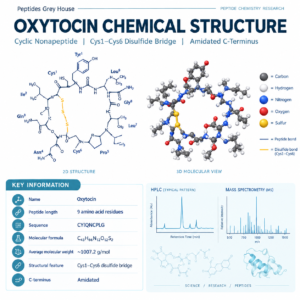
The standard oxytocin molecule is a cyclic nonapeptide with a defined amino acid sequence and an intramolecular disulfide bond. Its chemical identity is documented in the PubChem compound database.
Molecular formula
C₄₃H₆₆N₁₂O₁₂S₂
Molecular weight
1007.2 g/mol
Peptide length
9 amino acids
CAS Registry Number
50-56-6
Primary amino acid sequence
CYIQNCPLG
The two cysteine residues form a disulfide bond between positions 1 and 6. The C-terminus is amidated in standard oxytocin.
These reference values describe oxytocin itself, not necessarily every salt, formulation, derivative, or commercial sample. For laboratory documentation, the chemical form and reference standard should always be identified.
What does the molecular formula mean?
The molecular formula indicates the number of atoms of each element in one molecule:
| Element | Number of atoms |
|---|---|
| Carbon (C) | 43 |
| Hydrogen (H) | 66 |
| Nitrogen (N) | 12 |
| Oxygen (O) | 12 |
| Sulfur (S) | 2 |
The sulfur atoms are particularly significant because they originate from the cysteine residues that form the disulfide bridge. The molecule’s carbon, nitrogen, oxygen, hydrogen, and sulfur atoms collectively make up its peptide backbone and amino acid side chains.
The molecular formula can help researchers compare a reference structure with analytical data, but it does not independently establish the identity, purity, or quality of a physical sample.
3. Oxytocin amino acid sequence explained
The standard oxytocin sequence is Cys–Tyr–Ile–Gln–Asn–Cys–Pro–Leu–Gly–NH₂, commonly abbreviated as CYIQNCPLG.
Each letter corresponds to a particular amino acid. Their order defines the primary structure of the peptide.
| Position | Amino acid | Code | Structural significance |
|---|---|---|---|
| 1 | Cysteine | C | Forms the disulfide bridge |
| 2 | Tyrosine | Y | Contains an aromatic phenol group |
| 3 | Isoleucine | I | Branched hydrophobic side chain |
| 4 | Glutamine | Q | Polar side chain containing an amide |
| 5 | Asparagine | N | Polar side chain containing an amide |
| 6 | Cysteine | C | Forms the disulfide bridge |
| 7 | Proline | P | Constrains local backbone geometry |
| 8 | Leucine | L | Hydrophobic side chain |
| 9 | Glycine | G | Small side chain; terminus is amidated |
The sequence is read from the N-terminus to the C-terminus. The terminal amide group is part of the standard oxytocin structure and should not be confused with an unmodified terminal carboxylic acid.
For researchers, sequence information is useful when checking the identity of a peptide reference standard, interpreting mass-spectrometry results, or comparing oxytocin with related nonapeptides.
4. Understanding the oxytocin disulfide bond
One of the most important features of the oxytocin chemical structure is its disulfide bond, written as –S–S–.
This covalent bond forms between the sulfur-containing side chains of cysteine at positions 1 and 6. It creates a ring within the peptide structure, while the remaining residues extend beyond that ring.

Why the disulfide bridge matters
The disulfide bond influences the three-dimensional arrangement of the peptide. It limits some conformational freedom and contributes to the structural features that allow oxytocin to interact with its biological receptor.
A change in this bond can alter the molecule’s chemical and structural properties. For analytical research, this means that simply detecting the expected amino acid composition may not be sufficient to establish that a sample has the expected molecular structure.
Researchers may need complementary methods to investigate identity, oxidation state, degradation products, and other potential impurities.
Oxytocin’s cyclic and linear forms
The terms cyclic and linear describe different structural arrangements. Standard oxytocin has a disulfide-linked ring; a form lacking the expected bond may have different chemical properties.
A structural comparison should account for:
-
Whether both cysteine residues are present.
-
Whether the expected disulfide linkage is present.
-
oxytocin chemical structure Whether the terminal amide is correctly represented.
-
Whether the analytical mass and fragmentation data agree with the intended structure.
These distinctions are especially relevant when interpreting peptide synthesis records and laboratory characterization reports.
5. Two-dimensional and three-dimensional oxytocin structure
A two-dimensional chemical structure represents atoms, bonds, and connectivity on a flat page. A three-dimensional model represents the spatial arrangement of those atoms.
Both views are useful, but they answer different questions.
A 2D oxytocin structure is suitable for explaining the molecular formula, amino acid connectivity, and disulfide linkage. A 3D model can help illustrate the shape and conformational relationships of the peptide.
However, a single 3D rendering should not automatically be treated as the only conformation oxytocin can adopt. Peptides can display conformational flexibility, and the observed structure can depend on the environment and measurement method.
For an authoritative chemical reference, see the PubChem oxytocin record, which includes the molecular formula, sequence, identifiers, and structural representations.
6. Oxytocin molecular weight and exact mass
The molecular weight of standard oxytocin is approximately 1007.2 g/mol. PubChem also reports a monoisotopic mass of approximately 1006.4365 Da.
These figures are related, but they are not interchangeable in every analytical context.
-
Molecular weight (average molar mass): The average mass per mole of molecules, accounting for naturally occurring isotope distributions.
-
Monoisotopic mass: A calculated mass using the most abundant isotope of each element.
-
Mass-to-charge ratio (m/z): The quantity measured for a particular ion in mass spectrometry.
In electrospray mass spectrometry, the instrument may detect multiply charged ions rather than a single neutral molecule. Researchers therefore interpret observed peaks in the context of the expected ionization state, charge, adducts, and analytical method.
Why mass values may differ between records
Differences may arise because a record refers to a salt rather than the peptide itself, a different terminal group, a chemical derivative, or an alternate molecular form. Measurement conditions and reporting conventions can also affect the way mass values are presented.
For this reason, a research report should specify the molecular form being analyzed and the calculation or measurement used to support the reported value.
7. Oxytocin chemical structure versus vasopressin
Oxytocin and vasopressin are related peptide hormones. Both are nonapeptides, and both contain a disulfide bond linking cysteine residues at positions 1 and 6. Their related structural framework makes them an important comparison in peptide biochemistry.
They are not identical molecules, however. Differences in amino acid sequence and side-chain chemistry contribute to differences in receptor interactions and biological roles.
When writing about oxytocin structure, avoid using an illustration or sequence for vasopressin as though it represented oxytocin. Confirm the peptide name, sequence, terminal modification, and molecular identifiers before publishing structural diagrams.
This distinction also matters in mass spectrometry and other analytical work, where related peptides can require careful identification rather than relying on a broad class label.
8. Analytical characterization of oxytocin
The chemical structure provides a reference for designing and interpreting analytical tests. No single analytical result should automatically be treated as proof of every quality attribute.
For a research-oriented oxytocin page, explain the following techniques accurately.
High-performance liquid chromatography (HPLC)
HPLC separates components of a sample based on their interactions with a stationary phase and a mobile phase. Depending on the validated method, it can help assess chromatographic purity and reveal peaks associated with impurities or degradation products.
A chromatogram alone does not confirm every impurity’s identity. The method, detection conditions, integration parameters, and reference materials affect how results should be interpreted.
Liquid chromatography–mass spectrometry (LC-MS)
LC-MS combines chromatographic separation with mass analysis. It can provide evidence relevant to molecular mass and help distinguish components within a sample.
When used alongside an appropriate reference and validated interpretation, LC-MS can support identity assessment. Nevertheless, a matching mass by itself may not distinguish all structural isomers or confirm the correct disulfide connectivity.
Tandem mass spectrometry (MS/MS)
MS/MS examines fragmentation patterns generated from selected ions. Fragmentation data can provide additional evidence about sequence and structural features, depending on the method and peptide.
For oxytocin, sequence-related fragmentation may complement intact-mass analysis. A researcher should interpret results using suitable reference data and documented analytical conditions.
Certificate of Analysis (COA)
A Certificate of Analysis is a document reporting specified test results for a particular material or batch. When evaluating a COA, look for:
-
Product name and unambiguous material identification.
-
Lot or batch number.
-
Test date and laboratory identification.
-
Analytical methods used.
-
Reported results and acceptance criteria.
-
Reference standards and traceability, where applicable.
-
A clear distinction between measured results and supplier claims.
A COA should be consistent with the material being offered. Generic or unrelated laboratory reports are not adequate substitutes for batch-specific evidence.
Purity versus identity
Purity and identity answer different questions.
Identity asks whether the material corresponds to the intended compound. Purity concerns the proportion of the material represented by the target component under a defined analytical method.
A high chromatographic purity result does not necessarily establish correct sequence, biological activity, sterility, or suitability for a particular application. These attributes require their own appropriate evidence.
9. Oxytocin stability and sample integrity
Peptides can be affected by environmental conditions, including temperature, pH, moisture, oxidation, and repeated handling. The extent of these effects depends on the specific material, its formulation, packaging, and exposure conditions.
For research involving oxytocin, sample integrity should be managed using documented laboratory procedures and material-specific storage instructions. Researchers should avoid assuming that the same storage conditions are suitable for every formulation.
Useful documentation includes the material’s chemical form, packaging details, storage requirements, receipt date, lot identifier, and any applicable stability information.
Analytical comparisons over time can help identify changes in chromatographic profiles or mass spectra, provided that the methods are suitable and consistent. Such observations should not be interpreted as a universal shelf-life claim without supporting stability data.
10. Research applications of oxytocin structural analysis
Oxytocin’s well-defined sequence and disulfide-linked structure make it relevant to several areas of laboratory research.
Peptide chemistry: Researchers can investigate peptide-bond formation, terminal modifications, oxidation, and the relationship between chemical structure and conformation.
Analytical method development: Oxytocin can serve as a reference analyte in appropriate methods for chromatographic separation and mass-spectrometric characterization.
Structure–activity research: Studies may investigate how sequence or conformational changes affect molecular recognition. These studies require suitable controls and should not assume that structural similarity guarantees equivalent biological effects.
Reference-material evaluation: Documented molecular identifiers and analytical measurements can help researchers compare a sample with a specified reference.
Molecular modeling: Structural representations can help illustrate connectivity, conformational constraints, and potential interactions. Computational models are hypotheses or representations, not substitutes for experimental validation.
These applications illustrate why a reliable understanding of the oxytocin chemical structure is useful beyond simply memorizing its molecular formula.
11. How to evaluate oxytocin research materials
For a U.S.-targeted research information page, it is important to distinguish general chemistry education from claims about a specific product.
When reviewing a research material, consider the following criteria.
Chemical identity
Confirm the intended sequence, terminal modification, chemical form, and reference identifiers.
Analytical evidence
Review the underlying chromatographic and mass-spectrometric evidence when available.
Batch traceability
Check that the reported results correspond to the specific lot being evaluated.
Scope of testing
Determine whether the available data support identity, purity, or another specific quality attribute.
Do not publish a specific purity percentage, analytical result, or claim of independent testing unless it is supported by the relevant documentation. A molecular structure illustration is explanatory material; it is not evidence that a physical product has been tested.
Research-use wording
For a product or informational page, the following wording can help clarify the scope of the content:
Oxytocin is a nonapeptide with a defined amino acid sequence and disulfide-linked cyclic structure. This page presents general chemical and analytical information for educational and laboratory research purposes. Any material-specific identity, purity, or quality claim should be supported by applicable analytical documentation. Research materials must not be represented as approved for human use unless that status is independently established.
A research-use disclaimer should not be used to imply that a product is automatically lawful, appropriately manufactured, or suitable for any particular laboratory purpose. Product claims should reflect the actual material and applicable regulations.
12. Oxytocin chemical structure: frequently asked questions
What is the chemical structure of oxytocin?
Oxytocin is a cyclic nonapeptide containing nine amino acids. Its standard sequence is CYIQNCPLG, with a disulfide bond between cysteine residues at positions 1 and 6 and an amidated C-terminus.
What is the molecular formula of oxytocin?
The molecular formula of standard oxytocin is C₄₃H₆₆N₁₂O₁₂S₂. It describes the numbers of carbon, hydrogen, nitrogen, oxygen, and sulfur atoms in the molecule.
What is the molecular weight of oxytocin?
Oxytocin has an average molecular weight of approximately 1007.2 g/mol. Its reported monoisotopic mass is approximately 1006.4365 Da. These values represent different mass conventions.
What is the amino acid sequence of oxytocin?
The sequence is cysteine, tyrosine, isoleucine, glutamine, asparagine, cysteine, proline, leucine, and glycine. Its one-letter abbreviation is CYIQNCPLG.
Why does oxytocin have a cyclic structure?
The sulfur atoms in the cysteine residues at positions 1 and 6 form a covalent disulfide bond. This creates a ring within the peptide and constrains its three-dimensional conformation.
What is the CAS number for oxytocin?
The CAS Registry Number commonly associated with standard oxytocin is 50-56-6. Always verify the identifier against the exact chemical form being documented.
How is oxytocin structure analyzed in a laboratory?
Depending on the research objective, analytical approaches may include HPLC, LC-MS, and tandem mass spectrometry. Complementary methods may be needed to establish identity, evaluate purity, and investigate structural features.
Does HPLC purity confirm oxytocin identity?
No. HPLC can provide evidence about chromatographic composition, but a purity result alone does not conclusively establish the peptide sequence, disulfide connectivity, or every other quality attribute.
Is oxytocin the same as vasopressin?
No. They are related nonapeptide hormones with some shared structural features, including a disulfide bond, but their amino acid sequences differ.
Can the molecular structure confirm the quality of a commercial sample?
No. A reference structure establishes what the intended molecule should look like chemically. Verifying an actual sample requires suitable analytical evidence and documentation relevant to that sample.