Ipamorelin HPLC Testing: A Complete Guide to Purity, Chromatograms and COAs
Introduction
Ipamorelin HPLC testing is an analytical appr
oach used to assess the chromatographic profile of an Ipamorelin sample and estimate its relative purity under specified laboratory conditions. For researchers, quality-control professionals, and people reviewing research-product documentation, understanding this process can help distinguish meaningful analytical evidence from incomplete or poorly explained claims.
High-performance liquid chromatography (HPLC) separates components in a sample as they pass through a chromatographic column. A detector records signals from compounds as they elute, producing a chromatogram. Analysts can evaluate the resulting peaks to investigate the sample’s composition and calculate a reported chromatographic purity value when an appropriate method is used.
However, one number does not tell the whole story. A reported purity of 98% or 99% does not automatically prove the identity of Ipamorelin, establish the amount of active material in a vial, confirm sterility, or demonstrate suitability for any particular use. Those questions require the appropriate additional tests and documentation.
This guide explains what Ipamorelin HPLC testing can show, how to review chromatograms, which details to look for in a Certificate of Analysis, and why independent verification and batch traceability matter.
What Is Ipamorelin HPLC Testing?
Ipamorelin HPLC testing refers to the chromatographic analysis of a sample identified as Ipamorelin. The method is used to separate detectable sample components and generate analytical data that a qualified laboratory can interpret.
HPLC is widely used in chemical and pharmaceutical analysis because it can separate compounds that may otherwise be difficult to distinguish in a mixed sample. Depending on the method and detector, the analysis can help identify a principal peak, reveal additional detectable components, and support an estimate of relative chromatographic purity.
For a research peptide, the value of an HPLC report depends on more than the instrument name. Important factors include the method’s suitability for the sample, the detector used, the laboratory’s quality procedures, the identity of the tested material, and whether the report can be connected to the actual batch being evaluated.
A useful report should make it possible to answer several questions:
-
What sample was tested?
-
Which batch or lot does the result represent?
-
What analytical method was used?
-
How was the reported purity calculated?
-
When was the sample tested?
-
Are the results linked to supporting identity data?
-
Is the report complete enough to evaluate its limitations?
HPLC data should be interpreted within the scope of the documented method. A chromatogram is evidence of an analytical measurement, not a universal guarantee of product quality.
How Does HPLC Work for Peptide Analysis?
HPLC separates compounds based on how they interact with the stationary phase inside a column and the mobile phase flowing through it. Components interact differently with these phases, so they may leave the column at different times.
A detector records the compounds it can detect as they exit the column. The resulting signal is plotted against time, forming a chromatogram.
1. Sample identification and documentation
Before interpreting results, the laboratory must identify the sample and record its relevant details. This may include a sample identifier, lot number, receipt date, and other information needed to maintain traceability.
Documentation is essential because even technically sound results become difficult to apply if the report cannot be tied to the material under review.
2. Chromatographic separation
The sample is analyzed using a documented HPLC method. The method specifies the relevant analytical conditions and helps define what the separation can reveal.
A well-developed method should be suitable for the analyte and the purpose of the analysis. The existence of a chromatogram alone does not establish that the method can separate every potentially relevant impurity.
3. Detection and peak recording
As components leave the column, the detector records a signal. Each detectable component may appear as a peak, depending on the sample, method, and detector response.
The main peak is often associated with the intended analyte, but retention time alone does not conclusively establish chemical identity. Additional evidence, such as mass spectrometry or a suitable reference standard, may be needed.
4. Data processing and reporting
The laboratory processes the chromatographic data and reports the findings according to its method. The report may include the chromatogram, peak table, retention times, integration results, and a calculated purity percentage.
A responsible review should consider the method and calculation behind the number rather than treating the percentage as a complete description of sample quality.
What Does Ipamorelin HPLC Purity Mean?
Ipamorelin HPLC purity commonly refers to the proportion of the integrated chromatographic signal attributed to a principal peak relative to the total integrated signal included in the calculation.
A simplified area-normalization calculation is:
This equation describes one common reporting approach. Actual laboratory methods may use different calculations, corrections, or reporting conventions.
For example, if the principal peak represents 98 units of integrated signal out of 100 units included in a specified calculation, the reported area percentage would be 98%. This is a mathematical illustration, not a claim about any particular Ipamorelin sample.
What a high purity percentage can indicate
A high reported area percentage may indicate that the principal detected component accounts for most of the integrated signal under the stated analytical conditions.
It may support a sample-quality assessment when the method is suitable, the data are reliable, and the sample identity is independently supported.
What it cannot establish by itself
An HPLC purity percentage does not necessarily establish:
-
The exact mass or amount of Ipamorelin in the container.
-
Definitive molecular identity.
-
The absence of every impurity.
-
The absence of residual solvents, counterions, or contaminants that the method does not detect appropriately.
-
Sterility or endotoxin status.
-
Stability throughout storage or transport.
-
Safety or suitability for administration to humans or animals.
This distinction is critical for accurate SEO content: chromatographic purity is not the same as overall product quality.
How to Read an Ipamorelin HPLC Chromatogram
A chromatogram is one of the most useful visual elements in a laboratory report. It provides a record of detector response over the course of the analysis.
When reviewing an Ipamorelin chromatogram, look at the following features.
Main peak
The main peak is the prominent signal that the method associates with the principal component. The report should explain how that peak was assigned and whether identity was confirmed by supporting evidence.
A large peak may be consistent with a sample dominated by one detectable component, but it is not enough to establish the compound’s identity on its own.
Additional peaks
Smaller peaks may represent impurities, degradation products, related compounds, or other detectable components. Their interpretation depends on the method, sample preparation, and supporting data.
The absence of visible secondary peaks does not prove that the sample is completely free of impurities. Components may be below the detection limit, may not be resolved, or may not produce a measurable response with the selected detector.
Retention time
Retention time is the time between sample introduction and the detection of a component. It can help compare a sample’s behavior with that of a reference under the same method conditions.
Retention time is method-dependent. It can change with column chemistry, mobile-phase composition, flow conditions, temperature, and other factors. A retention time from one report should not be treated as a universal identifier.
Peak area and integration
Peak area represents the integrated detector signal associated with a peak. Laboratories may use peak areas to calculate relative percentages or evaluate other characteristics defined by their methods.
Integration choices matter. The report should be sufficiently clear to show which peaks were included in the calculation and whether the calculation is appropriate for the stated purpose.
Baseline and resolution
The baseline is the signal level used when integrating peaks. Resolution describes how well adjacent peaks are separated.
Poor separation can make it difficult to quantify individual components accurately. A readable image is helpful, but a professional assessment may require access to the full analytical data and method details.
HPLC Testing vs. Mass Spectrometry: What Is the Difference?
HPLC and mass spectrometry (MS) are complementary analytical techniques. They answer different questions and should not be treated as interchangeable tests.
| Analytical method | Primary purpose | Important limitation |
|---|---|---|
| HPLC | Separates detectable components and supports relative purity analysis | A main peak alone does not definitively identify a compound |
| Mass spectrometry | Measures mass-to-charge ratios to support molecular identification | A mass match alone does not establish overall purity |
| HPLC combined with MS | Can connect chromatographic separation with mass information | Results remain dependent on method suitability and interpretation |
| Quantitative assay | Estimates the amount of target material using an appropriate calibrated method | Requires a suitable reference standard and defined calculation |
| Microbiological testing | Evaluates specified microbial characteristics | Does not replace chemical identity or purity testing |
The U.S. Food and Drug Administration’s review of Ipamorelin describes peptide-related impurities that can arise during synthesis, including incomplete coupling, truncated sequences, side reactions, and process-related residues. This illustrates why a single purity result may not characterize every relevant quality attribute.
Why use both HPLC and mass spectrometry?
HPLC helps separate components, while MS can provide molecular-mass evidence. When the methods are appropriate and the results agree, the combined evidence can strengthen an analytical assessment.
For example, a report might show a dominant chromatographic peak and a mass spectrum consistent with the expected compound. This is more informative than a purity percentage with no supporting identity data, although the exact level of confirmation depends on the method and report.
For quality documentation, look for a clear explanation of which tests were performed, which results were obtained, and what the laboratory concludes from those results.
What Should an Ipamorelin HPLC Certificate of Analysis Include?
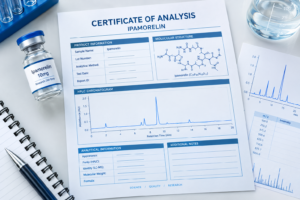
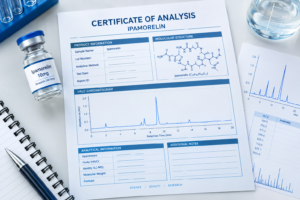
A Certificate of Analysis (COA) summarizes test results for a defined sample or batch. For research materials, the document should be traceable, readable, and specific about the scope of testing.
A useful Ipamorelin HPLC COA review checklist includes the following.
1. Compound and sample identification
The report should identify the material tested and provide a sample identifier. Where applicable, the name on the report should correspond with the product documentation.
2. Lot or batch number
A batch identifier connects the test report to a defined production lot. Confirm that the identifier on the COA matches the identifier on the relevant product documentation.
A report for a different lot is not evidence that the current lot has the same analytical characteristics.
3. Test date and report identifier
Check when the sample was tested and whether the report has a unique reference number. A date alone does not establish authenticity, but it helps establish the record’s timeline.
4. Method description
Look for the method name or identifier and enough detail to understand what was measured. The method should explain the basis of the purity calculation and identify relevant analytical conditions.
5. Reported purity and chromatogram
The reported percentage should be accompanied by supporting data when available. Check that the chromatogram, peak table, and stated calculation are consistent with the report’s conclusions.
6. Identity confirmation
Determine whether identity was evaluated by retention-time comparison, mass spectrometry, or another documented method. These approaches do not provide identical levels or types of evidence.
7. Laboratory identification and authorization
The document should identify the laboratory responsible for the analysis and include relevant report approval or authorization details. If a supplier claims independent testing, verify that the report supports that claim.
8. Scope and limitations
A COA should make clear which attributes were tested and, ideally, which were not. HPLC purity results should not be presented as proof of sterility, endotoxin control, absolute content, or human-use safety unless those attributes have been separately assessed using appropriate methods.
Common Mistakes When Evaluating Ipamorelin HPLC Results
Mistake 1: Treating purity as a universal quality score
A reported 99% area purity does not mean that 99% of the labeled mass is necessarily the target peptide. Area percentages and quantitative content measurements are different results.
Mistake 2: Accepting a COA without checking the lot
Documentation from another batch cannot verify the specific lot being assessed. Confirm the identifiers before relying on the result.
Mistake 3: Assuming a clean-looking chromatogram proves identity
A dominant peak can support a purity assessment, but chemical identity needs appropriate supporting evidence.
Mistake 4: Assuming HPLC proves sterility
HPLC is a chemical analytical technique, not a substitute for microbiological testing. Claims about sterility or endotoxins require their own relevant evidence.
What Other Tests May Complement HPLC?
HPLC is one part of a broader analytical quality framework. Depending on the sample and intended laboratory research, additional testing may include:
-
Mass spectrometry: to support molecular identity.
-
Quantitative content assay: to estimate the amount of target material using a suitable reference standard.
-
Related-substance analysis: to investigate detectable impurities under a defined method.
-
Residual-solvent testing: to assess specified residual solvents when relevant.
-
Water or moisture analysis: to characterize water content when required.
-
Microbial testing: to assess specified microbial attributes.
-
Bacterial endotoxin testing: to measure endotoxin using an appropriate validated or qualified method.
-
Stability studies: to evaluate changes over time under defined conditions.
Not every sample requires every possible test. The appropriate panel depends on the analytical objective, sample type, relevant specifications, and applicable laboratory quality requirements. The key is to avoid claiming that a test establishes attributes it was not designed to measure.
How to Evaluate a Research Peptide Supplier’s Testing Documentation
When reviewing supplier documentation for laboratory research, prioritize evidence over marketing language.
First, check whether the COA identifies a specific lot. Next, review the test methods and determine whether the reported results are supported by chromatograms, spectra, or other relevant records. Where a third-party laboratory is claimed, check whether the report identifies the laboratory and whether the report can be independently verified.
Pay attention to precise language. “HPLC tested” does not explain which method was used, how purity was calculated, or whether identity was confirmed. Likewise, “high purity” is a claim that should be supported by traceable analytical data.
Avoid assuming that an impressive percentage, a QR code, a laboratory logo, or a visually polished PDF proves authenticity by itself. These details may help with verification, but the underlying report and its traceability are more important.
A transparent quality page should state what was tested, which batch the results represent, which methods were used, and what the findings do—and do not—establish.
Research-Use-Only and Regulatory Considerations
Ipamorelin is discussed in scientific and pharmaceutical research, but analytical purity does not establish that a product is approved for human use or safe to administer.
For a U.S.-targeted research-product page, use precise wording such as:
Research Use Only: This material is intended solely for legitimate laboratory research and analytical purposes. It is not intended for human or veterinary use, self-administration, diagnosis, treatment, cure, or prevention of disease. Analytical testing results describe only the sample and attributes evaluated by the stated methods. A COA is not a guarantee of safety, clinical efficacy, sterility, or regulatory approval.
A disclaimer is not a substitute for complying with applicable laws and regulations. Avoid unsupported therapeutic claims, promises about human outcomes, or statements suggesting that a high HPLC purity percentage makes a substance suitable for injection or other administration.
For U.S. regulatory context, consult current FDA information on Ipamorelin and compounded drugs rather than treating supplier documentation as evidence of approval.
Frequently Asked Questions About Ipamorelin HPLC Testing
1. What is Ipamorelin HPLC testing?
Ipamorelin HPLC testing uses high-performance liquid chromatography to separate detectable components in a sample. Depending on the method, it can support relative chromatographic purity analysis and help characterize the sample’s component profile.
2. What does HPLC purity mean on an Ipamorelin COA?
It commonly means the percentage of the included chromatographic signal attributed to the principal peak. The calculation depends on the method and detector, so it should not automatically be interpreted as the percentage of total sample mass that is Ipamorelin.
3. Does a high HPLC purity result prove Ipamorelin identity?
No. A high purity result does not, by itself, establish molecular identity. Supporting methods such as mass spectrometry or comparison with a suitable reference standard may provide additional evidence.
4. Is HPLC testing the same as mass spectrometry?
No. HPLC separates sample components, while mass spectrometry measures mass-to-charge ratios. The techniques can complement one another, but each has a distinct analytical purpose.
5. What should an Ipamorelin HPLC report contain?
Ideally, it should include sample identification, batch or lot details, test date, method information, the reported result, and supporting chromatographic data. Identity confirmation and quantitative content results may require separate or additional measurements.
6. Can HPLC prove that a peptide is sterile?
No. HPLC is not a sterility test. Microbiological testing and bacterial endotoxin testing are distinct analyses, and neither should be claimed unless the relevant test has been performed and documented.
7. Does a COA guarantee that every vial has the same quality?
No. A COA documents results for the sample or batch covered by the report. Its relevance to a particular product depends on sample traceability, batch identification, testing scope, and handling after testing.
8. Is 99% HPLC purity always better than 98%?
Not necessarily in every practical sense. Results should be interpreted using the methods, specifications, uncertainty, and reporting conventions involved. A higher area percentage alone does not prove better identity confirmation, content accuracy, or overall quality.
9. How can I verify an Ipamorelin COA?
Compare the report’s batch identifier with the product documentation, review the named laboratory and methods, and seek independent confirmation of the report where available. Do not rely only on a printed percentage or a supplier’s claim.
10. Does HPLC purity establish that Ipamorelin is approved for human use?
No. Analytical testing describes specified characteristics of a sample. It does not establish regulatory approval, clinical efficacy, or suitability for human or veterinary administration.