

GLP3-R 20mg Peptide: Product Information, Technical Specifications and Quality Documentation
Introduction to GLP3-R 20mg
Understanding a specialized laboratory compound requires more than recognizing its product name or stated quantity. Buyers, researchers, and laboratory procurement professionals need reliable information about chemical identity, composition, product specifications, analytical documentation, and intended-use classification.
GLP3-R 20mg is a product designation that includes a stated quantity of 20mg. However, a product name alone cannot establish its complete chemical identity, molecular structure, formulation, purity, or regulatory status. These details must be supported by appropriate supplier or manufacturer documentation.
Interest in the search terms GLP3-R 20mg peptide, GLP3-R peptide, and GLP3-R 20mg vial makes it especially important to explain what information is necessary when evaluating this product. Similar abbreviations can be used for different materials, and product descriptions should not imply a chemical classification or biological mechanism without evidence.
This guide examines the information buyers should look for when reviewing GLP3-R 20mg. It covers chemical identification, ingredient transparency, product specifications, quality documentation, research-use wording, storage considerations, and frequently asked questions.
The objective is to provide a clear technical reference that distinguishes confirmed information from details that still require verification.
What Is GLP3-R 20mg?
GLP3-R 20mg is the product designation and stated quantity supplied for this listing. Its exact chemical identity must be confirmed through reliable product documentation.
A chemical or research-compound designation may represent a full chemical name, abbreviated name, supplier identifier, or commercial product label. These terms are not necessarily interchangeable. Consequently, buyers should not infer a complete molecular identity from the abbreviation GLP3-R.
Before treating GLP3-R as a particular peptide or pharmaceutical compound, it is important to establish:
- The full chemical or product name.
- The confirmed chemical classification.
- The molecular formula, where applicable.
- The molecular mass, where established.
- The amino-acid sequence, if it is a peptide.
- The chemical form or salt designation, where relevant.
- The manufacturer or responsible supplier.
- The batch or lot identification.
- The intended-use classification.
These details help distinguish a properly identified material from a listing that provides only a marketing name.
Why exact product identification matters
Chemical identity is fundamental to technical product evaluation. Two materials with similar abbreviations may have different structures, compositions, properties, and regulatory requirements.
A reliable supplier should be able to identify the material clearly and provide documentation that corresponds to the product being offered.
The term GLP3-R should not automatically be interpreted as evidence of a specific receptor target, biological mechanism, relationship to another compound, or therapeutic application. Those claims require independent supporting evidence.
GLP3-R Peptide: Understanding the Chemical Classification
The phrase GLP3-R peptide is a relevant search term for people investigating this product. However, the word peptide should only be used as a confirmed chemical classification when supporting documentation is available.
Peptides are molecules composed of amino acids connected through peptide bonds. Their identities can be characterized using information such as amino-acid sequence, molecular mass, molecular formula, and chemical form.
If the supplier confirms that GLP3-R is a peptide, its technical profile should include appropriate identity information. The exact details will depend on the material and the available analytical records.
Peptide identity and sequence information
A product page should not invent or approximate this sequence. It should be obtained from a reliable manufacturer specification or other appropriate identity documentation.
Other potentially relevant details include:
- Molecular formula.
- Molecular mass.
- Peptide length.
- Chemical form.
- Any applicable salt designation.
- Documented composition.
- Analytical identity results.
Not every product specification will contain all these fields. The important point is that published details should be accurate and traceable to a credible source.
Avoiding assumptions based on product names
A name or abbreviation is not sufficient evidence of molecular identity. Buyers should avoid relying on similarities between product names or assuming that a compound has the same properties as another material with a related designation.
For GLP3-R, the exact identity and peptide classification should be confirmed before publishing a detailed molecular description.
GLP3-R 20mg: Understanding the Quantity
The 20mg designation is an important part of the product listing, but it needs to be interpreted correctly.
Milligrams measure mass. They do not automatically indicate concentration, solution strength, container volume, or the amount of a compound per millilitre.
A product described as 20mg may refer to a stated net quantity, but the precise meaning should be confirmed through the product label and supplier specification.
Quantity versus concentration
These terms describe different measurements:
- Mass: The amount of material expressed in units such as milligrams.
- Concentration: The amount of material within a defined volume or mass of another substance.
- Container volume: The volume of the container or its contents, usually expressed in millilitres where applicable.
A clear product description should not confuse these measurements.
Customers researching GLP3-R 20mg should verify exactly what the quantity represents rather than assuming it indicates a particular concentration or formulation.
GLP3-R 20mg Vial: Packaging and Presentation
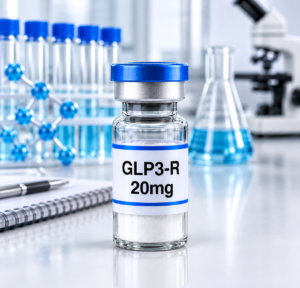
The search term GLP3-R 20mg vial reflects an interest in the product’s physical presentation. However, the product name alone does not prove that the material is supplied in a vial.
Packaging information should be confirmed using the actual product label, packaging specification, or supplier documentation.
Packaging details to verify
Before publishing a detailed presentation description, confirm:
- Whether the material is supplied in a vial or another container.
- The stated net quantity.
- The container material, where disclosed.
- The product label and identification details.
- The batch or lot number.
- Any relevant manufacturer packaging information.
- Whether product documentation accompanies the package.
Packaging should not be used to imply sterility, injectable suitability, pharmaceutical status, or a particular formulation.
Why accurate packaging descriptions matter
Clear packaging information helps buyers understand what is being offered. It also reduces confusion between a product’s quantity, physical container, and formulation.
For example, a container described as a vial does not automatically establish that its contents are sterile or suitable for administration. Such claims require specific evidence and appropriate regulatory authorization.
Ingredients and Composition of GLP3-R 20mg
The complete ingredient composition of GLP3-R 20mg cannot be established from its product name alone.
A responsible technical description should identify the confirmed primary material and any additional ingredients disclosed by the manufacturer. It should not assume the presence of solvents, preservatives, stabilizers, buffers, carriers, or other formulation components.
Primary compound
The primary compound should be identified using its full and verified chemical name.
If GLP3-R is confirmed as a peptide, the supplier should provide appropriate information supporting that classification. If it is another type of chemical material, the product page should use the correct terminology instead.
Additional ingredients and excipients
Where applicable, a complete ingredient declaration should identify additional formulation components.
The information should come from the actual supplier documentation rather than from a generic description of similar products.
Chemical form
Some chemical materials may be supplied in different chemical forms. Where a salt designation or other chemical form is relevant, it should be clearly documented.
Do not assume a particular form based on the product name.
Ingredient transparency
A transparent product page should distinguish between:
- Confirmed primary compound.
- Confirmed additional ingredients.
- Documented chemical form.
- Stated product quantity.
- Information that remains unavailable.
If the supplier has not provided a complete composition statement, the correct approach is to identify ingredient information as pending confirmation.
GLP3-R 20mg Product Specifications
Technical specifications help buyers compare product information and determine whether a listing contains sufficient detail for evaluation.
The following table separates the supplied product designation from information requiring verification.
| Specification | Information |
|---|---|
| Product name | GLP3-R |
| Stated quantity | 20mg |
| Product designation | GLP3-R 20mg |
| Chemical classification | To be confirmed |
| Exact chemical identity | Supplier confirmation required |
| Peptide classification | To be confirmed |
| Amino-acid sequence | To be confirmed, if applicable |
| Molecular formula | To be confirmed |
| Molecular mass | To be confirmed |
| Chemical form | To be confirmed |
| Ingredient composition | Supplier confirmation required |
| Physical presentation | To be confirmed |
| Purity | Refer to applicable batch-specific documentation |
| Manufacturer | To be confirmed |
| Batch or lot number | Refer to product label |
| Certificate of Analysis | Availability to be confirmed |
| Intended-use classification | Must match verified labeling and applicable law |
| Storage requirements | Follow verified manufacturer instructions |
The importance of complete specifications
A complete specification sheet should be consistent with the product label and supporting documentation.
For example, a molecular formula should correspond to the confirmed chemical identity. A purity percentage should be supported by an applicable analytical report. A packaging description should match the physical product.
Avoid publishing assumed specifications to make a product listing appear more technically complete than the available evidence supports.
GLP3-R 20mg Quality Documentation
Quality documentation is an important part of evaluating specialized chemical and laboratory materials.
Where available, a Certificate of Analysis (COA) can provide information about specified tests performed on a particular batch or lot.
The usefulness of a COA depends on the identity of the tested material, the analytical methods used, the reported results, and the traceability of the document.
Certificate of Analysis information
A relevant COA may include:
- Product or compound identification.
- Batch or lot number.
- Testing date.
- Analytical method.
- Reported results.
- Applicable specifications or acceptance criteria.
- Testing laboratory or provider identification.
- Authorized review information, where applicable.
The exact contents depend on the product and the tests performed.
Batch-specific traceability
A COA should correspond to the batch being supplied. Buyers should compare the batch number on the document with the number printed on the product label.
A generic report or a document relating to an unrelated batch should not be presented as proof of the quality of the current material.
HPLC and analytical testing
High-performance liquid chromatography (HPLC) is an analytical technique used to separate components in a sample. Depending on the method and material, it may provide information about a sample’s chromatographic profile.
However, an HPLC result should not automatically be interpreted as proof of chemical identity, sterility, clinical safety, or overall product suitability.
Mass spectrometry
Mass spectrometry is an analytical technique that measures the mass-to-charge ratios of ions. It may be used in chemical characterization and identity assessment.
Its relevance depends on the confirmed identity of the material and the analytical method used.
A mass spectrometry report should not be represented as proof of every quality characteristic. Its conclusions should be limited to the information supported by the actual test.
What a COA does not prove
A Certificate of Analysis documents the tests and results included in the report. It does not automatically establish:
- Clinical safety.
- Sterility.
- Suitability for injection.
- Human-use suitability.
- Regulatory approval.
- Compliance with every USP requirement.
- Independent certification of the supplier or manufacturer.
Buyers should evaluate each claim according to the supporting evidence.
Research-Use-Only Wording and Regulatory Classification
Research-use wording must accurately reflect the product’s actual classification, supplier labeling, and applicable regulations.
A product should not automatically be described as research-use-only because it appears on a laboratory or research website. Similarly, a material should not be described as a regulated pharmaceutical unless its identity and authorization support that description.
When research-use-only classification is confirmed
If the supplier’s documentation and applicable regulations establish that the product is intended exclusively for research applications, the product information may include a statement such as:
“Intended solely for the research applications specified by the supplier. Not represented for human or veterinary use. Review the applicable product documentation and legal requirements before purchase.”
This wording should only be used when it accurately describes the product.
When the product is a regulated pharmaceutical
If the material is supplied as a regulated pharmaceutical, its product description must follow the applicable approved labeling and jurisdiction-specific requirements.
It should not be relabeled as a research material to avoid pharmaceutical regulatory obligations.
No claim of therapeutic benefit, clinical efficacy, human-use suitability, or regulatory approval should be made without the required evidence and authorization.
Storage and Product Handling Information
Storage requirements depend on the confirmed chemical identity, formulation, container, and manufacturer stability information.
There is no reliable basis for assigning a specific storage temperature to GLP3-R 20mg without product-specific instructions.
Storage information to verify
Before publishing storage details, obtain confirmation of:
- Recommended storage temperature.
- Whether protection from light is required.
- Whether moisture protection is required.
- Packaging-related storage requirements.
- Documented shelf life or expiration information.
- Relevant handling precautions.
Do not assume that the material requires refrigeration, freezing, or room-temperature storage.
Likewise, do not provide reconstitution, preparation, administration, or post-opening instructions without verified product-specific information and an appropriate regulatory basis.
Customers should follow the actual product label and manufacturer instructions.
How to Evaluate GLP3-R 20mg Product Information
Before making a purchasing decision, buyers should review the product identity, quantity, presentation, documentation, and intended-use information.
1. Confirm the chemical identity
Request the complete product or chemical identity. If the material is described as a peptide, ask for documentation supporting that classification.
2. Verify the stated quantity
Confirm what the 20mg designation represents and ensure that the information matches the product label.
3. Review the physical presentation
Check whether the material is supplied in a vial or another container. Do not infer packaging from a search term or product title.
4. Examine ingredient information
Review the supplier’s ingredient declaration and any relevant formulation details.
5. Request applicable quality records
Ask whether a batch-specific COA or relevant analytical reports are available.
6. Confirm intended-use classification
Check the supplier’s labeling and applicable regulations. Ensure that research-use or pharmaceutical wording is accurate.
7. Review supplier information
Verify the supplier’s business details, contact information, product documentation, order conditions, and purchasing policies.
Frequently Asked Questions About GLP3-R 20mg Peptide
1. What is GLP3-R 20mg?
GLP3-R 20mg is the product designation and stated quantity used for this listing. Its precise chemical identity and classification should be established through supplier documentation.
2. Is GLP3-R 20mg a peptide?
The product name alone does not establish that GLP3-R is a peptide. If the supplier identifies it as one, the classification should be supported by appropriate chemical identity documentation.
3. What does 20mg mean in GLP3-R 20mg?
The 20mg figure is the stated quantity in the product name. It should not automatically be interpreted as a concentration or quantity per millilitre. Buyers should confirm the measurement basis with the supplier.
4. Is GLP3-R 20mg supplied in a vial?
The physical presentation must be confirmed using the product packaging or supplier specification. The search term GLP3-R 20mg vial does not independently prove the packaging format.
5. What ingredients are included in GLP3-R 20mg?
The complete ingredient composition has not been established from the product name alone. Refer to the verified ingredient declaration or product specification sheet.
6. Does GLP3-R 20mg come with a Certificate of Analysis?
COA availability should be confirmed with the supplier. If a report is provided, check that its product identification and batch number match the supplied material.
7. Does a COA guarantee product safety?
No. A COA documents the tests and results included in that report. It does not automatically establish clinical safety, sterility, suitability for human use, or regulatory approval.
8. Is GLP3-R 20mg FDA-approved?
No FDA approval claim can be established from the product name or quantity. Any regulatory statement must be supported by verifiable authorization for the exact product and relevant jurisdiction.
9. How should GLP3-R 20mg be stored?
Storage requirements must come from verified manufacturer instructions. Temperature, light protection, moisture protection, and shelf-life information should not be assumed.
10. Is GLP3-R 20mg intended for research use only?
Its intended-use classification must be confirmed through supplier labeling and applicable regulations. Research-use-only wording should not be applied automatically.
11. What documentation should I review before buying GLP3-R 20mg?
Review the product label, specification sheet, ingredient declaration, supplier information, and any applicable batch-specific COA or analytical records. Ensure that all documents refer to the same product and batch.
12. What should I confirm before placing an order?
Confirm the exact product identity, stated quantity, physical presentation, ingredient information, regulatory classification, available quality documentation, supplier details, and applicable purchasing terms.
Conclusion: Understanding GLP3-R 20mg Product Information
Evaluating a specialized laboratory product requires accurate identification, transparent specifications, and relevant supporting documentation.
GLP3-R 20mg is identified here by its supplied product designation and stated quantity. Further technical details, including its chemical classification, composition, physical presentation, and intended use, should be confirmed through reliable supplier records.
For buyers researching GLP3-R peptide information or a GLP3-R 20mg vial, the most important step is to review the actual product documentation rather than rely on assumptions based on the name.
Need more information about GLP3-R 20mg? Contact our team to request the current product specification, confirm the product presentation and classification, and ask about applicable batch-specific quality documentation before making a purchasing decision.